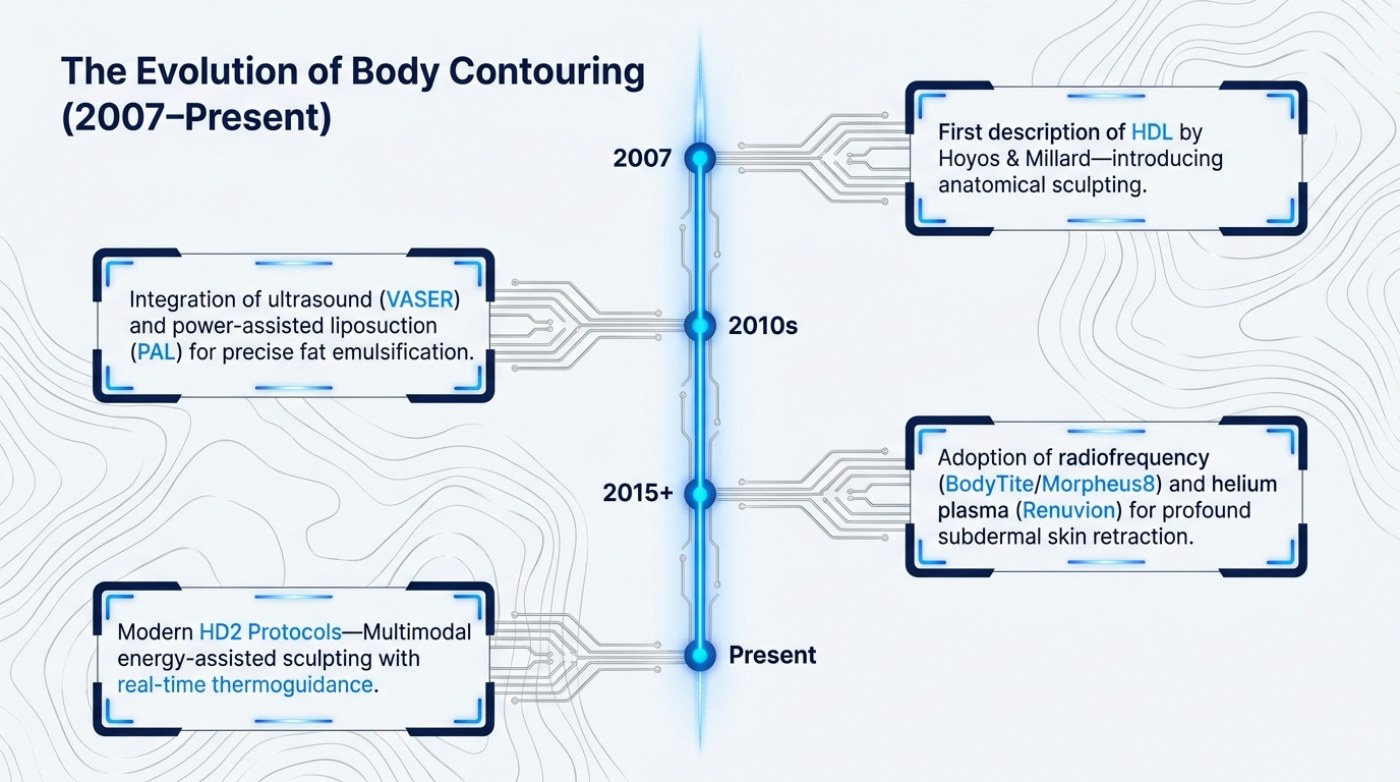
The slide titled "The Evolution of Body Contouring (2007–Present)" is a timeline with four stops, and the interesting thing about it is what each stop was trying to fix. Timeline slides in surgical decks usually celebrate technology. This one reads more like a problem log: a technique arrived, it solved something specific, and it left something else open for the next entry to address. Read that way, the four eras explain why high-definition liposuction today is a composite of methods rather than a single instrument with a brand on it. This is written for homeowners around Miami, FL who are looking into body contour services and want the honest version rather than a sales page.
The short version
- The evolution of body contouring runs through four eras: the 2007 anatomical sculpting idea, 2010s emulsification, 2015+ retraction and today's protocols.
- The slide credits the first description of high-definition liposuction in 2007 to Hoyos and Millard.
- The 2010s added ultrasound as VASER and power-assisted liposuction, both aimed at precise fat emulsification before aspiration.
- Radiofrequency as BodyTite and Morpheus8, plus helium plasma as Renuvion, arrived for subdermal skin retraction from 2015 onward.
- The current era is described as multimodal energy-assisted sculpting with real-time thermoguidance, combining methods rather than choosing between them.
The markers on the slide are 2007, the 2010s, 2015+, and the present. Each carries one development, and the developments move from the description of a technique, to the machinery that made it practical, to the energy sources that added a skin effect, to the coordinated protocol in use now. Device names below are the ones the slide itself prints; the figures are the ones already carried in this site's published guides. Nothing here predicts how any individual case will go.
The four eras, and what each one fixed
In 2007 the slide credits the first description of high-definition liposuction to Hoyos and Millard, and characterises it as the introduction of anatomical sculpting. That is a description of an idea rather than of a device: fat removal could be planned against muscle anatomy so that transitions became visible, instead of being planned as a global reduction. The limitation of the era was execution. The concept was easier to describe than to perform consistently, because working close to the skin with the instruments of the time carried a high cost in bleeding and bruising.
The 2010s entry lists two integrations: ultrasound, printed on the slide as VASER, and power-assisted liposuction, shortened to PAL. Both are described as supporting "precise fat emulsification." Emulsification is the operationally important word, because fat that has been liquefied or loosened before it is aspirated can be removed with less mechanical force applied to the tissue — which in turn makes it possible to address one layer more selectively than a layer-agnostic pass allows. What remained unresolved was the skin envelope. Removing fat does not remove skin, and neither ultrasound nor powered instrument motion adds a tightening effect of its own.
The 2015+ entry is where tightening arrives. The slide names radiofrequency, in the form of BodyTite and Morpheus8, and helium plasma, in the form of Renuvion, and describes the goal as "profound subdermal skin retraction." This is a different class of claim from the earlier stops: the first two eras were about removing tissue well, and this one is about changing the tissue left behind. It also introduces a safety problem that did not previously exist, because energy delivered into tissue has to be measured. The same heating that contracts collagen can burn skin when it is not controlled, and the published approach already covered on this site pairs a 65 °C subdermal working target with a 42 °C surface cap watched continuously.
The final entry, labelled "Modern HD2 Protocols — Multimodal energy-assisted sculpting with real-time thermoguidance," closes the loop. Multimodal means more than one energy or mechanical method is used in the same case rather than choosing between them. Real-time thermoguidance means the temperature problem introduced in the previous era is answered by measurement during the operation rather than by judgement afterwards. Together those two words describe the current state of the art as the deck presents it: not one better tool, but a coordinated set of tools with a monitoring layer over the top.
| Era on the slide | What arrived | The problem it addressed | What it left unresolved |
|---|---|---|---|
| 2007 | First description of HDL by Hoyos & Millard — introducing anatomical sculpting | Fat removal could be planned against muscle anatomy instead of as global reduction | Consistent execution close to the skin was difficult with the instruments of the time |
| 2010s | Integration of ultrasound (VASER) and power-assisted liposuction (PAL) for precise fat emulsification | Loosening or liquefying fat before aspiration lowered the mechanical force required | No effect on the skin envelope itself |
| 2015+ | Adoption of radiofrequency (BodyTite/Morpheus8) and helium plasma (Renuvion) for profound subdermal skin retraction | Addressed the loose skin that fat removal leaves behind | Energy put into tissue has to be monitored or it burns |
| Present | Modern HD2 protocols — multimodal energy-assisted sculpting with real-time thermoguidance | Combines mechanical and energy methods, with temperature measured during the case | More complexity and more cost; none of it substitutes for anatomical judgement |
What each device family added
The slide treats the device families as additions rather than as alternatives, and the distinction matters when reading a quotation. Ultrasound and power-assisted instruments act on the fat: one uses acoustic energy, the other rapid mechanical motion, and both exist to make the fat easier to remove. The two energy families act on the tissue that stays: radiofrequency heats from within the dermis to drive collagen contraction, and helium plasma delivers very rapid superficial heating for the same contractile purpose. The slide describes the tissue effect in each case and the optimal use in each case, and it does not claim that any of them tightens skin on its own at the level a lift achieves.
That reading is supported by the site's own skin-tightening guide, which states plainly that removing fat does not tighten skin and that the honest answer for severe laxity is excision rather than an energy add-on. The timeline makes more sense with that constraint in view: the 2015+ era did not make skin problems disappear, it made a partial, measurable contraction effect available for the patients who sit between good elasticity and obvious excess skin.
| Device family, as named on the slide | Mechanism described | What it added to the operation | What it does not do |
|---|---|---|---|
| VASER (ultrasound) | Ultrasound for precise fat emulsification | Liquefies fat so it can be removed with less force | Does not tighten skin |
| PAL (power-assisted) | Powered instrument motion toward the same emulsification goal | Consistent mechanical extraction with less effort per pass | Does not tighten skin |
| BodyTite / Morpheus8 (radiofrequency) | Radiofrequency energy delivered for subdermal skin retraction | A contraction effect on the tissue left in place | Requires temperature control; a burn is the failure mode |
| Renuvion (helium plasma) | Helium plasma energy for the same retraction goal | Rapid superficial heating for immediate contraction | Operator-dependent; the heat is confined to a thin layer |
Why the order of the timeline matters more than the dates
The four entries are not four fashions. They are four dependencies, and each one only becomes useful once the previous one exists. Anatomical sculpting required a way to work near the skin safely; that came from better fat handling; that handling in turn made a definition-focused case reproducible; and only then did it make sense to ask whether the skin left behind could be encouraged to contract. Run the sequence backwards and the result is a case that either bleeds more, heals unevenly, or ends with a contour the skin cannot cover.
Read as a sequence of trade-offs, the timeline also shows what each step added to the risk and cost side of the ledger, which is the part marketing language tends to skip.
| Shift | Before | After |
|---|---|---|
| Goal of planning | Global fat reduction by broad area | Layer-specific sculpting against named anatomy |
| Handling of fat | Suction alone | Emulsification before aspiration (VASER, PAL) |
| Skin | Left to contract on its own | Deliberate energy-assisted retraction (radiofrequency, helium plasma) |
| Safety control | Judgement after the case | Real-time thermoguidance during it |
Frequently asked questions
When did high-definition liposuction actually begin?
The slide dates the first description of HDL to 2007 and attributes it to Hoyos and Millard, introducing anatomical sculpting as a concept. That is the starting point for the name, not for liposuction itself; the operation existed long before, and what 2007 marks is the shift from fat reduction as the goal to fat removal as the means of revealing anatomical structure.
Does an energy device on the timeline replace the need for a lift?
No. The 2015+ entry describes energy-assisted subdermal retraction, which is a partial contraction effect, and the site's own skin-tightening guide states that removing fat does not tighten skin and that severe laxity is addressed by excision. Energy devices sit between good elasticity and obvious excess skin; they do not remove skin.
Why is the current era described as multimodal rather than as a single best technique?
Because the four entries solved different problems and none of them solved all of them. Ultrasound and powered instruments act on fat, radiofrequency and helium plasma act on the tissue left behind, and thermoguidance exists to keep the energy step safe. A case that needs more than one of those effects uses more than one of them, which is what the slide's final entry calls multimodal energy-assisted sculpting.
Related reading
- Heat-Based Skin Tightening After Liposuction: What the Numbers Mean
- AI, Robotics and Data in Body Contouring: What Changes, What Does Not
- Why Transplanted Fat Survives — or Does Not
This is published information, not medical advice — a board-certified surgeon must assess whether a procedure suits you.