Removing fat does not tighten skin. That is the whole reason energy-assisted body contouring exists, and it is also the reason so many people come out of a liposuction consultation confused: they were quoted a fat-removal operation and sold a skin-tightening claim. The two are separate effects delivered by separate parts of the same procedure. The notebook material behind this guide puts the working target at 65 °C in the subdermal layer and the hard limit at 42 °C on the skin surface — two numbers that only make sense together, because everything between them is the safety problem. This is written for homeowners around Miami, FL who are looking into excess skin removal and want the honest version rather than a sales page.
The short version
- Removing fat does not tighten skin, which is why heat-based tightening is a separate effect with its own target temperatures.
- The notebook material sets a 65 C subdermal working target and a 42 C skin-surface ceiling, monitored continuously.
- The supporting room is set at 20 to 23 C ambient, 30 to 60% humidity and over 20 positive-pressure air exchanges hourly.
- In a 100-patient study, one radiofrequency technique delivered 84,939 joules on average against 44,195 joules for the alternative.
- Where laxity is severe, published guidance points to excision rather than heating, since no surface heating removes skin.
The deflated-balloon problem is a skin problem, not a fat problem
Liposuction removes fat cells from the layer under the skin. It does not remove skin, and it does not change how much skin there is. If the skin has good elastic recoil, it contracts back down over the new contour. If it does not — older age, large weight swings, pregnancy, genetics, or a long history of obesity — it hangs. ASPS states the trade-off plainly on its assisted-liposuction page: if there is additional skin, "it might require excision with an abdominoplasty." A 2026 prospective study of 100 liposuction patients opens on the same limitation, noting that liposuction's ability to address skin laxity is limited and that patients with pre-existing laxity or poor dermal elasticity may end up with excess redundant skin. None of that is a device failure. It is an anatomy fact, and it decides whether energy tightening is worth paying for.
What 65 °C and 42 °C actually describe
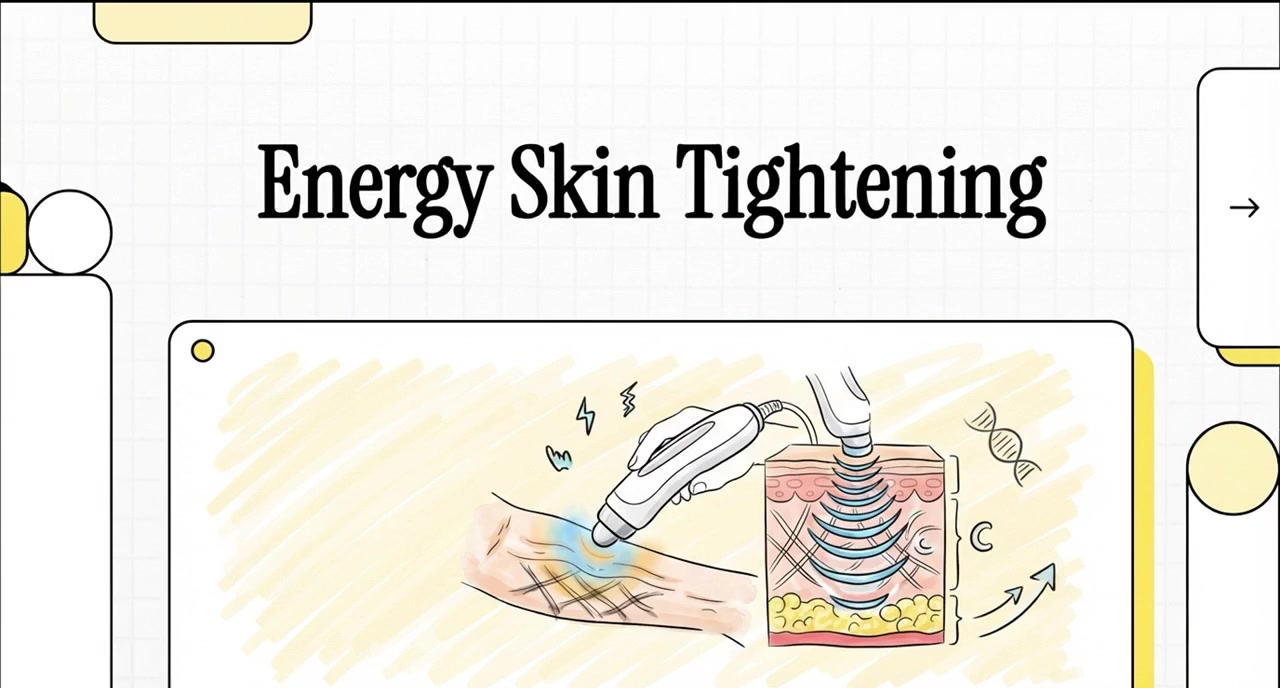
The notebook material for this topic describes a two-part thermal effect. First, heating the subdermal layer to roughly 65 °C partially denatures the triple-helix structure of existing collagen, which then reorganises and contracts — the "shrink-wrap" phase, which happens on the table. Second, that controlled injury triggers fibroblasts to synthesise new collagen and elastin over the following weeks and months. The immediate contraction is geometry; the later part is biology and cannot be hurried. The surface rule exists because skin burns long before collagen contracts: the same material caps cutaneous temperature at 42 °C, monitored in real time, and specifies an operating-room environment of 20–23 °C ambient with positive-pressure ventilation so the heat energy devices produce can actually dissipate. The published literature measures this problem differently — in joules delivered rather than degrees reached — and the range is enormous: in the 100-patient study above, a conventional radiofrequency-assisted technique delivered 84,939 J on average against 44,195 J for the alternative technique (P < 0.001). Both were called radiofrequency tightening. That is the first thing to understand before comparing quotes.
The working window matters as much as the target. The source material puts the contraction onset at a minimum of 65 °C and the useful range at 65–80 °C, while the skin surface is capped at 42 °C and watched continuously with infrared surface sensing — the gap between those two numbers is the entire safety margin. It describes the room that supports it as well: ambient temperature held between 20 and 23 °C, relative humidity 30–60%, and more than 20 positive-pressure air exchanges an hour. The notebook material also names the energetic step itself — hyalinisation of the collagen fibres, producing immediate contraction, followed by neocollagenesis over the months afterwards — and groups diode lasers with radiofrequency and helium plasma as the three energy families used.
| Modality class | How it works | What it changes | Main risk to weigh |
|---|---|---|---|
| Radiofrequency-assisted (RFAL) | Bipolar or fractional current heats the dermis from inside | Fat removal plus collagen contraction; ASPS describes 1–2 day typical recovery, often local or light sedation | Thermal injury if surface temperature is not monitored |
| Helium-plasma | Ionised gas delivers very rapid superficial heating | Fast collagen contraction directly under the skin | Heat confined to a thin layer; operator-dependent |
| Laser-assisted (LAL) | Fibre delivers specific wavelengths to emulsify fat and heat tissue | Fat emulsification plus tightening; published contralateral study found blood loss reduced by more than 50% versus traditional liposuction | Longer operative time; internal burns if energy is stacked |
| Ultrasound-assisted (UAL) | Ultrasonic waves liquefy fat before aspiration | Selective fat removal while sparing vessels and nerves; used for fibrous areas | Slower; cannula pass count climbs if fat is not fully emulsified |
| Power-assisted (PAL) | Motorised cannula vibration | Consistent extraction with less surgeon fatigue; no skin tightening of its own | Mechanical trauma and contour irregularity if over-used superficially |
| Excision (abdominoplasty or body lift) | Skin and fat removed surgically | The only option that physically removes loose skin; Mayo Clinic lists it as a separate operation with its own recovery | Scar length, longer recovery, higher cost |
The published anchors behind the claims
Two sets of numbers matter when a practice advertises tightening. The first is what the device does to tissue. ASPS describes radiofrequency-assisted liposuction as a minimally invasive procedure that uses thermal energy to promote skin tightening, performed without general anaesthesia and typically followed by a 1–2 day recovery. The second is what the whole operation does to the patient. In a prospective study of 56 patients who received equal amounts of traditional and laser-assisted liposuction at two contralateral sites, laser lipolysis reduced blood loss by more than 50% — a real, measured difference, and a better predictor of recovery than any tightening claim. The notebook material's thermal figures (65 °C subdermal, 42 °C surface, 20–23 °C ambient, more than 20 air exchanges per hour) come from the same source as the effect they describe; they are reproduced here because they are the numbers the technique is built on, not because they were independently re-measured for this page.
| Figure | Notebook material states | Published anchor |
|---|---|---|
| Temperature at which collagen contracts | 65 °C minimum in the subdermal layer, with 65–80 °C described as the working band | No single published threshold; ASPS describes thermal energy promoting tightening without publishing a temperature target |
| Skin-surface safety limit | 42 °C, monitored continuously, to prevent dermal burns | Temperature-controlled radiofrequency devices are studied precisely because surface control determines safety |
| Energy dose per case | Not stated | 44,195 J versus 84,939 J for two radiofrequency techniques in 100 patients (P < 0.001) |
| Blood loss | Not stated | Laser lipolysis reduced blood loss by more than 50% versus traditional liposuction (56 patients, contralateral sites) |
| Recovery after RF-assisted lipo | Not stated | Typical recovery 1–2 days; many patients return to work the next day (ASPS) |
| Named energy platforms | BodyTite (bipolar radiofrequency), Renuvion J-Plasma (helium plasma plus radiofrequency), Morpheus8 (fractional radiofrequency microneedling) and Quantum RF | No head-to-head published comparison of all four was located; the notebook material compares them by how the heat is delivered |
Who actually benefits, and who is sold the wrong operation
Candidacy is a laxity question, not a fat question. Localised fat with mild laxity and reasonable elasticity is the group where energy-assisted tightening earns its fee: the fat comes out and the skin follows over the following months. Where laxity is severe, the physics stops cooperating — no amount of surface heating removes a centimetre of skin, and the honest answer is a lift or a tuck, with a scar, a longer recovery and a higher published price. ASPS states that in some situations optimal results may not be achievable with a single procedure and a second operation may be necessary; treat that as a cost input, not a disclaimer. The middle group is the hardest: moderate laxity, moderate fat, and a genuine trade-off between a scar and a softer improvement. Weight stability across the preceding months matters in every one of these groups, because the result consolidates over 6–12 months and further weight loss can reopen the same problem.
| Presentation | Best-fit approach | Realistic tightening | Main trade-off |
|---|---|---|---|
| Localised fat, good elasticity, mild laxity | Liposuction with or without energy assistance | Skin follows the new contour over months | Energy add-on raises the fee; benefit is modest |
| Fat plus moderate laxity | Energy-assisted liposuction, sometimes staged | Partial retraction; residual looseness likely | May still need excision later |
| Severe laxity or hanging skin | Excision (tummy tuck, body lift) | Skin is removed, not tightened | Scar and recovery measured in weeks |
| Residual fat pockets after a lift or after weight loss | Staged contouring after the lift has settled | Refinement, not reshaping | Two recoveries; two sets of fees |
What to ask, and what the price should reveal
Energy-assisted tightening is usually billed as a technique upgrade rather than a separate line, which makes it hard to price — ask what share of the quote is the device component and what the total includes for compression garments, follow-up visits and any revision window. Published fee benchmarks are a starting point: ASPS puts the average surgeon's fee at $4,711 while stating it excludes anaesthesia, the operating room and related costs, and The Aesthetic Society's standard procedure cost is $2,764 for surgeon and facility fees together. Our own guides on what the surgeon, facility and anaesthesia fees actually cover and on Miami pricing go through the arithmetic. Clinically, four questions decide whether the tightening is real: which modality is being used and why, what internal temperature it targets, how that temperature is monitored (real-time fibre-optic sensing or infrared surface monitoring), and who stops the energy if the surface warms past its limit. Add one recovery question — what compression and massage schedule is expected — and compare the answers with our week-by-week recovery milestones. Everything above is a planning framework, not a prediction: skin quality varies between individuals, and only a board-certified plastic surgeon who examines you can judge whether energy-assisted liposuction, excision, or neither is the right answer for your body. If you want the full list of questions first, our 50-question consultation checklist covers credentials, technique and thermal safety in order.
Frequently asked questions
Does liposuction tighten loose skin on its own?
No. Liposuction removes fat cells from the layer under the skin but does not remove or change how much skin there is. Where skin has good elastic recoil it contracts over the new contour; where laxity is severe, published guidance says the excess skin may require excision.
Why do two quotes for radiofrequency tightening differ so much?
Because the energy delivered varies enormously. In a prospective study of 100 patients, one radiofrequency-assisted technique delivered 84,939 joules on average against 44,195 joules for the alternative technique, a significant difference. Both were described as radiofrequency tightening, so the name alone does not tell you the dose.
What happens if the skin laxity is severe after fat removal?
Heat-based tightening cannot compensate for skin that has to be removed rather than contracted, and no amount of surface heating removes a centimetre of skin. Published guidance points to a lift or a tuck in that situation, with a scar, a longer recovery and a higher published price.
Sources
Figures are published figures as of the access date (12 Sep 2026) and change over time. Notebook-material figures are reproduced as the supplied notebook material states them.
1. American Society of Plastic Surgeons, What is radiofrequency-assisted liposuction? — https://www.plasticsurgery.org/news/blog/what-is-radiofrequency-assisted-liposuction
2. ASPS, Liposuction — Assisted Procedure — https://www.plasticsurgery.org/cosmetic-procedures/liposuction-assisted/procedure
3. ASPS, Liposuction Candidates — https://www.plasticsurgery.org/cosmetic-procedures/liposuction/candidates
4. ASPS, Liposuction Results — https://www.plasticsurgery.org/cosmetic-procedures/liposuction/results
5. Hernández J, et al. Liposuction and Skin Tightening by Plastic Internal Low-angular Retraction Technique to Direct Skin Retraction with Monopolar Radiofrequency, Plastic and Reconstructive Surgery Global Open — https://pmc.ncbi.nlm.nih.gov/articles/PMC13367935
6. Comparison of Blood Loss in Laser Lipolysis vs Traditional Liposuction — https://pubmed.ncbi.nlm.nih.gov/24871303
7. ASPS, Liposuction Safety — https://www.plasticsurgery.org/cosmetic-procedures/liposuction/safety
8. QUAD A, Liposuction: What is Safe? — https://www.quada.org/en/standards-news-and-updates/liposuction
9. ASPS, Liposuction Cost — https://www.plasticsurgery.org/cosmetic-procedures/liposuction/cost
10. The Aesthetic Society, Liposuction — Associated Costs — https://www.theaestheticsociety.org/procedures/body/liposuction/associated-costs
11. Mayo Clinic, Tummy tuck — https://www.mayoclinic.org/tests-procedures/tummy-tuck/about/pac-20384892
12. Notebook source material for this site: video overview Energy Skin Tightening (thermal targets, operating-room environment) and the accompanying consultation-research report.
Medical-safety note: This article is general information about published techniques and figures, not medical advice, and nothing here guarantees a result. Suitability, technique choice and any temperature or energy setting are clinical decisions that depend on your examination, history and anatomy — only a board-certified plastic surgeon can make them.