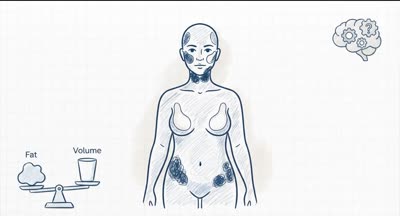
A fat graft has no blood supply when it lands. The cells that survive the first days do so by diffusion alone, and the ones that do not are reabsorbed by the body — which is why the same operation performed by two surgeons can produce noticeably different volumes from the same amount of harvested fat. Everything that happens before the fat reaches its destination is therefore a survival variable: the vacuum pressure used to harvest it, the diameter of the cannula, how it is purified, whether it is enriched with the patient's own regenerative cells, and how thinly it is layered into the recipient site. In the source material's terms that first variable has a number: low vacuum pressure of roughly 400 mmHg with harvesting cannulas around 3 mm is the range given for protecting cell integrity — and the stakes are stated just as plainly, since in conventional transfers as much as 80% of the transferred fat is lost. Transplanted fat can be kept alive; it cannot be guaranteed, and no practitioner can honestly promise a specific final volume. Published reviews put the reported volume loss across conventional grafting between 30% and 80%.
The short version
- Transplanted fat cells have no blood supply when placed, so early survival depends on diffusion from the surrounding bed.
- Published reviews put reported volume loss across conventional fat grafting between 30% and 80%.
- Cell-assisted lipotransfer mixes the stromal vascular fraction back into the graft so it carries its own support cells.
- Culture-expanded adipose-derived stem cells are grown under GMP conditions to greater than 90% purity, a two-stage process.
- Facial fat grafting posted the largest single-year gain of any procedure ASPS tracks in its 2025 report, at 39% growth.
The avascular phase decides the volume
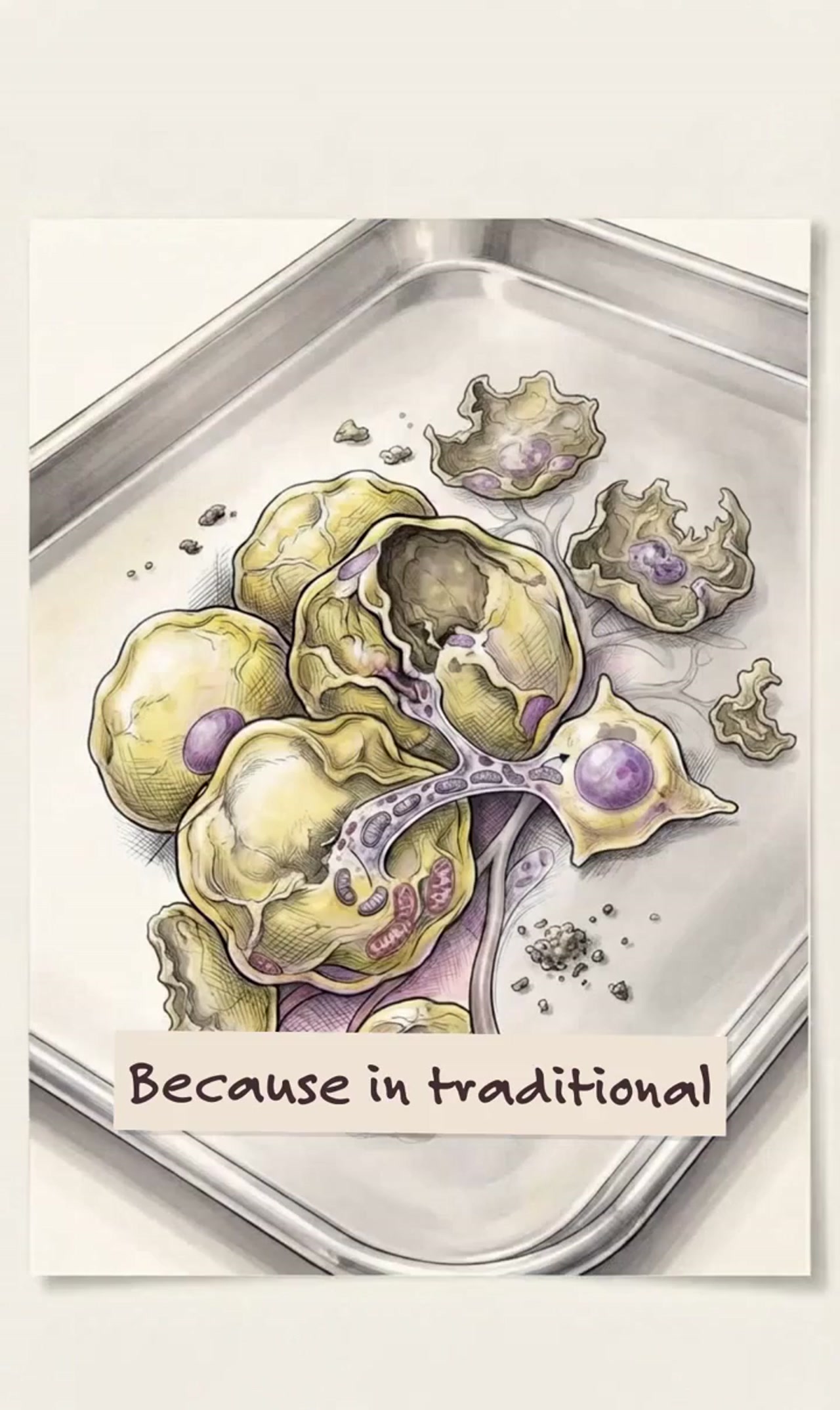
The notebook material for this topic describes the biology in unusually concrete terms: a microscopic cluster of freshly transplanted fat, isolated from blood vessels, suffocating from lack of oxygen until new capillaries reach it. What rescue looks like at the cellular level, according to that same material, is a combination of signals that prompt existing vessels to sprout new branches, physical connections between cells that transfer functioning components to stressed neighbours, and immune signalling that shifts the local environment from inflammation to repair. Whatever the mechanism, the clinical consequence is the same: the graft that gets revascularised quickly keeps its volume, and the graft that does not, does not. Published fat-grafting reviews put retention well below 100% and describe wide variability between patients and between recipient sites — the honest framing for a consultation is a range and a plan for a possible second stage, not a percentage promise. The notebook material names those mechanisms: pro-angiogenic growth-factor secretion (VEGF and FGF2), a shift of macrophages toward the anti-inflammatory M2 phenotype, and mitochondrial transfer between cells through tunnelling nanotubes.
Harvesting and handling decide the starting material
The instrument settings are not a detail. In a three-patient study comparing abdominal lipoaspiration at high pressure (−760 mmHg) with low pressure (−250 mmHg), the adipocyte count immediately after harvest was 47% higher at the lower pressure, and cell viability remained significantly higher at day seven. Cannula and needle diameter have been the subject of similar work, because the shear forces acting on fat cells as they pass through a narrower instrument are higher. The notebook material for this topic suggests a harvesting pressure of roughly 400 mmHg with cannulas near 3 mm; the published comparison available to us used a different pair of pressures, so treat the exact figure as something to ask about rather than to assume. Purification is the next variable — mechanical filtration, centrifugation, or emulsification into nanofat — and each has a different trade-off between removing damaged cells and damaging intact ones. Layering matters for the same reason: fat placed in thick clumps has a core that will not be reached by new vessels in time, which is why multi-layer techniques are used to keep the graft thin enough to perfuse.
| Variable | Options | Published effect | Question to ask |
|---|---|---|---|
| Vacuum pressure | High (−760 mmHg) versus low (−250 mmHg) | 47% higher adipocyte count immediately after harvest at low pressure; better viability at day seven | "What pressure is used on my harvest, and is it manual or powered?" |
| Cannula and needle diameter | Larger bore versus fine-bore harvesting | Instrument size is a documented determinant of fat-cell survival in published series | "What diameter is used to harvest, and what is used to inject?" |
| Purification | Mechanical filtration, centrifugation, nanofat emulsification | No universally superior method published; each trades cell recovery against cell trauma | "Which method, and what does it remove?" |
| Layering | Single bolus versus multi-layer, thin placement | Thin, layered placement brings more of the graft within diffusion distance of a blood supply | "How many layers, and how is clumping avoided?" |
| Cell enrichment | None, stromal vascular fraction, or culture-expanded cells | Adipose-derived cell enrichment has been the subject of systematic reviews and meta-analyses in the plastic-surgery literature | "Which cells, how many, and is the tissue minimally manipulated or cultured?" |
Enrichment: what cell-assisted lipotransfer adds, and what it costs
Cell-assisted lipotransfer takes a portion of the harvested fat, isolates the stromal vascular fraction, and mixes it back into the graft so the transferred tissue carries its own support cells. The stronger version of the idea uses a laboratory step: cells are expanded in culture before being returned, and the notebook material for this topic reports retention gains above 60% from culture-expanded adipose-derived stem cells, describing the mechanism as new vessel formation, immune modulation and direct transfer of functioning components to stressed cells. That figure is the notebook material's, and the published literature is better read as a direction than a number: several systematic reviews and meta-analyses have compared adipose-derived stem cell–enriched grafting with conventional grafting, reporting improvements in retention while noting that study designs, cell preparation and dose vary so much between them that a single percentage does not transfer to an individual patient. There is a regulatory dimension too. Whether the cells are minimally manipulated or expanded in culture changes the tissue's legal status in the United States, and the safety and regulation of fat grafting is itself a published subject. Ask directly, and ask in writing. On the cell preparation itself, the notebook material draws the distinction that matters most: uncultured stromal vascular fraction is a fresh cell mix in which roughly 1–10% of cells are stem or stromal cells, while culture-expanded adipose-derived stem cells are grown under GMP conditions to greater than 90% purity.
| Approach | What is added | Evidence status | Practical consequences |
|---|---|---|---|
| Conventional fat grafting | Nothing — harvested fat only | Established technique with documented variable retention | Lowest cost; higher chance of a second stage |
| Stromal vascular fraction enrichment | Uncultured cells from the same harvest, mixed back in | Compared with conventional grafting in systematic reviews | Same-day procedure; no laboratory step |
| Culture-expanded adipose-derived stem cells | Cells multiplied in a laboratory before re-implantation | Higher reported retention in the notebook material and in published comparative reviews; heterogeneity limits transfer of a single figure | Raises regulatory, cost and scheduling questions — a two-stage process |
| Nanofat | Emulsified fat with cells destroyed, used for skin quality | Used for rejuvenation rather than structural volume | Not a volume filler — do not accept it as a substitute |
| Cell-free exosome preparations | Concentrated signalling vesicles with no living cells | An outlook in the notebook material rather than an established clinical option | Removes the cell-handling and regulatory questions; no established aesthetic protocol yet |
Where the fat goes, and what the destination changes
Recipient site changes the arithmetic. Facial grafting is judged on symmetry and skin quality, and small volumes can be layered precisely, which is why facial fat grafting posted the largest single-year gain of any procedure ASPS tracks in its 2025 report — 39% growth. Breast and buttock transfer move larger volumes into a space where the graft must establish a blood supply across a wider area, so retention variability matters more and staging is more common. Oncological safety is a legitimate question wherever fat is placed near breast tissue: the notebook material cites the long-term BREAST-I and BREAST-II trial experience as showing safety where tumour resection is complete, while stressing that pre-operative risk screening remains essential. Take the screening question seriously rather than the reassurance. Cost is the final variable: fat transfer is billed as its own procedure with its own anaesthesia and facility components, on top of the liposuction needed to harvest the fat, which is why our guide to what the fee lines actually cover matters more here than anywhere else on this site. For the comparison between removing volume and adding it, see liposuction, tummy tuck and body contouring, and for the questions about how much can be taken in one session, our article on volume limits sets out the published positions.
| Recipient area | What is being restored | Volume and staging | Special consideration |
|---|---|---|---|
| Face and mid-face | Volume lost after weight loss or ageing | Small volumes, precise layering; single stage common | Over-correction is more visible than under-correction |
| Breast | Shape and volume, often after weight loss | Larger volumes; staging frequently considered | Screening and oncological safety questions; imaging history |
| Buttock | Projection and proportion | High volume; requires a harvest site with enough donor fat | Highest volume-transfer risk profile of the common sites |
| Hands and other small areas | Fine volume loss | Very small volumes; repeat sessions sometimes used | Results are subtle by design — set expectations accordingly |
| Infraorbital (under-eye) area | Structural volume loss that reads as dark circles | Very small volumes, ultra-fine nanofat or fine fat | The result is subtle; skin quality, not only volume, drives the appearance |
| Scarred or radiation-treated skin | Contour and skin quality over the scar | Fine fat and nanofat rather than structural volume | Vascularity of irradiated tissue limits how much can be retained |
What to ask before agreeing to fat transfer
Five answers turn this topic from marketing into planning: the vacuum pressure and cannula diameters used to harvest, the purification method and what it removes, whether any cells are added and whether they are cultured, the retention range the surgeon expects for your recipient site, and what the plan is if the volume settles below target. Add the safety questions — oncological screening where relevant, and how the practice documents retained volume over the first months — and you have the shape of a serious consent conversation. Because fat transfer is usually paired with liposuction, the credential questions apply twice: who performs the harvest, who performs the transfer, and in which accredited facility. Our articles on verifying credentials and accreditation and on published complication rates cover both halves, and the printable 50-question consultation checklist includes the fat-grafting questions in section five. Nothing on this page is a promise about retention: graft take varies with the patient, the site and the technique, and only a board-certified plastic surgeon who examines you can judge whether fat transfer — with or without enrichment — is appropriate for your case.
Frequently asked questions
How much of a transplanted fat graft is typically lost?
Published reviews put reported volume loss across conventional fat grafting between 30% and 80%, with one source describing as much as 80% of transferred fat being lost. Retention varies between patients and between recipient sites, so a consultation should give a range and a plan for a possible second stage, not a percentage promise.
What harvest pressure and cannula size protect fat cells during fat transfer?
The notebook material suggests roughly 400 mmHg of vacuum with harvesting cannulas near 3 mm. The published comparison available used −760 mmHg against −250 mmHg and found 47% higher adipocyte counts immediately after harvest at the lower pressure, with better viability at day seven. Ask what pressure is used on your harvest.
What is the difference between stromal vascular fraction and culture-expanded stem cells?
Stromal vascular fraction is an uncultured cell mix from the same harvest in which roughly 1 to 10% of cells are stem or stromal cells. Culture-expanded adipose-derived stem cells are grown in a laboratory under GMP conditions to greater than 90% purity, which makes it a two-stage process with regulatory, cost and scheduling questions.
Sources
Figures are published figures as of the access date (12 Sep 2026) and change over time. Figures attributed to the notebook material are reproduced as that material states them and were not independently measured.
1. Low harvest pressure enhances autologous fat graft viability (three-patient study; −760 mmHg versus −250 mmHg) — https://pubmed.ncbi.nlm.nih.gov/24867719
2. The Influence of High and Low Negative Pressure Liposuction and Various Harvesting Techniques on Adipocyte Viability — https://pubmed.ncbi.nlm.nih.gov/33876289
3. Fat Graft Size: Relationship Between Cannula and Needle Diameters — https://pubmed.ncbi.nlm.nih.gov/32399332
4. ADSC-enhanced versus conventional fat grafting for breast reconstruction: a systematic review and meta-analysis — https://pmc.ncbi.nlm.nih.gov/articles/PMC12928805
5. Clinical Efficacy of Adipose-Derived Stem Cell-Enriched Lipotransfer Versus Conventional Fat Grafting — https://pmc.ncbi.nlm.nih.gov/articles/PMC13090857
6. Safety and Regulation of Fat Grafting — https://pmc.ncbi.nlm.nih.gov/articles/PMC7023970
7. ASPS, press release: Lift Procedures Led Growth as Demand for Restoration Drove Plastic Surgery in 2025 (facial fat grafting +39%) — https://www.plasticsurgery.org/news/press-releases/lift-procedures-led-growth-as-demand-for-restoration-drove-plastic-surgery-in-2025-new-asps-report-reveals
8. ASPS, Liposuction Results — https://www.plasticsurgery.org/cosmetic-procedures/liposuction/results
9. ASPS, Liposuction Candidates — https://www.plasticsurgery.org/cosmetic-procedures/liposuction/candidates
10. ASPS Practice Advisory on Liposuction: Executive Summary — https://www.plasticsurgery.org/documents/medical-professionals/health-policy/key-issues/executive-summary-on-liposuction.pdf
11. Notebook source material for this site: video overview on cell-assisted lipotransfer and transplanted-fat survival (82-second transcript), the origin of the avascular-phase explanation and the reported retention gain attributed to culture-expanded adipose-derived cells; the accompanying consultation-research report supplied the harvesting and layering questions.
Medical-safety note: This article is general information about published techniques and figures. It is not medical advice, it does not promise a retention rate, and no fat-grafting technique is endorsed here. Retention, safety and suitability vary between individuals — only a board-certified plastic surgeon who examines you can assess whether fat transfer, with or without cell enrichment, is appropriate.