Three technology claims show up in almost every modern body-contouring quote: software that plans the operation from a 3D scan, assisted or robotic cannula motion, and sensors that monitor tissue conditions while the surgeon works. They are not equally supported. Powered cannulas and energy-assisted platforms have published comparisons behind them — blood loss, operative time, cell handling. Real-time temperature sensing exists because energy devices burn tissue when they are not controlled, which is a safety argument rather than a marketing one. The third category, AI-driven planning with headline outcome percentages, currently rests mostly on the material supplied by the platform vendors and the notebook source for this guide, and should be read as a claim to interrogate rather than a measurement to rely on. If you have been weighing up body contour services for a home around Miami, FL, this guide covers how it actually works, what it tends to cost, and where the results usually fall short.
The short version
- Three technology claims appear in body-contouring quotes: AI planning software, assisted or robotic cannula motion, and sensing during surgery.
- Powered cannulas and energy platforms have published comparisons, while AI planning percentages come mostly from the platform vendors' own material.
- A 56-patient contralateral study of laser-assisted lipolysis found blood loss reduced by more than 50%.
- A 50-patient drain study reported seroma in 13 of 25 patients without adjunctive drainage versus 4 of 25 with it.
- Three-dimensional body scans count as identifiable health information, so they fall under the same privacy rules as any medical record.
What genuinely changed in the operating room
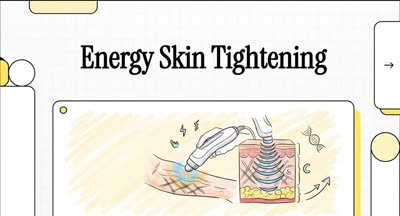
The shift is from manual extraction to instrumented extraction. Traditional liposuction was physical work: the surgeon's arm drove the cannula, and fatigue showed up in the result. Powered systems add motor vibration; ultrasonic systems liquefy fat before it is aspirated, which preserves vessels and nerves better and helps in fibrous areas; laser systems emulsify fat and reduce bleeding; radiofrequency systems add controlled heating for skin contraction. On top of that sits a data layer: 3D surface imaging for before-and-after comparison, intraoperative temperature or pressure readings, and — in the newest systems — software that models where fat sits before a cannula is inserted. Each of those changes what the surgeon can see, not what the patient's tissue can do. In the newest version of that layer, the software analyses 3D body-mapping data — fat distribution, skin elasticity and muscle tone — and uses it to set the energy delivery parameters for the case.
| Technology | What it does | Published evidence behind it | What remains a claim |
|---|---|---|---|
| Power-assisted extraction | Motorised cannula vibration | Described in ASPS technique pages as an established assisted approach | That it improves final contours for a given patient |
| Ultrasound-assisted emulsification | Liquefies fat with ultrasonic energy before aspiration | Contralateral and comparative studies of blood loss versus suction-assisted techniques | That emulsification is gentler in every anatomical area |
| Laser-assisted lipolysis | Fibre-delivered wavelength emulsifies fat, adds heat for tightening | 56-patient contralateral study: blood loss reduced by more than 50% | That the tightening matches an excision |
| Radiofrequency energy | Controlled heating for dermal contraction | ASPS describes thermal energy promoting tightening; temperature-controlled devices are studied for exactly this reason | That one platform's dose is comparable to another's — 44,195 J versus 84,939 J in one 100-patient series |
| Robotic or guided cannula motion | Steadies motion and reduces operator fatigue | Fatigue reduction in long cases is a reasonable engineering argument; direct comparative outcome trials in aesthetic liposuction are thin | Every percentage figure quoted for "uniformity" |
| AI and 3D planning | Maps fat distribution, elasticity and muscle tone; proposes an operative plan | Imaging-based planning is established; outcome improvements depend on the operator | Headline satisfaction and accuracy percentages attributed to "AI" |
How to read a technology claim
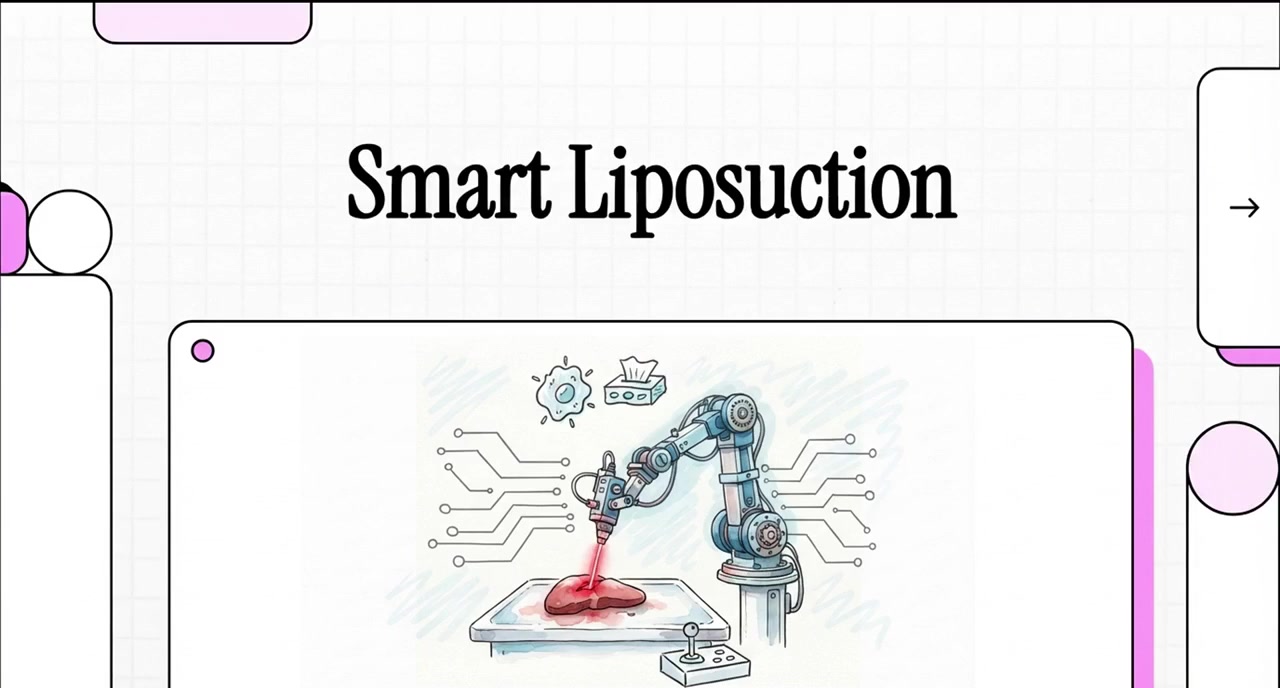
The notebook material for this topic frames the modern operating room as a data-driven one and attaches specific improvements to it — roughly 15% more uniform fat extraction with robotic assistance, up to 40% lower thermal-injury risk from real-time fibre-optic temperature sensing, and a 20% gain in patient satisfaction from AI-guided planning. Those are the notebook material's figures, not independent measurements, and they belong in the same sentence as the source that produced them. What published work does support is more modest and more useful: assisted and energy-assisted techniques change measurable things like blood loss — the 56-patient contralateral laser study again — and fluid handling, where a 50-patient drain study found post-operative seroma in 13 of 25 patients without adjunctive drainage versus 4 of 25 where drainage was added. Technology that reduces bleeding and fluid accumulation is making a claim you can verify. Technology that promises a better aesthetic as a percentage is making a claim about your body that nobody can verify in advance. The same source material reports retention gains above 60% where grafts are enriched with culture-expanded adipose-derived stem cells.
| Claim in circulation | Stated by | Published position | How to test the claim in a consultation |
|---|---|---|---|
| Robotic motion gives up to 15% more uniform extraction | Notebook source material | No comparable aesthetic-liposuction trial located; fatigue reduction is the defensible mechanism | Ask which part of your case is machine-controlled and who supervises it |
| Real-time sensing cuts thermal injury by up to 40% | Notebook source material | Temperature-controlled energy devices are studied because surface control determines burns — the mechanism is accepted, the percentage is not published | Ask what temperature is targeted, how it is measured, and what the cut-off is |
| AI-guided planning raises satisfaction by 20% | Notebook source material | No published trial of that design found for aesthetic liposuction | Ask whether the plan changes the operation or only the picture of it |
| Assisted techniques reduce blood loss | Peer-reviewed comparative studies | More than 50% reduction with laser-assisted lipolysis in a 56-patient contralateral study; other comparisons of suction-assisted versus ultrasound-assisted report measurable differences | Ask which technique is planned for you and what it changes about bleeding and bruising |
| Drains reduce fluid problems | Peer-reviewed drain study | Seroma in 13 of 25 without adjunctive drainage versus 4 of 25 with it | Ask what determines drains in your case and what the volume threshold is |
| Predictive AI recovery monitoring forecasts the recovery curve | Notebook source material | No published aesthetic-liposuction trial located; monitoring to date bounds risk rather than improving the aesthetic | Ask what data feeds the model, who reviews its output, and how it changes your aftercare |
The failure modes nobody advertises
Every instrument that can fail will eventually fail, and the questions worth asking are about that moment rather than about the brochure. If a sensor is giving a false reading, who notices, and does the case continue? If the plan generated from a 3D scan does not match what the tissue does when the cannula reaches it, which one wins? If the guidance software is unavailable, is the surgeon still able to complete the operation to the same standard by hand? Those are not hostile questions; they separate a practice that owns its equipment from one reselling it. There is a data question too. A 3D body scan is identifiable health information, and its handling is a privacy matter under the same rules as any other medical record — where it is stored, how long it is kept, whether it is transmitted to the device manufacturer for processing, and whether it can be deleted on request. A practice should be able to answer that without a phone call to a vendor.
| Failure mode | What it looks like | What a good answer sounds like |
|---|---|---|
| Sensor drift or false reading | Energy or pressure readings stop matching the tissue response | "The surgeon stops, verifies manually, and continues only with a second reading." |
| Plan-versus-tissue mismatch | Scan-based target volumes do not fit the anatomy encountered | "The plan is a starting point; intraoperative findings override it." |
| Equipment unavailability | A device is out of service on the day | "The case is re-scheduled or completed with the manual technique, and you are told which." |
| Unvalidated add-ons | Marketing language with no published comparison | "Here is the study, and here is what it does not show." |
| Scan data handling | Body images stored or shared beyond the practice | "Stored in the medical record, retained for X years, deletable on request." |
The post-operative half of the technology story
The data layer does not stop when the patient leaves the theatre. The notebook material for this topic describes two post-operative tools drawn from the same research: fan-pattern lymphatic taping to speed the resolution of bruising on the abdomen and flanks, and a seroma protocol combining strategic drain placement, manual lymphatic drainage and correctly fitted compression garments. The first is reported in the notebook material as a cited clinical-trial finding; the second is exactly the direction the published drain study points, where adjunctive drainage cut seroma from 13 of 25 patients to 4 of 25. Practically, that means a technology-led practice should be able to tell you what happens in week one and week three — which garment, how many hours a day, whether drainage or taping is planned — and not only which device is used on the day. The milestone sequence for that period is set out in our week-by-week recovery guide, and the fluid and bruising questions belong on the same list as the technology questions.
Where the data layer genuinely helps
Three uses survive scrutiny. First, consistency: instrumented extraction removes some of the variability that comes from a tired arm at hour four of a long case, and long cases are exactly where contour problems begin. Second, safety feedback: monitoring tissue temperature and aspirate characteristics gives the surgeon a signal that manual technique simply does not provide. Third, documentation: 3D imaging makes before-and-after comparison objective, which matters if a revision is ever discussed. None of that changes the fundamentals, and it should not change the price dramatically either — assisted techniques are usually quoted inside the surgeon's fee rather than as a separate line, which is why the useful comparison across quotes is not the equipment list but what the fee lines actually cover. Before agreeing to a technology-led plan, pair it with the boring questions: how the surgeon's credentials and the facility's accreditation check out, how many of these procedures they perform annually, and what the published complication profile looks like in our article on complication rates as published. Our printable 50-question consultation checklist puts the technology questions in the same list as the credential and pricing ones, which is where they belong. Only a board-certified plastic surgeon who examines you can judge which of these tools, if any, is appropriate for your case. Two tools beyond that are described as emerging rather than established: biofeedback systems that feed live tissue response back during the case, and predictive AI recovery monitoring that forecasts the recovery curve instead of documenting it afterwards.
Frequently asked questions
Does robotic assistance really make fat removal more uniform?
The published evidence does not confirm it. Robotic or guided cannula motion is described as steadying motion and reducing operator fatigue in long cases, which is an engineering argument rather than a measured outcome. The 15% uniformity figure comes from vendor-supplied notebook material, not an independent trial, so treat it as a claim to question.
Does real-time temperature sensing during liposuction lower burn risk?
The mechanism is accepted even if the percentage is not. Real-time fibre-optic temperature sensing exists because energy devices burn tissue when they are uncontrolled, and temperature-controlled devices are studied for exactly that reason. The 40% figure is notebook source material, so ask what temperature is targeted and what the cut-off is.
Is a 3D body scan taken for liposuction planning private health information?
Yes. A 3D body scan is identifiable health information, handled under the same privacy rules as any other medical record. A practice should be able to say where scans are stored, how long they are kept, whether they are sent to the device manufacturer, and whether they can be deleted on request.
Sources
Figures are published figures as of the access date (12 Sep 2026) and change over time. Figures attributed to the notebook material are reproduced as that material states them and were not independently measured.
1. Comparison of Blood Loss in Laser Lipolysis vs Traditional Liposuction — https://pubmed.ncbi.nlm.nih.gov/24871303
2. Blood loss in major liposuction procedures: a comparison study using suction-assisted versus ultrasound-assisted liposuction — https://pubmed.ncbi.nlm.nih.gov/11420531
3. Liposuction: Drains, Are They Adequate?, Plastic and Reconstructive Surgery Global Open — https://pmc.ncbi.nlm.nih.gov/articles/PMC7253242
4. Hernández J, et al. Liposuction and Skin Tightening by Plastic Internal Low-angular Retraction Technique with Monopolar Radiofrequency — https://pmc.ncbi.nlm.nih.gov/articles/PMC13367935
5. ASPS, What is radiofrequency-assisted liposuction? — https://www.plasticsurgery.org/news/blog/what-is-radiofrequency-assisted-liposuction
6. ASPS, Liposuction Safety — https://www.plasticsurgery.org/cosmetic-procedures/liposuction/safety
7. Saad M, et al. A Nationwide Analysis of Complications and Risks Associated With Types of Liposuction in 69,424 Patients, Aesthetic Surgery Journal — https://doi.org/10.1093/asj/sjaf147
8. Complications of Aesthetic Liposuction Performed in Isolation: A Systematic Literature Review and Meta-Analysis — https://pmc.ncbi.nlm.nih.gov/articles/PMC10902471
9. ASPS, Questions to Ask Your Plastic Surgeon About Liposuction — https://www.plasticsurgery.org/cosmetic-procedures/liposuction/questions
10. QUAD A, Liposuction: What is Safe? — https://www.quada.org/en/standards-news-and-updates/liposuction
11. Notebook source material for this site: video overview on AI, robotic assistance and data-driven surgery (561-second transcript; on-screen title cards "Smart Liposuction" and "Tech Evolution"), the origin of the 15%, 40% and 20% figures quoted above.
Medical-safety note: This article compares published evidence with marketing claims about technology. It is not medical advice and no listed device or technique is endorsed here. Whether any of these tools is used, and for whom, is a clinical decision — only a board-certified plastic surgeon who examines you can make it.