Why one matrix decides most technique arguments
The ninth slide is the deck's comparison page, and it settles an argument that patients and consultations often blur together: whether a technology is being chosen to remove fat or to tighten skin. The matrix answers that by separating the two properties and rating every modality on each one independently. Once emulsification power and retraction power are treated as different columns, "which technology is best" stops being a single question. If you are here looking into body contour services, the sections below walk through the process from the first quote to the finished job.
The short version
- The energy modality matrix rates five platforms, PAL, VASER, LAL, RFAL and plasma, separately for fat emulsification and skin retraction.
- PAL and VASER are rated high for emulsification but low and moderate respectively for tissue retraction.
- RFAL and plasma are rated extreme for retraction and low for emulsification, placing them after a fat-removal step.
- Laser-assisted lipolysis is the only row the slide rates above moderate on both emulsification and retraction.
- Those ratings are relative words, such as high or extreme, and the slide gives no units, study names or sample sizes.
The slide's five rows are PAL, VASER, LAL (SmartLipo), RFAL (BodyTite) and Plasma (Renuvion). Its columns are the modality, the primary physics, fat emulsification power, tissue retraction power, and the ideal clinical application. The structure is the message: the platform with the highest emulsification rating has the lowest retraction rating, and the two platforms with extreme retraction ratings have low emulsification ratings. Fat removal and skin tightening are described as separate jobs with separate tools.
The matrix as printed on the slide
| Modality | Primary physics | Fat emulsification power | Tissue retraction power | Ideal clinical application |
|---|---|---|---|---|
| PAL | Mechanical vibration | High | Low | High-volume debulking and widespread extraction |
| VASER | Acoustic cavitation | High | Moderate | High-definition (HD) muscle contouring and detailing |
| LAL (SmartLipo) | Photonic / wavelength | Moderate | Moderate–High | Fibrotic areas, submental regions, arms |
| RFAL (BodyTite) | Bipolar radiofrequency | Low | Extreme | Mild to moderate post-lipo skin laxity |
| Plasma (Renuvion) | Helium plasma + RF | Low | Extreme | Severe post-lipo skin laxity requiring immediate shrink-wrapping |
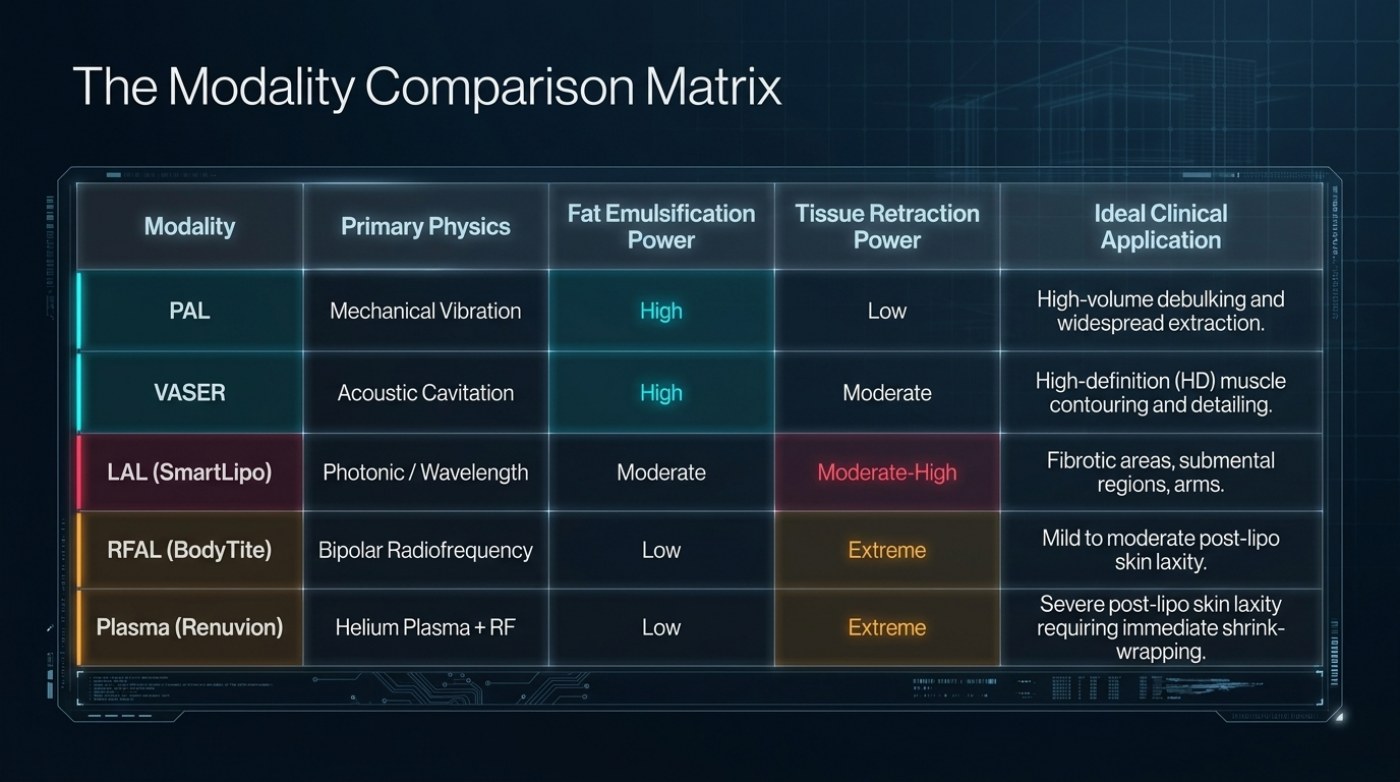
It is also worth naming what the matrix is not. It is not a ranking of outcomes, and it does not compare any two rows on cost, recovery time, complication profile or how long a result is expected to hold. It compares mechanisms against two functional properties and attaches an application to each row. Anything a reader wants to know beyond that — how much fat a session can remove, what a plan costs, how the first weeks go — lives in different documents. Our own site publishes separate guides on volume limits, cost structure and recovery milestones precisely because a technique comparison cannot answer those questions.
Two details in the table are easy to skim past. First, the ratings are relative words rather than measured quantities — high, moderate, low, extreme — and the slide does not attach a unit or a study to any of them. Second, the device names in brackets, SmartLipo, BodyTite and Renuvion, tell a reader which platform family each row describes, while PAL and VASER are named by their mechanism rather than by a product. The table is comparing technique families and platform families at the same time.
Reading the emulsification column
Emulsification is the part of the procedure that turns solid fat into something a cannula can remove. The slide rates PAL and VASER as high, LAL as moderate, and both RFAL and plasma as low. That ordering is what makes the first two rows the volume platforms: mechanical vibration dislodges adipocytes with reduced exertion, and acoustic cavitation uses microscopic bubbles that expand and collapse to emulsify fat selectively. Both descriptions in the deck are about moving fat rather than heating tissue.
| Row | Rating | Mechanism description in the deck |
|---|---|---|
| PAL | High | Rapid mechanical cannula oscillation; fat is physically dislodged with reduced exertion |
| VASER | High | High-frequency acoustic energy; cavitation bubbles emulsify fat while sparing surrounding architecture |
| LAL | Moderate | Photonic energy at named wavelengths, with one wavelength wavelength-tuned to fat liquefaction |
| RFAL | Low | Radiofrequency energy delivered between electrodes; the matrix does not present it as a fat-removal tool |
| Plasma | Low | Helium plasma combined with radiofrequency; again, not rated for fat removal |
The consequence is practical. A plan built around a large volume of fat has to start from a row with high emulsification. A plan built around a small amount of fat and a lot of loose skin starts from a different row entirely, because the matrix gives the tightening rows almost nothing in the way of fat removal.
Reading the retraction column
Retraction is the tightening side of the same table, and its ordering is roughly the reverse of emulsification. PAL is rated low, VASER moderate, LAL moderate to high, and both RFAL and plasma extreme. The slide's other pages explain the mechanism behind those ratings — thermal contraction of the collagen network, described elsewhere in the deck as a two-phase response with an immediate physical component and a prolonged biological one.
| Row | Retraction rating | What the deck pairs it with |
|---|---|---|
| PAL | Low | High emulsification; chosen for volume, not for tightening |
| VASER | Moderate | High emulsification plus enough retraction for defined contour work |
| LAL | Moderate–High | The only row rated above moderate in both columns |
| RFAL | Extreme | Low emulsification; the matrix places it after fat removal, for laxity |
| Plasma | Extreme | Low emulsification; placed with the most severe laxity and immediate shrink-wrapping |
LAL is the interesting row because it is the only modality the slide rates above moderate on both axes. Its column entry describes photonic or wavelength-based physics, which in the deck's wider material is split between deep-penetration settings aimed at fat liquefaction and high-water-absorption settings aimed at dermal heating and the fibroseptal network. The moderate-to-high retraction rating follows from that second behaviour rather than the first.
Where the layering actually happens
Read together, the last two rows describe a sequence rather than an alternative. RFAL is matched to mild to moderate post-lipo skin laxity and plasma to severe post-lipo skin laxity requiring immediate shrink-wrapping. Both are described as post-lipo, which places them after a fat-removal step rather than instead of one. The matrix is a layering diagram in table form: a high-emulsification modality takes the fat, and a high-retraction modality follows to address the envelope.
| Presentation on the slide | Fat-removal side | Tightening side | Why the matrix pairs them |
|---|---|---|---|
| High-volume debulking and widespread extraction | PAL | None named | The slide gives this row a volume application with no tightening claim attached |
| High-definition muscle contouring and detailing | VASER | VASER's own moderate retraction | The only row where one platform carries both jobs |
| Fibrotic areas, submental regions, arms | LAL | LAL's moderate-to-high retraction | Named for regions where fibrotic tissue and small volumes meet |
| Mild to moderate post-lipo skin laxity | A separate removal step, already performed | RFAL (BodyTite) | The slide's wording makes laxity after fat removal the indication |
| Severe post-lipo skin laxity | A separate removal step, already performed | Plasma (Renuvion) | Described as needing immediate shrink-wrapping rather than the milder row |
That sequencing is also the honest limit of the table. The matrix says nothing about how much retraction any row produces, how long it lasts, or what happens when the skin's elasticity is poor rather than merely loose. Our published guide to heat-based tightening addresses that gap directly: candidacy for tightening is a laxity question rather than a fat question, and skin that needs to be removed rather than contracted is not solved by any row in this matrix.
Questions this slide raises
Can one modality do both jobs well?
On the slide, no row is rated extreme in both columns. PAL and VASER lead on emulsification and sit low to moderate on retraction. RFAL and plasma are extreme on retraction and low on emulsification. LAL is the only row above moderate in both, and it is rated moderate rather than high on emulsification and only moderate-to-high on retraction. That gap is why the applications column pairs two rows for the laxity presentations.
Are the ratings measured numbers?
They are relative ratings — high, moderate, low, extreme — presented without units, study names or sample sizes. They describe how the deck ranks the mechanisms against each other, not a measured quantity of fat removed or skin retracted. The honest attribution for the whole table is the source material behind the deck.
Does the matrix say which modality suits a particular body area?
It names regions in three places: submental areas and arms for LAL, and the general categories of high-volume debulking and high-definition detailing for PAL and VASER. Those are applications rather than recommendations, and the slide attaches no patient selection criteria to any row. What it does provide is the vocabulary for a consultation — which part of the plan is doing the removing and which part is doing the tightening.
This is published information, not medical advice — a board-certified surgeon must assess whether a procedure suits you.
Related Guides
Three guides that go deeper into the rows of this matrix:
- High-Definition Liposuction: How Muscle Etching Actually Works — the two-pass technique, and why the superficial pass carries the risk.
- Heat-Based Skin Tightening After Liposuction: What the Numbers Mean — the thermal side of the retraction column, in detail.
- AI, Robotics and Data in Body Contouring: What Changes, What Does Not — which delivery and sensing claims are supported and which are not.