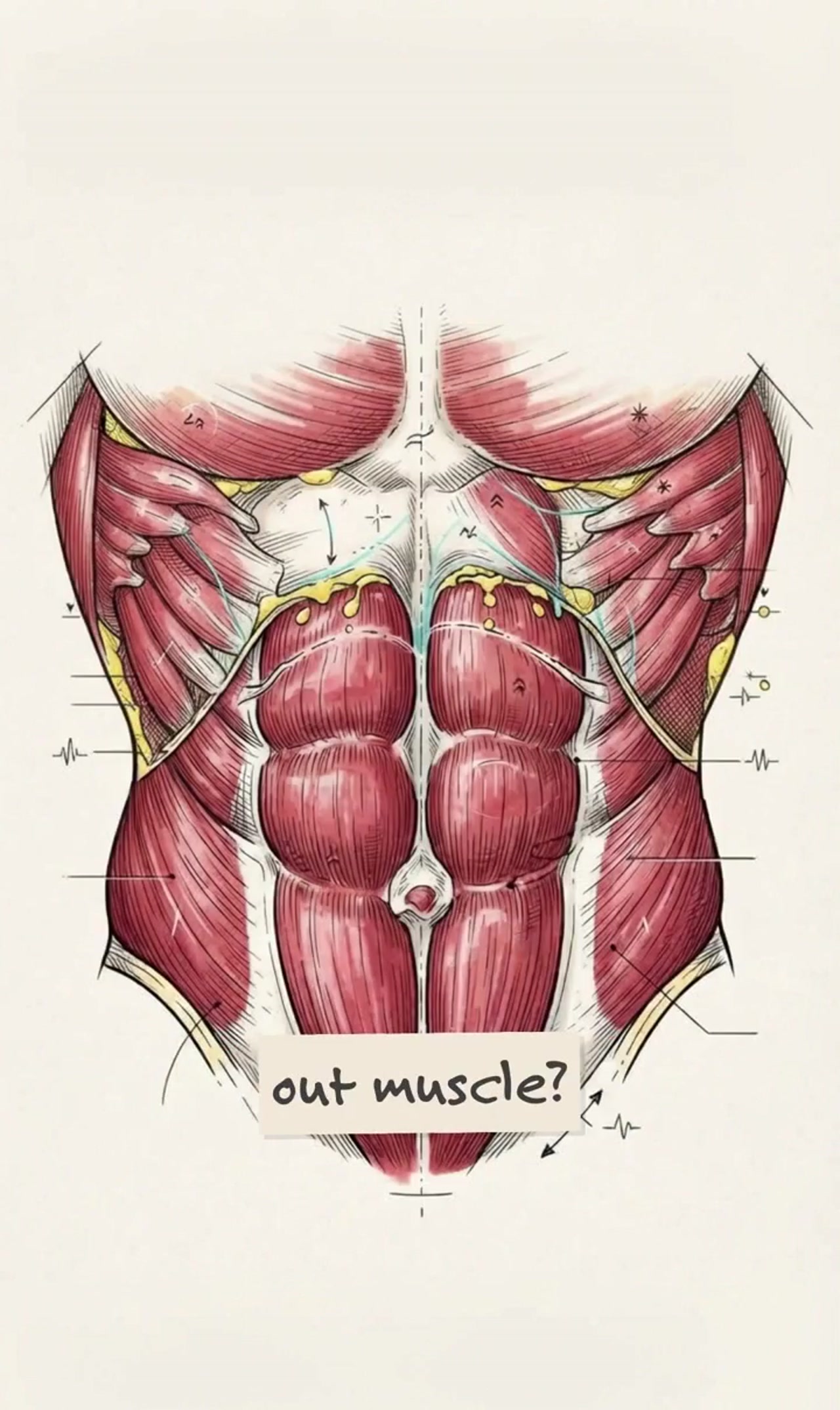
High-definition liposuction does not build muscle. It removes fat in two layers so that the muscle boundaries a patient already has become visible: deep fat first, to establish the overall contour, then a deliberate thinning of the superficial fat layer to trace the natural grooves between muscle groups. The first pass is volume work. The second pass is the one that produces the athletic look — and the one that carries the risks, because the fat being removed there is only millimetres from the skin it has to support. The technique is credited in the published literature to Hoyos and Millard, whose work established high-definition liposuction as a defined procedure rather than a label for aggressive suction. Most homeowners who read this are comparing facial liposuction options around Miami, FL, so what follows sticks to the details that change in practice.
The short version
- High-definition liposuction removes fat in two layers rather than building muscle, tracing grooves that were already there.
- The deep pass sets the overall contour with larger cannulas, while the superficial pass thins fat to reveal definition.
- In a 50-patient drain study, 17 patients developed seroma, 13 of 25 without drainage against 4 of 25 with it.
- Seroma was graded mild under 50 cc, moderate from 50 to 100 cc and severe above 100 cc.
- Aspirate volumes above five litres are flagged as mega-sessions, the setting where seroma is most common.
Why two passes, and what each one does
Traditional liposuction targets the deep fat compartment and stops. The result is thinner, but the surface stays soft because the superficial layer — the fat immediately under the skin — is untouched and still pads the contours. High-definition work continues into that layer with smaller cannulas, tracking the lines the underlying muscle creates. Before either pass, the area is infiltrated with tumescent fluid: a dilute solution with local anaesthetic and a vasoconstrictor that shrinks blood vessels, separates fat from connective tissue and reduces bleeding. The tumescent technique is what makes the superficial pass feasible at all — without it, working that close to the skin means more bleeding, more bruising and a higher chance the healing tissue scars into visible dents rather than smooth grooves. Two device families do the emulsifying: ultrasound-assisted liposuction (VASER) liquefies fat with ultrasonic sound waves before it is aspirated, while power-assisted liposuction (PAL) uses rapid mechanical cannula vibration to reduce the trauma of each pass. Ports are then placed deliberately for the areas being shaped — the anterior abdomen, the flanks and the pectorals — so a fine cannula can reach each groove without crossing fat that is being left in place.
| Layer | What the surgeon does | What it controls | Failure mode |
|---|---|---|---|
| Deep fat | Emulsified and aspirated in bulk with larger cannulas after tumescent infiltration | Overall circumference and silhouette | Over-resection leaving a hollowed or asymmetric trunk |
| Superficial fat | Selectively thinned with fine cannulas, tracing the natural muscle grooves | Definition — the visible edges of the underlying muscle | Contour irregularity, dimpling, excessive bruising, skin necrosis if over-thinned |
| Skin envelope | Left intact; must contract onto the new surface | Whether the etched look reads as muscle or as loose skin | Sagging if elasticity is poor — the patient who needed a lift, not an etching |
What the published data says about the risk
The complications of aesthetic liposuction are published in a systematic review and meta-analysis covering isolated liposuction procedures, and the specific numbers that matter for high-definition work are the ones about fluid and bleeding. A prospective study comparing laser-assisted lipolysis with traditional liposuction at contralateral sites in 56 patients measured a blood-loss reduction of more than 50% with the laser technique. Cannula geometry is not cosmetic detail either: published work on harvesting cannula and needle diameter and on adipocyte survival has repeatedly linked instrument size to cell viability, which is why a definition-focused case uses a different cannula set from a bulk-reduction case. Fluid collection is the other recurring problem. In a 50-patient study of liposuction drains, 17 patients developed a post-operative seroma — 13 of 25 in the group with no adjunctive draining and 4 of 25 in the group where drainage was added — with volumes graded as mild (under 50 cc), moderate (50–100 cc) and severe (over 100 cc). Mega-sessions above 5 litres were flagged in the same paper as the setting where seroma is most common. For cases that run long or remove large volumes, published guidance pairs the operation with thromboembolism prophylaxis — low-molecular-weight heparin and compression stockings — because deep-vein thrombosis is the systemic risk that scales with time and volume.
| Published finding | What was measured | Why it matters for definition work |
|---|---|---|
| Blood loss reduced by more than 50% | 56 patients, equal volumes of traditional versus laser-assisted liposuction at two contralateral sites | Less bleeding means less bruising and a faster visible recovery — the difference between etched and alarming |
| Seroma in 17 of 50 patients | 13 of 25 without drainage versus 4 of 25 with drainage added | Fluid pooling ruins a carved contour; drains are a risk-management decision, not a preference |
| Seroma graded by volume | Mild under 50 cc, moderate 50–100 cc, severe over 100 cc | Gives a scale for what "a little fluid" actually means at follow-up |
| Mega-session threshold | Aspirate volumes above 5 litres | Whole-trunk definition cases sit near this line — ask how the plan changes above it |
| Cannula diameter affects cell handling | Published studies of cannula/needle size and adipocyte survival | Ask which diameters are used for the deep pass and which for the superficial pass |
| Definition held past 5 years | Long-term follow-up in patients whose weight stayed stable | Durability tracks weight stability rather than the technique alone — regain blunts definition first |
| Thromboembolism prophylaxis | Low-molecular-weight heparin and compression stockings in published safety guidance | Systemic risk scales with operative time and volume, which is what mega-session definition work increases |
The recovery rules decide the result
Once the fat is out, the emptied superficial spaces have to heal flat against the muscle rather than fill with fluid or scar unevenly. That is why high-definition protocols are strict about compression and massage: the garment holds the skin against the new contour while it contracts, and manual lymphatic drainage or fan-pattern taping is used to move the fluid and bruising out of the area. Published studies of lymphatic taping after body contouring report faster resolution of ecchymosis on the abdomen and flanks, and the ASPS recovery guidance sets the broad expectations — compression garments continuously in the early weeks, desk work after roughly 1–2 weeks, and heavier exercise only once the treating surgeon clears it. Our week-by-week guide to recovery milestones sets out the sequence in more detail. Skipping the garment routine is the most common way a technically successful etching heals into a soft or uneven result.
| Phase | Typical timing | What is happening | What protects the result |
|---|---|---|---|
| First 48 hours | Days 0–2 | Peak swelling and bruising; drains, if used, are still in place | Compression worn continuously; someone at home; prescribed medication taken on schedule |
| Early contouring | Weeks 1–2 | Fluid shifting; the first hint of the underlying shape appears | Garment hours as instructed; lymphatic drainage or taping if recommended |
| Consolidation | Weeks 3–8 | Skin retracts onto the new surface; firmness gives way to a softer contour | Gradual return to movement; no heavy abdominal loading before clearance |
| Final definition | Months 3–12 | Residual swelling resolves; the etched grooves sharpen or soften with skin quality | Weight stability — regain blunts definition faster than it fills the grooves |
What the quote should itemise before you compare
Definition work is usually quoted per area, and areas are not comparable between practices — one quote's "flanks" is another's "flanks and lower back". Getting to a comparable number means asking five things in writing: how many areas are being treated and what each one covers, the planned aspirate volume for the session, whether the anaesthesia and facility fees are inside the figure or billed separately, whether compression garments and foam padding are included, and what the policy is if a touch-up is needed within a defined window. Published benchmarks are a sanity check rather than a quote: ASPS puts the average surgeon's fee for liposuction at $4,711 and states that it excludes anaesthesia, operating room and related expenses, while The Aesthetic Society's standard procedure cost is $2,764 covering surgeon and facility fees together. In a city where whole-trunk definition cases sit close to the 5-litre mega-session line, the volume question is not academic — it changes both the fee structure and the drain decision. Our guide to what the surgeon, facility and anaesthesia fees actually cover walks through each line, and the Miami cost guide covers local ranges.
Candidacy, and when definition is the wrong goal
The patients who do best have localised fat, muscle tone already visible under the skin, reasonable elasticity and a stable weight. Definition is a subtraction, so the more muscle you already carry, the more there is to reveal — a patient at a low body-mass index with an existing training history gets a different result from the same operation than a patient using surgery to replace training. Poor elasticity, significant loose skin, or a large volume of fat to move usually point to a lift or a staged plan rather than etching: ASPS states that in some situations optimal results may not be achievable with a single procedure and another operation may be necessary. Revisions are where expectations were set wrongly the first time — the published guides advise asking up front how revision is handled, because some surgeons waive their own fee and still charge the other expenses. Before committing, read our breakdown of what the fee lines cover and the comparison of liposuction, tummy tuck and body contouring, then take the open questions to the consultation: which cannula set is used for each pass, what aspirate volume is planned, whether drains are anticipated, what happens if the surface heals unevenly, and what compression schedule is required. Our printable 50-question consultation checklist covers all of it. Nothing here predicts an individual result; only a board-certified plastic surgeon who examines you can judge whether high-definition liposuction is appropriate for your anatomy.
Frequently asked questions
How does high-definition liposuction make abdominal muscles visible?
It removes fat in two layers rather than building muscle. Deep fat is emulsified and aspirated first to set the overall contour, then the superficial layer immediately under the skin is deliberately thinned with fine cannulas to trace the natural grooves between muscle groups. The muscle boundaries were already there.
What are the most common complications of high-definition liposuction?
Fluid and bleeding problems. In a 50-patient drain study, 17 patients developed a post-operative seroma, 13 of 25 without adjunctive drainage versus 4 of 25 where drainage was added, graded from mild under 50 cc to severe over 100 cc. Mega-sessions above 5 litres were flagged as the setting where seroma is most common.
Who is a good candidate for abdominal etching?
Patients with localised fat, muscle tone already visible under the skin, reasonable elasticity and a stable weight do best. Poor elasticity, significant loose skin or a large volume of fat to move usually point to a lift or a staged plan rather than etching, because definition is a subtraction of fat.
Sources
Figures are published figures as of the access date (12 Sep 2026) and change over time.
1. Liposuction: Drains, Are They Adequate?, Plastic and Reconstructive Surgery Global Open — https://pmc.ncbi.nlm.nih.gov/articles/PMC7253242
2. Comparison of Blood Loss in Laser Lipolysis vs Traditional Liposuction — https://pubmed.ncbi.nlm.nih.gov/24871303
3. Blood loss in major liposuction procedures: a comparison study using suction-assisted versus ultrasound-assisted liposuction — https://pubmed.ncbi.nlm.nih.gov/11420531
4. Fat Graft Size: Relationship Between Cannula and Needle Diameters — https://pubmed.ncbi.nlm.nih.gov/32399332
5. Complications of Aesthetic Liposuction Performed in Isolation: A Systematic Literature Review and Meta-Analysis — https://pmc.ncbi.nlm.nih.gov/articles/PMC10902471
6. ASPS, Liposuction Recovery — https://www.plasticsurgery.org/cosmetic-procedures/liposuction/recovery
7. ASPS, Liposuction Results — https://www.plasticsurgery.org/cosmetic-procedures/liposuction/results
8. ASPS, Liposuction Safety — https://www.plasticsurgery.org/cosmetic-procedures/liposuction/safety
9. ASPS Practice Advisory on Liposuction: Executive Summary — https://www.plasticsurgery.org/documents/medical-professionals/health-policy/key-issues/executive-summary-on-liposuction.pdf
10. ASPS, Liposuction Candidates — https://www.plasticsurgery.org/cosmetic-procedures/liposuction/candidates
11. Notebook source material for this site: the video overview on high-definition liposuction and abdominal etching (on-screen title card "Smart Liposuction"; 214-word transcript), covering the two-layer sequence, tumescent infiltration and the compression/massage protocol.
Medical-safety note: This article describes published techniques and figures only. It is not medical advice and it does not predict any individual outcome. Contour irregularity, seroma and the other complications listed are real risks that a treating surgeon must weigh against your anatomy, history and goals.