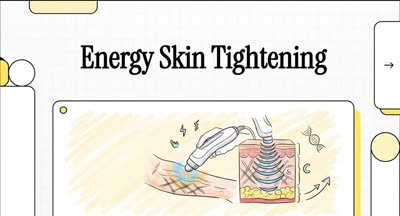
Why retraction is not a mechanical result
Liposuction is a subtraction. It removes fat cells from the layer beneath the skin, and it does not remove skin, so whatever tightening a patient sees after a fat-removal procedure comes from something other than the suction itself. That is the premise of the sixth slide in this deck, and it is the reason the energy-assisted category exists at all: if removing volume tightened the envelope, nothing else would be needed. The same point opens our own guide to heat-based skin tightening: fat removal does not tighten skin, and the technology is sold on the second half of the operation. Most homeowners who read this are comparing body contour services options around Miami, FL, so what follows sticks to the details that change in practice.
The short version
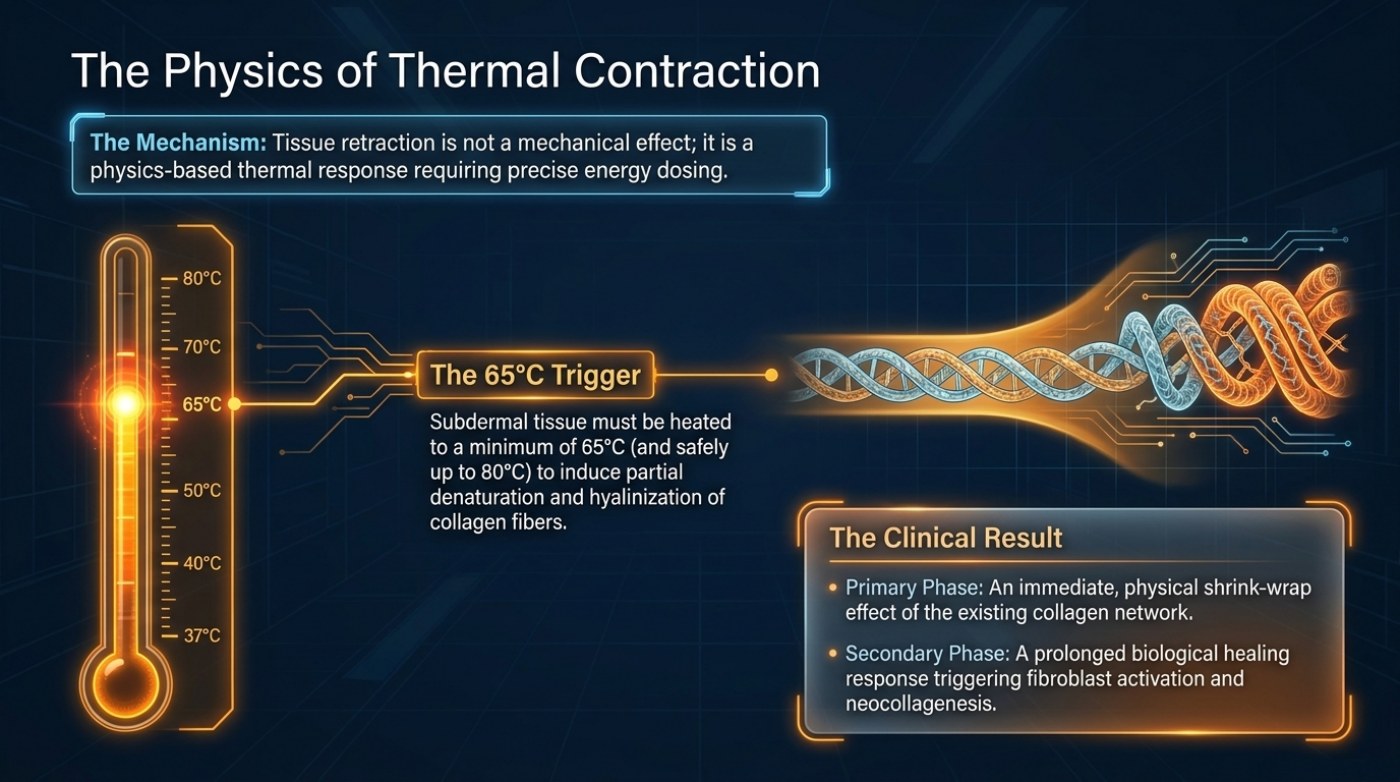
- The slide states tissue retraction is not a mechanical effect but a thermal response requiring precise energy dosing.
- Subdermal tissue must reach at least 65 C, and safely up to 80 C, to induce partial denaturation and hyalinization of collagen.
- The ladder marks 37, 40, 50, 65, 70 and 80 C, framing the working range as a band rather than one number.
- The primary phase is an immediate physical shrink-wrap of existing collagen; the secondary phase is prolonged healing with neocollagenesis.
- The slide gives no percentage of contraction, no measurement protocol and no durability figure for either phase.
The slide states the mechanism in a single sentence: tissue retraction is not a mechanical effect; it is a physics-based thermal response requiring precise energy dosing. Two claims sit inside that sentence, and both matter when a technique is being described to a patient. The first is that the effect is thermal — it is produced by delivered heat energy, not by pulling, scraping or the negative pressure of a cannula. The second is that the thermal dose has to be precise: below a certain point the tissue does not respond, and beyond a certain point the tissue is injured rather than reshaped.
A thermal claim without a stated temperature is not a specification. The slide supplies the temperatures, and the rest of this article is about what those numbers describe and what they deliberately leave open.
The temperature ladder the slide draws
The visual centre of the slide is a thermometer, and its numbered marks are the figures this article has to respect: 37 °C, 40 °C, 50 °C, 65 °C, 70 °C and 80 °C. They are not decorative. 37 °C is body temperature, the reference the whole diagram is measured against. The 40 °C and 50 °C marks sit in a range where tissue is warmed but the structural response the deck describes has not yet been reached. The 65 °C mark is the threshold the slide calls a trigger, and the 70 °C and 80 °C marks sit above it, inside the band the deck treats as the working range.
| Mark on the ladder | What the value is | How the slide treats it |
|---|---|---|
| 37 °C | Nominal body temperature | The baseline the diagram is scaled against |
| 40 °C | Warm tissue | Below the described trigger; the scale gives it a position rather than a role |
| 50 °C | Below the described trigger | Still short of the collagen response the slide describes |
| 65 °C | The stated minimum | Labelled on the slide as the trigger point for the effect |
| 70 °C | Above the trigger | Inside the band the deck treats as usable |
| 80 °C | The stated upper value | Described as the safe ceiling of the same band |
The useful reading of the ladder is that the deck is not describing a single magic number. It is describing a band with a floor and a ceiling, and the two numbers that matter clinically — what has to be reached, and what must not be exceeded — are the ends of that band rather than the middle.
The 65 °C trigger and the stated band
The slide's central callout is explicit. Subdermal tissue, in the deck's wording, must be heated to a minimum of 65 °C — and safely up to 80 °C — to induce partial denaturation and hyalinization of collagen fibres. Every word in that sentence is doing work. Minimum sets the floor. And safely up to 80 °C sets a ceiling, which means the deck is treating 80 °C as the edge of the usable range rather than a target to exceed. Partial denaturation is the qualifier that keeps the description honest: the collagen is not destroyed, its structure is altered. Hyalinization names the tissue change the heating is meant to produce.
Our published guide on this topic describes the same figures as a working band and notes where they come from: the 65 °C subdermal target and the 65–80 °C working range are the numbers the notebook source material behind this deck is built on. They are the temperatures the technique is described by, not an independently re-measured clinical threshold for any individual patient.
What the slide says happens clinically
The lower half of the slide divides the clinical result into two phases, and the division is the most practically useful thing on it. The primary phase is described as an immediate, physical shrink-wrap effect of the existing collagen network — the tissue that is already there contracts. The secondary phase is described as a prolonged biological healing response that triggers fibroblast activation and neocollagenesis — new collagen is laid down afterwards. One phase is chemistry happening on the table; the other is a wound-healing programme running for months.
| Phase | What the slide says happens | What that implies about timing |
|---|---|---|
| Primary | An immediate, physical shrink-wrap effect of the existing collagen network | Occurs during and immediately after the energy delivery itself |
| Secondary | A prolonged biological healing response triggering fibroblast activation and neocollagenesis | Extends well past the procedure, as a healing process rather than a mechanical one |
The two-phase framing explains a complaint that recurs in patient accounts of energy-based tightening: the effect seen in the first days and the effect seen at six months are not the same event, and neither one is a promise. The deck does not publish a percentage of contraction, a measurement protocol or a durability figure for either phase. It describes the mechanism and stops there, which is the correct place for a slide to stop and the correct place for a consultation to take over.
It also explains why the deck pairs thermal physics with monitoring on the following slide. Heat that must reach a subdermal band while sparing the surface is only achievable if the temperature is being measured during delivery, and the deck's next page is entirely about that constraint.
What these numbers do not establish
A precise temperature is not the same thing as a published outcome. The slide gives thresholds and a mechanism; it does not give a study, a sample size, a measurement method or a comparison group, and the article should not pretend otherwise. Where a figure on the deck is not tied to a named study, the honest attribution is to the source material itself.
| Item | Stated on the slide | Not stated on the slide |
|---|---|---|
| Trigger temperature | Minimum 65 °C subdermal | How the temperature is verified in tissue rather than at the device |
| Working band | Safely up to 80 °C | Any dose–response curve linking a given temperature to a given amount of contraction |
| Tissue change | Partial denaturation and hyalinization of collagen fibres | Histological confirmation, biopsy data or a named series |
| Clinical result | A primary immediate phase and a secondary biological phase | Percentage of skin retraction, or how much of it persists over years |
| Source | Presented as the physics the technique is built on | A citation that would let a reader check the figures independently |
The candidacy questions that follow from this are not answered by the slide either. Tissue that has lost elasticity does not reorganise on command, and a thermal response in the subdermal layer cannot compensate for skin that has to be removed rather than contracted. That gap between what the physics can do and what a given patient needs is the part of a consultation that no slide can settle.
Questions the slide raises
Why 65 °C rather than simply as hot as possible?
Because the slide treats the range as a band with two ends, not a threshold to clear. 65 °C is described as the minimum needed to induce the collagen change, and 80 °C is described as the safe upper value. A higher temperature is not described as a stronger version of the same effect; it is described as leaving the band the technique is built on.
Is the shrink-wrap effect immediate?
The slide separates the response into an immediate physical phase and a prolonged biological phase. The immediate phase is the existing collagen network contracting. The biological phase is the healing response that follows, with fibroblast activation and neocollagenesis. A patient is therefore looking at two overlapping timelines, not one, and the second is measured in months rather than days.
Does the deck say how much tightening to expect?
No. There is no percentage, no measurement scale and no durability statement on this slide. Our published guide on the topic reaches the same conclusion from the other direction: no single published threshold exists for the temperature at which collagen contracts, which is why the figures belong to the technique's own source material rather than to a comparative trial.
This is published information, not medical advice — a board-certified surgeon must assess whether a procedure suits you.
Related Guides
Three guides that share this deck's material and go further into it:
- Heat-Based Skin Tightening After Liposuction: What the Numbers Mean — the 65 °C target and 42 °C surface cap, and when excision is the honest answer.
- High-Definition Liposuction: How Muscle Etching Actually Works — what happens when energy platforms are used to shape rather than simply tighten.
- Liposuction Risks and Complication Rates as Published — why complication figures differ so much between published sources.