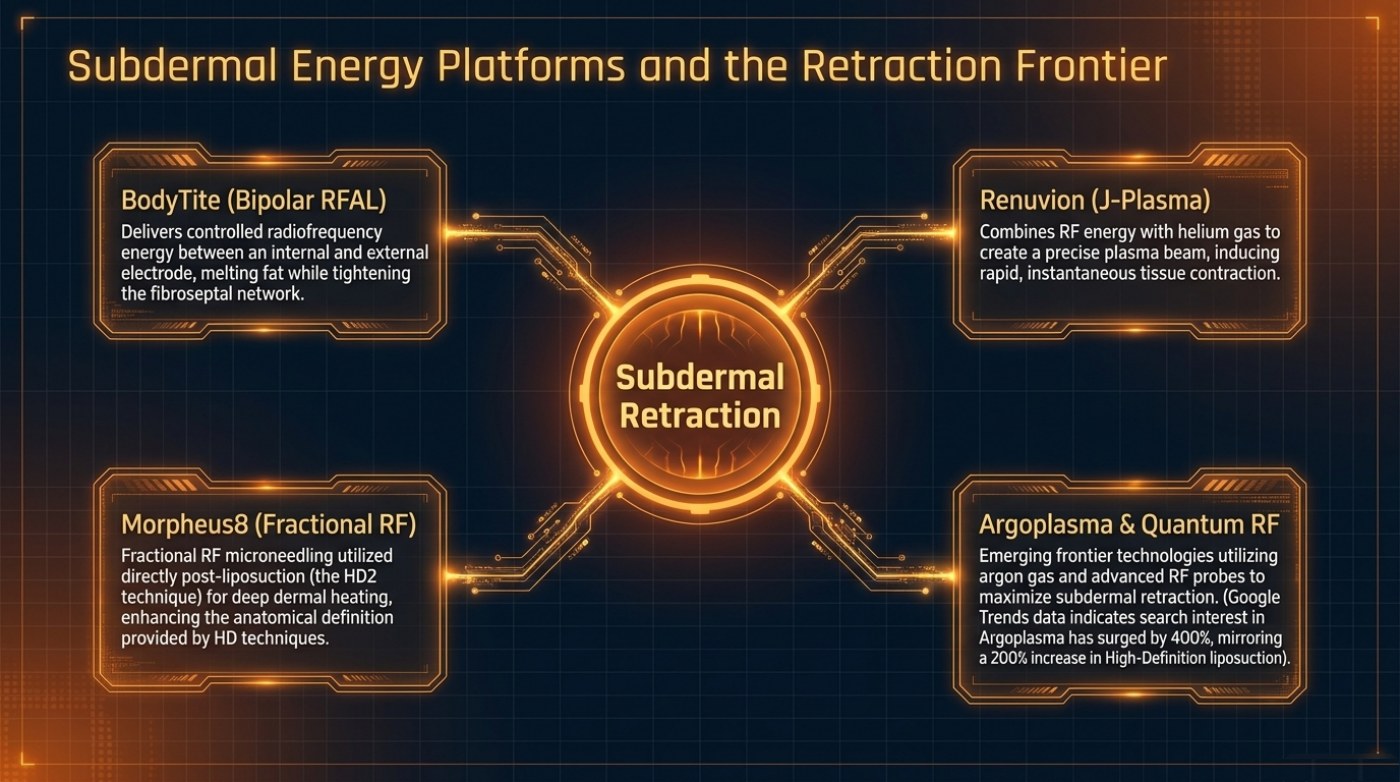
The final phase in the deck The Biophysics of Energy-Assisted Lipolysis and Thermal Tightening is the one that works from beneath the skin rather than on the fat alone. The slide is titled Subdermal Energy Platforms and the Retraction Frontier, and its central hub is a single phrase: subdermal retraction. Around that hub sit four platforms, each combining an energy source with a delivery geometry intended to tighten the fibrous architecture that remains after fat has been removed. If you are here looking into body contour services, the sections below walk through the process from the first quote to the finished job.
The short version
- The slide frames subdermal retraction as a phase that follows fat removal, targeting the fibroseptal network and dermis.
- BodyTite is described as bipolar radiofrequency delivered between an internal and an external electrode, melting fat and tightening the fibroseptal network.
- Renuvion combines radiofrequency with helium gas to create a plasma beam the slide credits with rapid, instantaneous contraction.
- Morpheus8 is fractional radiofrequency microneedling applied directly after liposuction for deep dermal heating, labelled the HD2 technique.
- The slide only quantitative claims are Google Trends changes: a 400% search-interest surge for Argoplasma mirroring 200% for high-definition liposuction.
Why Retraction Is Its Own Problem
Removing fat and tightening skin are different objectives, and the deck keeps them visibly separate. Phases one through three were about extraction and emulsification — getting tissue out. Phase four is about what the envelope does afterwards. The structures named on this slide are the fibroseptal network, the fibrous scaffolding that runs between muscle and skin, and the dermis above it. Both are collagen-based, and both are described here as responding to controlled heat.
The slide's positioning is deliberate. Subdermal retraction is not presented as an alternative to liposuction; it is presented as the frontier that follows it, applied directly to the tissue left behind. Every platform on the slide is described in terms of how it delivers energy below the skin surface, and the differences between them are differences in delivery geometry rather than in objective.
BodyTite: Bipolar Radiofrequency Between Two Electrodes
The first platform named on the slide is BodyTite, described as bipolar RFAL. The mechanism stated is that it delivers controlled radiofrequency energy between an internal and an external electrode, melting fat while tightening the fibroseptal network.
The two-electrode arrangement is the defining feature. Radiofrequency energy flows between the internal electrode, positioned beneath the skin, and the external electrode above it, which concentrates the current in the tissue between the two rather than allowing it to disperse. The deck describes the result as two simultaneous effects: fat is melted, and the fibroseptal network is tightened. Both are treated as products of the same energy flow, which is what distinguishes this platform from the extraction phases.
The word controlled is doing work in the slide's wording. Radiofrequency applied subdermally is a thermal intervention, and the deck has already established, on its opening slide, that safely using these technologies demands strict thermoguidance and rigorous environmental operating room controls. The bipolar geometry is described as the means by which the energy is controlled, and the fibroseptal network is the named target of that control.
Renuvion: Radiofrequency Combined With Helium Plasma
The second platform is Renuvion, identified on the slide as J-Plasma. It combines RF energy with helium gas to create a precise plasma beam, and the deck attributes to it rapid, instantaneous tissue contraction.
Adding helium to radiofrequency changes the character of the energy delivery. The slide describes the output as a plasma beam rather than a current path, and plasma is a distinct state of matter produced when gas is energised. The precision of the beam is the property the deck names first, which places this platform firmly in the targeted end of the subdermal range.
The effect the deck attributes is also the most immediate wording on the slide: rapid and instantaneous contraction. Where the dermal heating described in the photonic phase was framed around shrinking the fibroseptal network and stimulating neocollagenesis for immediate tissue contraction, this platform is described purely in terms of contraction happening at the moment of application. The slide does not describe a longer-term remodelling process for Renuvion, and it does not attribute a percentage to it.
Morpheus8: Fractional Radiofrequency Microneedling After Liposuction
The third platform is Morpheus8, described as fractional RF microneedling. The slide states that it is utilised directly post-liposuction — the HD2 technique — for deep dermal heating, enhancing the anatomical definition provided by HD techniques.
Two things stand out in that description. The first is timing. This platform is placed directly after liposuction rather than as a separate intervention, which is consistent with the slide's overall framing of subdermal work as a phase that follows extraction. The second is modality. Microneedling delivers energy through needles that penetrate to a set depth, and the fractional description means the treatment is applied in a pattern of small zones rather than continuously. The deck describes the target as deep dermal heating.
The stated purpose is definition-oriented rather than volume-oriented. Morpheus8 is described as enhancing the anatomical definition that high-definition techniques provide, which places it in support of the sculpting objective rather than as a tightening procedure applied for its own sake. The coupling between a high-definition extraction approach and a fractional dermal treatment afterwards is the deck's own pairing, summarised in the HD2 label attached to it.
Argoplasma and Quantum RF: The Emerging Frontier
The fourth box groups two further technologies, described as emerging frontier technologies utilising argon gas and advanced RF probes to maximise subdermal retraction. The pairing treats gas-based and probe-based radiofrequency as two expressions of the same frontier rather than as established, separate procedure categories.
The slide attaches a market-interest figure to this box. Google Trends data, it states, indicates that search interest in Argoplasma has surged by 400%, mirroring a 200% increase in high-definition liposuction. These are both trend-search figures rather than clinical or outcome measures, and the source material presents them as such. They read as evidence that interest in subdermal retraction platforms is moving alongside interest in high-definition techniques, which is the connection the deck is drawing by placing the two numbers in the same sentence.
The number sequencing is worth noting precisely. The 400% figure describes the change in search interest for Argoplasma, and the 200% figure describes the change for high-definition liposuction, and the slide says one mirrors the other. Neither is presented as a measure of how well any platform performs. They describe attention, not results.
What the Four Platforms Have in Common
Read as a group, the slide describes four routes to the same objective and four different delivery geometries. An internal and external electrode pair for radiofrequency. A helium plasma beam. A fractional microneedle array applied dermally after extraction. Argon gas and advanced RF probes, described as the frontier. Each is characterised by where the energy starts and how it is constrained, and every one of them targets subdermal tissue rather than the fat being removed.
The slide states no comparative outcome data between the platforms and attaches no percentages to three of the four boxes. That restraint is informative in itself: the deck is describing a landscape of delivery mechanisms, and the only quantitative claims it makes are the two Google Trends figures about search interest. Anyone reading the slide for a ranking of platforms against each other will not find one.
| Platform | Slide label | Stated mechanism | Stated effect |
|---|---|---|---|
| BodyTite | Bipolar RFAL | Controlled radiofrequency energy delivered between an internal and an external electrode | Melting fat while tightening the fibroseptal network |
| Renuvion | J-Plasma | RF energy combined with helium gas to create a precise plasma beam | Rapid, instantaneous tissue contraction |
| Morpheus8 | Fractional RF | Fractional RF microneedling used directly post-liposuction (the HD2 technique) | Deep dermal heating, enhancing the anatomical definition provided by HD techniques |
| Argoplasma & Quantum RF | Emerging frontier | Argon gas and advanced RF probes | Maximising subdermal retraction |
| Platform | Energy source | How it is delivered | Named target tissue |
|---|---|---|---|
| BodyTite | Radiofrequency | Between an internal and an external electrode | Fat and the fibroseptal network |
| Renuvion | Radiofrequency plus helium | Plasma beam | Tissue undergoing immediate contraction |
| Morpheus8 | Fractional radiofrequency | Microneedling, applied post-liposuction | Deep dermis |
| Argoplasma & Quantum RF | Argon gas and advanced RF | RF probes | Subdermal tissue |
| Stated figure | Source the slide names | What it measures | What it does not measure |
|---|---|---|---|
| 400% surge in search interest for Argoplasma | Google Trends | Change in search volume | Clinical performance, safety or outcomes |
| 200% increase in high-definition liposuction | Google Trends | Change in search volume | Numbers of procedures, clinical performance or outcomes |
Frequently Asked Questions
What is subdermal retraction?
The slide uses the phrase as the hub connecting all four platforms and pairs it with phase four's label, subdermal thermal shrink-wrapping. The named targets are the fibroseptal network and the dermis, and the objective is tightening the tissue that remains after fat has been removed rather than removing more fat. Each platform is described as reaching that tissue through a different delivery geometry.
Are the 400% and 200% figures clinical results?
No. Both are attributed to Google Trends and describe changes in search interest. The 400% figure refers to search interest in Argoplasma and the 200% figure to search interest in high-definition liposuction, with the slide stating that one mirrors the other. They are measures of attention, not of outcomes or procedure volumes.
Is Morpheus8 described as a standalone tightening treatment?
The slide places it directly post-liposuction and labels the approach the HD2 technique, describing its role as deep dermal heating that enhances the anatomical definition provided by high-definition techniques. It is presented in the context of a sequence rather than as an independent procedure, and the deck states no outcome figures for it.
Related Reading
- Thermal Skin Tightening: The Biology and Physics of Retraction
- High-Definition Liposuction and Abdominal Etching
- Liposuction vs Non-Surgical Fat Reduction
This is published information, not medical advice — a board-certified surgeon must assess whether a procedure suits you.