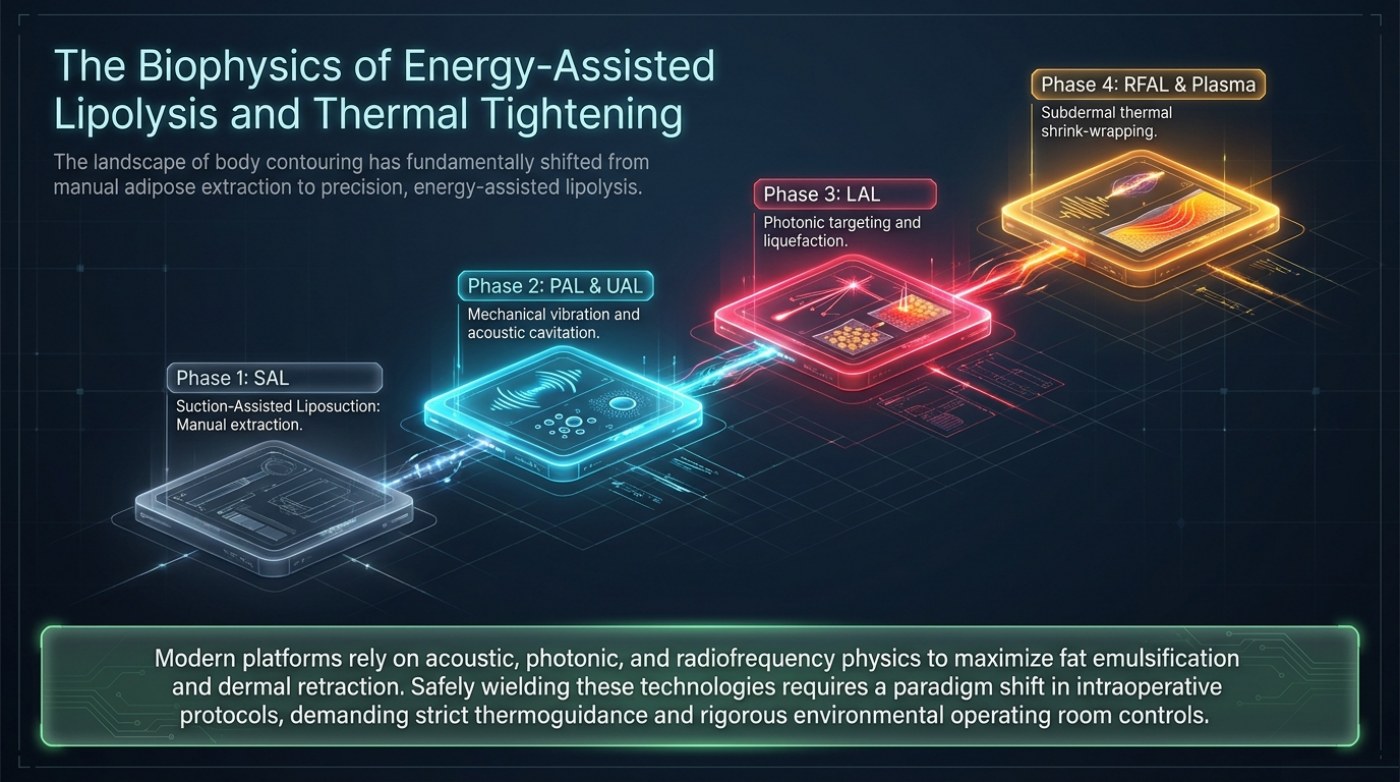
Energy-assisted lipolysis did not arrive as a single invention. The deck The Biophysics of Energy-Assisted Lipolysis and Thermal Tightening presents the field as a four-phase sequence, each phase adding one more physical mechanism to the operating room while the mechanisms that came before it stay in use. Suction-assisted extraction is the foundation. Mechanical oscillation, acoustic cavitation, photonic energy and finally subdermal thermal tightening are layered on top of it. Each layer changes what an operator can control and what has to be watched, which is why the deck describes the transition as a shift in surgical discipline rather than a change in equipment alone. Most homeowners who read this are comparing body contour services options around Miami, FL, so what follows sticks to the details that change in practice.
The short version
- The deck maps energy-assisted lipolysis as four phases that layer onto manual extraction rather than replacing it.
- Suction-assisted liposuction is the baseline phase, with no energy source and every stroke decided by the operator's hand.
- PAL adds mechanical vibration while UAL uses acoustic cavitation to emulsify fat selectively, sparing surrounding architectural structures.
- Laser-assisted lipolysis liquefies adipocytes before extraction, and radiofrequency and plasma platforms deliver subdermal thermal shrink-wrapping.
- The deck states that safely using these technologies demands strict thermoguidance and rigorous operating room environmental controls.
Read as an operating framework, the four phases explain why modern cases are planned around energy physics first and cannula technique second. The slide that opens this deck is a map of that framework, and the sections below take each phase in turn.
Phase 1: SAL and the Logic of Manual Extraction
The deck labels the first phase plainly: suction-assisted liposuction, manual extraction. There is no energy source in this phase at all. A cannula is moved through subcutaneous fat by hand, and a vacuum source draws the loosened tissue out through the same cannula. The physics is mechanical and the operator is the motor. Every stroke is a decision made in the moment, which gives an experienced hand great freedom and makes the result depend heavily on that hand's consistency.
Because the energy budget is essentially zero, the constraints in a SAL case are anatomical rather than thermal. Fat is freed by mechanical shear, the tissue that resists shear is connective structure, and the endpoint is reached by feel and by volume accounting rather than by instrument feedback. The deck's framing puts SAL in the position of the baseline: it defines what the later phases are measured against, and it remains the reference for what "extraction" means when no energy has been introduced to the tissue.
Phase 2: PAL and UAL — Mechanical Vibration and Acoustic Cavitation
The second phase separates into two distinct branches in the deck. Power-assisted liposuction introduces mechanical vibration, while ultrasound-assisted liposuction — the acoustic branch, described in this material under the VASER name — introduces acoustic cavitation. Both are still extraction techniques, but they change how the fat is prepared for extraction, and they do it through two different physical routes.
In the PAL branch, the cannula itself oscillates rapidly. The deck's wording is that this physically dislodges adipocytes with reduced exertion while preserving connective tissue, vessels and nerves. The mechanism is entirely mechanical, and its value proposition is effort: the instrument supplies reciprocating motion that the operator's wrist would otherwise supply, so the same reach is achieved with less manual work per stroke. The clinical application named on the slide is high-volume debulking and efficient widespread extraction.
The acoustic branch works on a different principle. High-frequency acoustic energy induces cavitation — microscopic bubbles that expand and collapse within the tissue. The collapse of those bubbles selectively emulsifies fat while sparing surrounding architectural structures, according to the slide. The clinical application it names is high-definition muscular sculpting and precise anatomical detailing, a far more selective goal than bulk removal. The difference between the two branches is visible in the physics: one moves tissue, the other emulsifies it.
Phase 3: LAL — Photonic Targeting and Liquefaction
The third phase leaves mechanics behind and introduces light. Laser-assisted lipolysis, abbreviated LAL on the slide, is described as photonic targeting and liquefaction. A fibre delivers laser energy into the subcutaneous plane, and the target fat is liquefied before extraction rather than being mechanically detached. The deck's framing places the photonic mechanism as a distinct capability: energy is used to change the physical state of the target tissue, not simply to loosen it.
Liquefaction changes the extraction step that follows it. When fat has been rendered into a more liquid state, the mechanical component of the procedure is working on a different material, and the slide's phase diagram places LAL between the mechanical phases and the thermal-tightening phase. This positioning is deliberate: the wavelength section of the deck makes clear that LAL sits on a spectrum between fat-directed and dermis-directed work, with some wavelengths aimed primarily at fat and others aimed at the fibroseptal network.
Phase 4: RFAL and Plasma — Subdermal Thermal Shrink-Wrapping
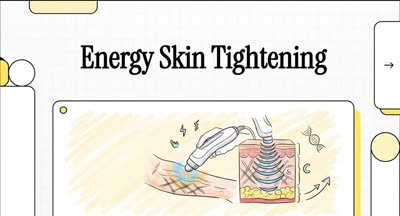
The fourth phase is the one that changes what the procedure is for. Radiofrequency-assisted lipolysis and plasma-based platforms are grouped on the slide under subdermal thermal shrink-wrapping. The targets named are the fibroseptal network and the dermis itself, and the mechanism is heat delivered beneath the skin surface. Where the earlier phases were built around removing or emulsifying fat, phase four is built around retraction of the envelope that remains.
The deck's summary line ties the whole sequence together. Modern platforms, it states, rely on acoustic, photonic and radiofrequency physics to maximise fat emulsification and dermal retraction. Those are two separate objectives served by three separate physics families, and the four-phase map is really a way of showing which family serves which objective. Acoustic energy works on fat. Photonic energy can work on both, depending on wavelength. Radiofrequency energy works on the fibrous architecture, which is why it is the phase associated with tightening.
What the Four-Phase Framework Changes in Practice
The closing panel of the slide is the part that matters most for anyone reading it as a description of how modern procedures are run. Safely using these technologies, the deck states, requires a paradigm shift in intraoperative protocols, demanding strict thermoguidance and rigorous environmental operating room controls. That sentence is doing real work. Once heat, sound and light are all in play, the procedure has stopped being a purely mechanical exercise, and the safety envelope is no longer defined by anatomy alone.
Thermoguidance is the deck's shorthand for the monitoring that thermal and photonic phases require: the operator needs to know what temperature the tissue is reaching, not only where the cannula tip is. Environmental controls point at the same problem from the other direction — the operating room itself becomes a variable once energy delivery is involved. The deck presents both as consequences of the shift from manual extraction to precision, energy-assisted lipolysis, not as optional additions to it.
Seen this way, the four phases are cumulative rather than sequential replacements. A modern platform is rarely one phase; it is a selection from all four, chosen per patient and per anatomical zone.
| Phase | Slide label | Energy or mechanism | Stated objective |
|---|---|---|---|
| 1 | SAL | Suction-assisted liposuction; manual extraction | Removal of fat by suction and hand-guided cannula movement |
| 2 | PAL & UAL | Mechanical vibration and acoustic cavitation | Loosening fat with reduced exertion; selective emulsification |
| 3 | LAL | Photonic targeting | Liquefaction of adipocytes prior to extraction |
| 4 | RFAL & Plasma | Subdermal thermal application | Thermal shrink-wrapping of the fibroseptal network and dermis |
| Physics family | Introduced in phase | Primary effect the deck attributes to it |
|---|---|---|
| Mechanical vacuum and shear | Phase 1 (SAL) | Manual extraction of adipose tissue |
| Mechanical oscillation | Phase 2 (PAL) | Dislodging adipocytes with reduced exertion |
| Acoustic cavitation | Phase 2 (UAL) | Emulsifying fat while sparing surrounding architecture |
| Photonic energy | Phase 3 (LAL) | Liquefaction of fat; wavelength-dependent dermal effect |
| Radiofrequency and plasma | Phase 4 (RFAL, plasma) | Dermal retraction and tightening |
| Objective named in the deck | Physics families it draws on |
|---|---|
| Fat emulsification | Acoustic, photonic, radiofrequency |
| Dermal retraction | Photonic (wavelength dependent), radiofrequency, plasma |
| Intraoperative safety requirement | Strict thermoguidance and rigorous environmental operating room controls |
Frequently Asked Questions
Are the four phases used one at a time, or together?
The deck treats them as cumulative capability rather than a menu of mutually exclusive options. Phase one describes the extraction baseline, and each later phase adds a mechanism — mechanical oscillation, acoustic cavitation, photonic liquefaction, subdermal thermal energy — that a given case may or may not draw on. The framework is a map of what the physics can do, not a required order of events for an individual patient.
Does a later phase replace the need for the earlier ones?
No, and the slide's closing panel is explicit about why. Even with acoustic, photonic and radiofrequency mechanisms in play, the deck states that safely using them requires strict thermoguidance and rigorous environmental operating room controls. The manual extraction baseline and its anatomical constraints do not disappear when energy is added; the monitoring burden grows instead.
Why does the deck separate fat emulsification from dermal retraction?
Because they are different objectives served by different physics families. Emulsification is about changing or breaking down the fat so it can be removed, which is where acoustic, photonic and radiofrequency mechanisms are named. Retraction is about the skin envelope that remains afterwards, which is where thermal energy directed at the fibroseptal network and dermis is named. Keeping the two separate is what makes the phase map useful.
Related Reading
- Thermal Skin Tightening: The Biology and Physics of Retraction
- Liposuction vs Non-Surgical Fat Reduction
- High-Definition Liposuction and Abdominal Etching
This is published information, not medical advice — a board-certified surgeon must assess whether a procedure suits you.