Choosing a wavelength is only half of laser-assisted lipolysis. Once photonic energy is aimed at a given layer, the remaining question is how that energy is delivered over time and where, exactly, it lands. The deck The Biophysics of Energy-Assisted Lipolysis and Thermal Tightening devotes a slide to that question, and the three items it names all concern control rather than physics: pulse modulation, algorithmic planning, and automated or robotic fibre movement. Each is attached to a percentage improvement stated in the source material. Most homeowners who read this are comparing body contour services options around Miami, FL, so what follows sticks to the details that change in practice.
The short version
- Once wavelength sets the target layer, the deck treats pulse timing, planning and fibre movement as the remaining controls.
- Pulse modulation with precise thermal dosing is stated as up to a 25% increase in fat reduction against continuous-wave lasers.
- AI-guided planning tailors laser parameters to patient anatomy and is linked to approximately 20% better patient satisfaction scores.
- Automated and robotic-assisted fibre movement is described as achieving up to 15% more uniform fat removal across the treated area.
- The article warns the 25%, 20% and 15% figures should not be added together because they measure different things.
Why Delivery Parameters Matter Once the Target Is Set
The previous slide in this sequence established that wavelength determines whether the energy acts mainly on fat or on the dermis. This slide assumes that choice has been made and moves to the variables that remain. In a continuous-wave delivery, energy is applied steadily for as long as the operator holds the fibre in place. In a modulated delivery, energy is turned on and off in a pattern, and the pattern itself becomes a clinical variable.
That is why the deck frames the three items as a progression from dosing to planning to execution. Pulse modulation governs the shape of energy delivery in time. Algorithmic analysis governs where that delivery should be aimed for a given patient. Automated movement governs how faithfully the plan is carried out during the procedure. Read together, they describe a shift from an operator-controlled energy budget to a planned one.
Pulse Modulation: Precise Thermal Dosing
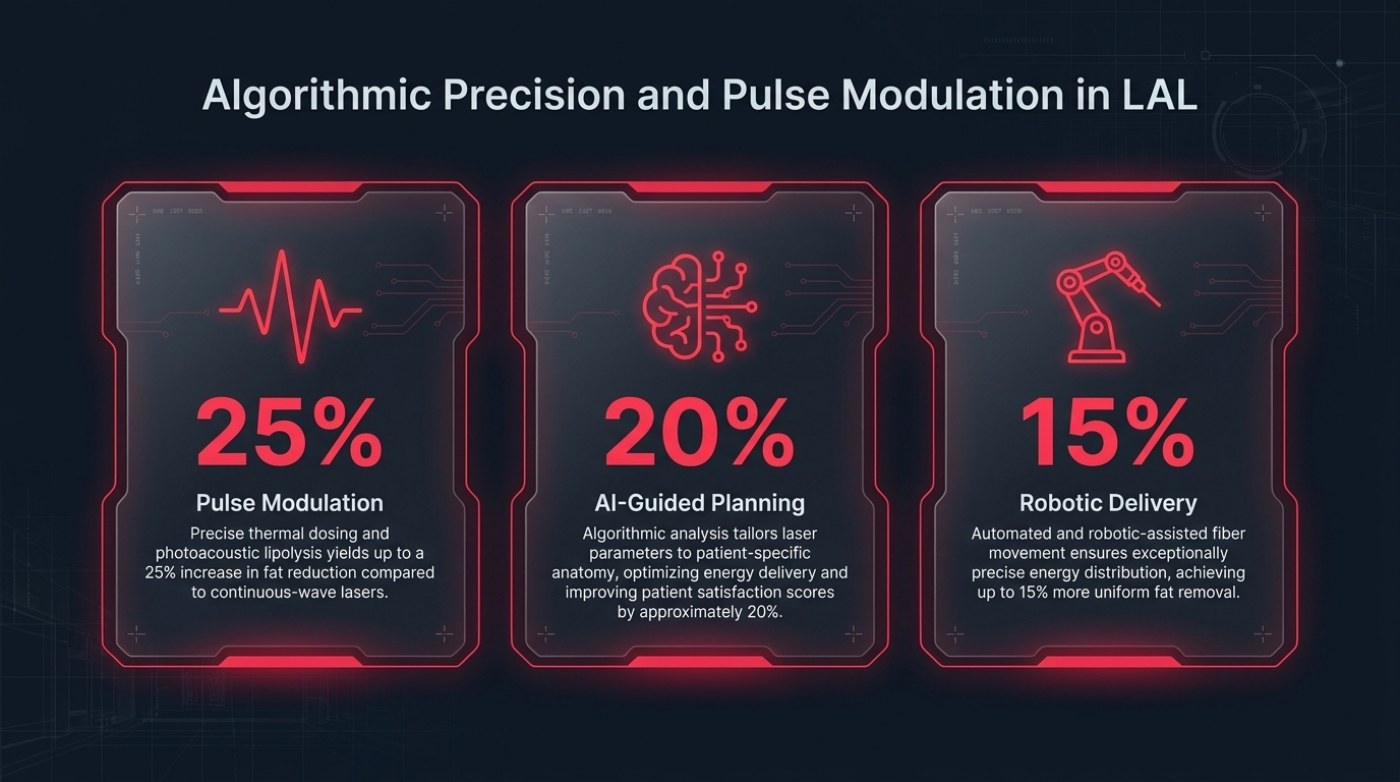
The first panel on the slide is labelled Pulse Modulation and carries the largest figure on the slide, 25%. The description states that precise thermal dosing and photoacoustic lipolysis yields up to a 25% increase in fat reduction compared to continuous-wave lasers.
The comparison is specific and worth reading carefully. The baseline is not another technology or another procedure; it is the same photonic approach delivered continuously. That makes the claim a statement about delivery pattern rather than about the energy source itself. Pulse modulation is presented as a way of improving what the laser achieves without changing what kind of laser it is.
The phrase precise thermal dosing explains the mechanism the deck implies without spelling out. Interrupting energy delivery allows the tissue to respond between pulses rather than accumulating heat continuously, which is what makes dosing precise instead of cumulative. The slide states the result as an upper bound — up to 25% — and the source material does not name a study behind the figure, so it is best treated as the deck's stated comparison against continuous-wave delivery.
AI-Guided Planning: Tailoring Parameters to Anatomy
The second panel, labelled AI-Guided Planning, introduces a 20% figure but attaches it to a different kind of measure. Algorithmic analysis, the slide states, tailors laser parameters to patient-specific anatomy, optimising energy delivery and improving patient satisfaction scores by approximately 20%.
Notice what the percentage describes. It is not a fat-reduction figure; it is a satisfaction figure, and the deck marks it as approximate rather than exact. The claim being made is therefore about the match between a planned energy distribution and an individual patient's anatomy, measured in how satisfied patients report being, rather than about how much tissue was removed.
This panel is the point where energy-assisted lipolysis stops being a purely physical exercise. Tailoring parameters to anatomy means the plan is patient-specific, which in turn means the planning step has to happen before delivery rather than being adjusted entirely in the moment. The deck presents algorithmic analysis as the tool that makes that planning tractable, and the ordering of the three panels places it between dosing and physical execution for exactly that reason.
Robotic Delivery: Uniform Energy Distribution
The third panel, Robotic Delivery, states that automated and robotic-assisted fibre movement ensures exceptionally precise energy distribution, achieving up to 15% more uniform fat removal. The figure here is about uniformity rather than total volume — the deck is describing evenness of removal across a treated area, not a larger amount removed.
Uniformity is a different problem from dose. A modulated pulse pattern can deliver a precisely timed dose and still distribute it unevenly if the fibre passes over some regions more slowly than others. Automated movement addresses that by taking the pattern of travel out of the operator's hands. The slide's wording, exceptionally precise energy distribution, is the result the deck attributes to that automation.
It is worth noting how the slide orders the three claims. Modulation produces a larger reduction relative to continuous-wave delivery, planning produces a satisfaction improvement, and robotic movement produces greater uniformity. Three different measures, three different percentages, and none of them presented as a substitute for the others. The deck treats them as three separate contributions to control.
What the Three Panels Add Up To
Taken as a group, the slide describes a control stack. Wavelength selection from the previous slide sets the target layer. Pulse modulation sets the timing of delivery. Algorithmic planning sets the geometry. Robotic or automated movement sets the consistency with which the geometry is followed. Each layer constrains the one below it, and each contributes a figure the deck states as an improvement over the unmodulated, unaided alternative.
The material does not present these improvements as additive, and no combined figure appears on the slide. That is a meaningful omission. A reader should not add 25%, 20% and 15% together; they describe different measures taken against different baselines, and the deck reports each one on its own terms.
| Panel | Stated mechanism | Measure improved | Stated magnitude |
|---|---|---|---|
| Pulse Modulation | Precise thermal dosing and photoacoustic lipolysis | Fat reduction, compared to continuous-wave lasers | Up to 25% increase |
| AI-Guided Planning | Algorithmic analysis tailoring laser parameters to patient-specific anatomy | Energy delivery optimisation and patient satisfaction scores | Approximately 20% improvement |
| Robotic Delivery | Automated and robotic-assisted fibre movement | Uniformity of fat removal | Up to 15% more uniform |
| Figure | Baseline it is measured against | Type of measure |
|---|---|---|
| Up to 25% increase in fat reduction | Continuous-wave lasers | Volume of fat reduction |
| Approximately 20% improvement | Not stated on the slide; presented as an improvement attributable to algorithmic planning | Patient satisfaction score |
| Up to 15% more uniform fat removal | Not stated on the slide as a named comparator | Uniformity of removal across the treated area |
| Stage of the procedure | Control named in the deck | Variable it governs |
|---|---|---|
| Target selection | Wavelength choice (previous slide) | Which layer absorbs the energy |
| Dosing | Pulse modulation | Timing of energy delivery; thermal dosing precision |
| Planning | AI-guided planning | Distribution of parameters across patient-specific anatomy |
| Execution | Robotic delivery | Consistency of fibre movement and uniformity of effect |
Frequently Asked Questions
Can the 25%, 20% and 15% figures be combined?
The slide does not present them as additive, and it states no combined figure. The 25% is an increase in fat reduction compared to continuous-wave lasers, the 20% is an approximate improvement in patient satisfaction scores attributed to algorithmic planning, and the 15% concerns how uniform fat removal is. They are measured against different baselines and should be read separately.
Does the deck cite a source for these figures?
The slide does not name a study behind any of the three percentages. It attributes the improvements to pulse modulation, algorithmic analysis and automated fibre movement respectively, and states the magnitudes as approximate or as upper bounds. They are reported here as the source material's own stated figures.
What is the difference between AI-guided planning and robotic delivery?
The slide separates planning from execution. Algorithmic analysis tailors laser parameters to patient-specific anatomy before delivery, which is a planning function. Automated and robotic-assisted fibre movement is described as ensuring precise energy distribution during the procedure, which is an execution function. The deck presents them as two distinct contributions to control rather than as one system.
Related Reading
- AI and Robotics in Body Contouring
- High-Definition Liposuction and Abdominal Etching
- How Much Fat Can Be Removed in One Liposuction Session
This is published information, not medical advice — a board-certified surgeon must assess whether a procedure suits you.