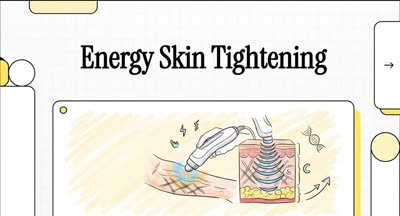
Laser-assisted lipolysis is the phase of energy-assisted body contouring that trades mechanics for light. Where suction-assisted extraction pulls fat loose and power-assisted instruments vibrate it free, laser-assisted lipolysis delivers photonic energy into the subcutaneous plane and changes the tissue before anything is removed. The deck The Biophysics of Energy-Assisted Lipolysis and Thermal Tightening devotes a dedicated slide to the wavelengths involved, and the reason is straightforward: in this phase the wavelength determines what the energy does. If you are here looking into body contour services, the sections below walk through the process from the first quote to the finished job.
The short version
- In laser-assisted lipolysis the chosen wavelength determines what the energy does, making it a family of techniques.
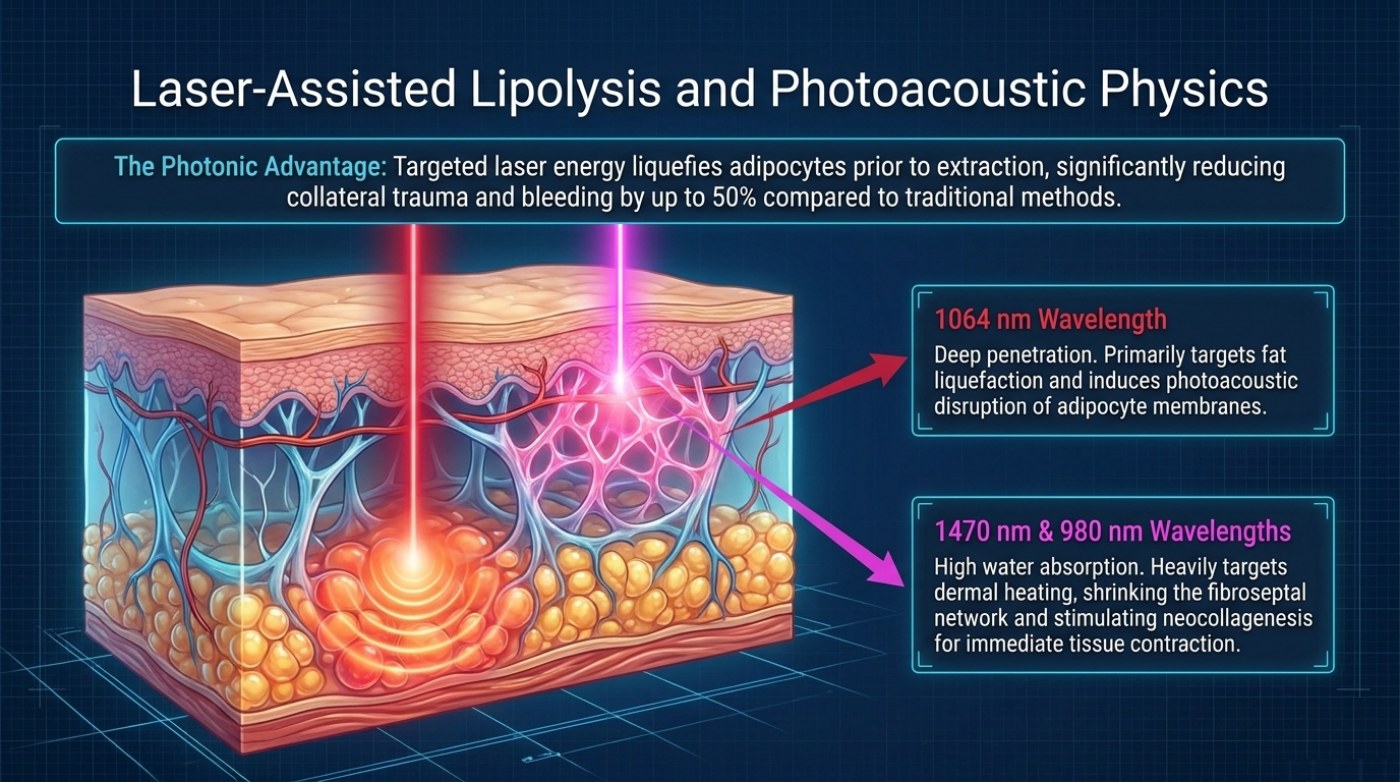
- The slide states that targeted laser energy liquefies adipocytes before extraction, cutting collateral trauma and bleeding by up to 50%.
- The 1064 nm wavelength is described as deeply penetrating, targeting fat liquefaction and photoacoustic disruption of adipocyte membranes.
- The 1470 nm and 980 nm wavelengths absorb water strongly, heating the dermis, shrinking the fibroseptal network and stimulating neocollagenesis.
- The article notes the 50% figure carries no named study and is presented as an upper bound rather than a typical result.
The Photonic Advantage: Liquefaction Before Extraction
The slide opens with a claim it labels as the photonic advantage. Targeted laser energy, it states, liquefies adipocytes prior to extraction, significantly reducing collateral trauma and bleeding by up to 50% compared to traditional methods. Two separate propositions sit inside that sentence. The first is physical: fat is converted into a more liquid state as a preparatory step rather than being detached by mechanical force. The second is a comparison against traditional methods, expressed as an upper bound — up to 50% — rather than a fixed figure.
The distinction between a preparatory step and an extraction step is worth dwelling on. In a purely mechanical procedure, the same instrument does both jobs: it disrupts and it removes. The laser phase separates them. Energy is applied first, the target tissue changes state, and extraction works on different material than it otherwise would have. That is why the deck presents the photonic mechanism as an advantage rather than simply an alternative, and it is also why the comparison is framed in terms of trauma and bleeding rather than volume.
The source material states the 50% figure without naming a study behind it, and it presents the number as a ceiling rather than an average. It should be read as an upper bound on the reduction in collateral trauma and bleeding that the deck attributes to the technique, relative to traditional methods, rather than as a typical or promised result for any individual procedure.
Wavelength as the Control Variable
The slide's central argument is that laser-assisted lipolysis is not one technique but a family of techniques sharing a delivery method and differing by wavelength. It names two wavelength groupings, and the descriptions attached to them point in different directions. One grouping is presented as fat-directed, the other as dermis-directed, and the deck treats that split as the core of photonic planning.
This is the point in the phase sequence where the concept of targeting becomes literal. Earlier phases in the deck's framework use energy to work on tissue generally: mechanical oscillation and cavitation act on what is in front of them. Photonic energy has a selectivity that is set before the procedure begins, because the wavelength chosen determines how the energy is absorbed and therefore what it heats or disrupts. The two boxes on the slide are a compact statement of that principle.
The 1064 nm Wavelength: Deep Penetration and Fat Liquefaction
The slide describes the 1064 nm wavelength in two parts. The first is deep penetration. The second is its primary target: fat liquefaction, combined with photoacoustic disruption of adipocyte membranes. This is the fat-directed end of the photonic spectrum as the deck presents it.
Photoacoustic disruption is a distinct mechanism from simple heating. The energy is delivered in a way that produces a mechanical effect at the level of the adipocyte membrane, in addition to whatever thermal effect accompanies it. The deck's phrasing places both effects on the same wavelength: liquefaction and membrane disruption working together, which is why the 1064 nm box is associated with making fat easier to remove rather than with tightening the skin above it.
The deep-penetration wording is the deck's shorthand for reach. A wavelength described as deeply penetrating is one whose effect extends further from the delivery point, which matters when the target is the fat layer rather than the dermis. The slide pairs that reach with a fat-specific target, and the pairing is the argument: depth without selectivity would simply heat more tissue indiscriminately.
The 1470 nm and 980 nm Wavelengths: Dermal Heating and the Fibroseptal Network
The second grouping on the slide is described through a different physical property. The 1470 nm and 980 nm wavelengths are characterised by high water absorption. Their target is heavily dermal heating, and the stated consequences are shrinking of the fibroseptal network and stimulation of neocollagenesis for immediate tissue contraction.
High water absorption explains why this grouping behaves differently from the 1064 nm wavelength. Water absorbs these wavelengths readily, so the energy is deposited closer to where it is delivered rather than reaching deep into the fat layer. The deck's description follows directly: the effect lands on the dermis rather than on adipocytes, and the structures named — the fibroseptal network and collagen — are the ones associated with skin tone rather than with fat volume.
The phrase immediate tissue contraction is doing specific work. Shrinking the fibroseptal network is a mechanical effect on the fibrous scaffolding that holds fat in place, and the deck presents it as happening during energy delivery rather than months afterwards. Neocollagenesis, the stimulation of new collagen, is described as accompanying it. This is the photonic version of the retraction objective that the deck's fourth phase pursues through radiofrequency and plasma, achieved here by choosing a wavelength the dermis absorbs strongly.
How the Two Groupings Fit Together
The practical shape of the slide is a division of labour. One wavelength grouping is aimed at the fat and described in terms of deep penetration and liquefaction. The other is aimed at the dermis and described in terms of water absorption, septal shrinkage and collagen stimulation. Laser-assisted lipolysis, on this account, is not a single intervention but a choice of which layer the energy is intended to act on.
That framing also explains why the deck goes on to discuss pulse modulation and algorithmic planning in the following slide. Once wavelength has been selected, the remaining variables are how the energy is delivered over time and where it is directed. Wavelength sets the target; the delivery parameters determine the dose and distribution. The two slides are a sequence, and this one establishes the target before the next establishes the modulation.
| Wavelength | Named property | Stated target | Stated effect |
|---|---|---|---|
| 1064 nm | Deep penetration | Fat | Liquefaction and photoacoustic disruption of adipocyte membranes |
| 1470 nm & 980 nm | High water absorption | Dermis | Dermal heating, shrinkage of the fibroseptal network, neocollagenesis, immediate tissue contraction |
| Element | What the deck states |
|---|---|
| Preparatory action | Targeted laser energy liquefies adipocytes prior to extraction |
| Comparison | Compared to traditional methods |
| Effect attributed | Significant reduction in collateral trauma and bleeding |
| Stated magnitude | Up to 50% |
| Stated basis | No study named on the slide; presented as an upper bound |
| Layer the energy is intended for | Wavelength grouping | Physical property relied on |
|---|---|---|
| Subcutaneous fat | 1064 nm | Penetration depth with photoacoustic membrane disruption |
| Dermis and fibroseptal network | 1470 nm and 980 nm | Water absorption concentrating energy in the dermal layer |
Frequently Asked Questions
What does the 50% figure in the deck refer to?
The slide states that targeted laser energy liquefies adipocytes prior to extraction, significantly reducing collateral trauma and bleeding by up to 50% compared to traditional methods. It is presented as an upper bound and no source study is named on the slide. The figure describes the deck's stated comparison against traditional methods, not a promised result.
Why do 1470 nm and 980 nm appear together?
Because the slide groups them by a shared physical property rather than by individual behaviour. Both are characterised by high water absorption, and both are described as targeting dermal heating, shrinkage of the fibroseptal network and stimulation of neocollagenesis for immediate tissue contraction. The 1064 nm wavelength is described separately because its stated property and target are different.
Does photoacoustic disruption mean the fat is heated?
The slide describes the 1064 nm wavelength as producing liquefaction and photoacoustic disruption of adipocyte membranes, and it describes the 1470 nm and 980 nm wavelengths as producing dermal heating. The material presents photoacoustic disruption as its own mechanism alongside the thermal descriptions rather than folding the two into one, so the deck's wording is best read as naming both effects distinctly.
Related Reading
- Thermal Skin Tightening: The Biology and Physics of Retraction
- Liposuction vs Non-Surgical Fat Reduction
- High-Definition Liposuction and Abdominal Etching
This is published information, not medical advice — a board-certified surgeon must assess whether a procedure suits you.