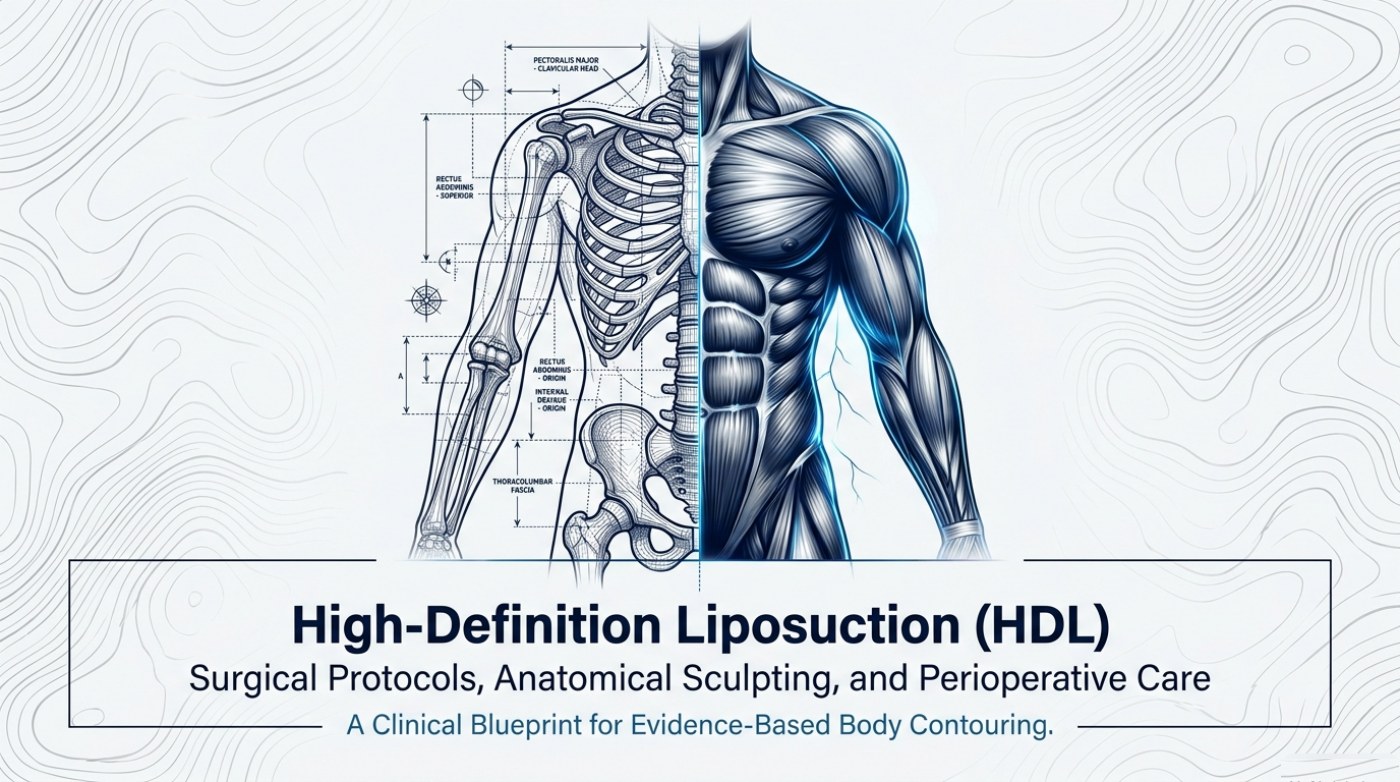
High-definition liposuction is usually introduced as fat removal with a better name. The slide deck this page explains opens with a different claim: that high-definition liposuction (HDL) is a surgical discipline with its own protocols, its own anatomical logic and its own perioperative rules — and that the difference between a defined result and an uneven one sits in the parts of the operation most patients never hear named. The cover carries three phrases beneath the title: "Surgical Protocols, Anatomical Sculpting, and Perioperative Care." Under those sits a single framing line: "A Clinical Blueprint for Evidence-Based Body Contouring." If you are here looking into facial liposuction, the sections below walk through the process from the first quote to the finished job.
The short version
- The clinical blueprint frames high-definition liposuction as three pillars: surgical protocols, anatomical sculpting and perioperative care.
- Complication rates are documented rather than anecdotal: 2.62% pooled in a 39-study analysis and 1.16% in a 69,424-patient registry analysis.
- The cover's anatomical callouts name structures such as pectoralis major, rectus abdominis and the thoracolumbar fascia rather than fat.
- The blueprint does not promise muscle, because definition is a subtraction from anatomy the patient already has.
- Whole-trunk definition cases sit near the volume line where complication rates step up, so staging is the published answer.
The word blueprint is the thesis. A blueprint is a specific kind of document: it assumes a structure that can be described in advance, measured during the work, and checked once the work is finished. Apply that standard to body contouring and the result stops being a product of how hard fat was suctioned and becomes a product of how deliberately each layer was treated, how the fluid environment around the tissue was managed, and how the healing period was controlled. Everything on this page comes from that slide, the deck it belongs to, or the published guides already carried on this site. None of it describes an individual case, and none of it predicts an individual result.
What the blueprint actually claims
The cover makes three claims at once, and they are worth separating because each one carries a different promise. A protocol claim says there is a repeatable sequence — the same steps, in the same order, for the same anatomical problem. An anatomical claim says the plan is written on named structures rather than on general areas such as "the abdomen" or "the flanks". A perioperative claim says the result is finished outside the operating room, during the weeks in which skin has to settle onto the surface the surgeon left behind.
Those three claims fail independently, which is why the deck treats them as one blueprint. A surgeon can follow a careful operative sequence and still produce a soft result if the drainage and compression phases are treated as an afterthought. A well-planned contour can be undone by an instrument passed one layer too close to skin that cannot contract. And a technically neat case on a patient who expected muscle they do not have will still end in disappointment. The blueprint framing exists to hold all three questions open at the same time rather than answering one and hoping the others follow.
| Pillar, as the cover names it | What it covers | The question it puts to any provider |
|---|---|---|
| Surgical protocols | A defined sequence for the operation, agreed before the case rather than improvised during it | Is there a repeatable method here, and can it be described back to me? |
| Anatomical sculpting | Layer-by-layer planning against named muscle and fascial structures | Which layer is being changed in each area, and what is being left alone? |
| Perioperative care | Fluid management, drainage, compression and the follow-up schedule | What happens to the result after I leave the operating room? |
What the cover's anatomical study is actually showing
The illustration on the cover is split down the middle, and the split is the argument. On the left is an anatomical study: line work, callout labels and leader lines pointing at connective tissue and muscle attachments. On the right is a muscular torso, rendered to show the surface that the same anatomy creates. Read together, the two halves make the point the title only implies. The left side is the map. The right side is the destination.
The callouts on the left half name structures a sculpting plan has to respect. Pectoralis major, clavicular head. Rectus abdominis, superior. Rectus abdominis, origin. Internal oblique, origin. Thoracolumbar fascia. None of those labels sits on fat. That is deliberate: fat is not the object being designed, it is the material being removed so that the structures underneath can read through the surface. A plan that does not know where a muscle boundary sits cannot trace a groove along that boundary, and a plan that ignores the fascial planes cannot predict how the surface will settle once the padding above them is gone.
| Callout on the cover | Structure | Why a sculpting plan names it |
|---|---|---|
| Pectoralis major, clavicular head | Chest muscle, upper border | Its boundary is one of the lines a contour plan traces |
| Rectus abdominis, superior | Upper abdominal muscle, above the navel | Its segments create the horizontal divisions of an etched abdomen |
| Rectus abdominis, origin | Lower attachment of the abdominal muscle | Locates where the muscle body ends and the lower abdomen begins |
| Internal oblique, origin | Lateral abdominal wall muscle | Defines the diagonal transition at the flank |
| Thoracolumbar fascia | Deep connective tissue of the lower back | Sets the posterior edge of the field being shaped |
Why "evidence-based" earns its place in the subtitle
The word evidence is the most contestable thing on the slide, so it is worth testing rather than accepting. The deck calls its blueprint evidence-based rather than advanced, and the published literature already summarised on this site supports that framing in three specific ways. First, the complication profile of liposuction is documented rather than anecdotal. Pooled analyses put overall complication rates at 2.62% in one 39-study meta-analysis and about 12% in a 60-study analysis, while a national cosmetic-registry analysis of 69,424 patients reports 1.16% for liposuction performed alone. The spread is real and it comes from how each study defines a complication, but the point for a blueprint is that the risks are measurable at all.
Second, the strongest single lever on risk is volume, and that lever has been quantified. Published safety analysis found the overall complication rate rising from 1.1% to 3.7% above the five-litre aspirate line, with seroma the most common complication driving that step. Third, technique changes what the body loses besides fat. In a prospective study of 56 patients who received equal volumes of traditional and laser-assisted liposuction at two contralateral sites, blood loss fell by more than 50% on the laser-treated side. A claim that rests on numbers like those is a different kind of claim from a claim that rests on a device brochure, and it is also the reason the deck treats safety benchmarks as one of the three things a surgeon has to master.
| Claim the subtitle implies | Published anchor already carried on this site | Where it comes from |
|---|---|---|
| Complications are measurable | 2.62% overall in a 39-study analysis of 29,368 patients; about 12% in a 60-study analysis; 1.16% in a 69,424-patient registry analysis of liposuction performed alone | The site's published risk guide |
| Volume is the dominant lever | Overall complication rate rises from 1.1% to 3.7% above the five-litre aspirate line, with seroma the main driver | The site's published risk guide |
| Technique changes blood loss | More than 50% reduction in blood loss across 56 patients treated with traditional versus laser-assisted liposuction at two contralateral sites | The site's published risk guide |
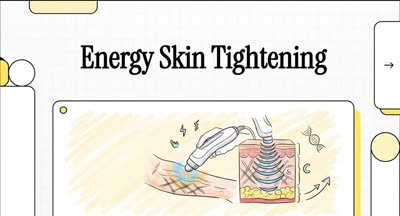
| Skin is a separate variable from fat | Contraction is described against a 65 °C subdermal target with a 42 °C surface cap, monitored continuously | The site's heat-based skin tightening guide |
What the blueprint does not promise
It does not promise muscle. Definition is a subtraction, and the torso on the right half of the cover has to already exist in some form for a sculpting plan to reveal it. A patient at a low body-mass index with a training history gets a different result from the identical operation than a patient hoping surgery will substitute for training. That difference is anatomy, not effort, and no protocol change removes it.
It does not promise a single session either. Whole-trunk definition cases sit close to the volume line at which published complication rates step up, and staging is the published answer to that arithmetic rather than a bigger single case. It does not promise that a technique name on a quotation means the protocol behind the name was followed. And it does not promise that skin will follow the fat. Where elasticity is poor, the published guidance points toward excision instead of contouring, because removing fat does not remove skin — a limitation stated plainly in the sources this site already cites.
Frequently asked questions
Is high-definition liposuction a distinct operation, or a label for aggressive suction?
The cover frames it as a defined technique: a protocol, an anatomical layer plan, and a perioperative schedule. The label is used loosely in advertising, so the practical test is whether a provider can describe the layer-by-layer plan, the volume limit and the recovery routine without being prompted. If those three answers do not exist, what is on offer is traditional liposuction under a different heading.
What does "anatomical sculpting" mean without the jargon?
It means the operation is planned against named structures — muscle bodies, their borders, and the connective-tissue planes between them — rather than against broad regions. Fat is removed from chosen depths so the transitions between muscle groups become visible at the surface. The callout labels on the cover are that plan, drawn on the anatomy before anything is removed.
Does the blueprint say anything about who it suits?
Only indirectly, and the deck leaves the judgement where it belongs — with an examining surgeon. What the material does establish is the shape of the trade-off: localised fat with reasonable skin quality is the setting the technique is built around, while large volumes, poor elasticity or a large amount of loose skin are the settings that published guidance associates with different operations. Suitability is an assessment, not a self-test.
Related reading
- High-Definition Liposuction: How Muscle Etching Actually Works
- Heat-Based Skin Tightening After Liposuction: What the Numbers Mean
- Verifying Surgeon Credentials and Facility Accreditation
This is published information, not medical advice — a board-certified surgeon must assess whether a procedure suits you.