GLP-1 medication and liposuction solve two different halves of the same problem, and that is why the consultation conversation has changed. The medication shrinks fat cells across the whole body; it does not remove them, and it does not choose where the shrinkage lands. What most patients arrive with after reaching their goal weight is a smaller body with the same stubborn areas — under the chin, the abdomen, the arms and the thighs — plus deflation in places they would rather have kept volume, such as the face and breasts. Surgical contouring exists to fix that second half, and it is the reason ASPS's 2025 report noted a rise in consultations related to GLP-1 weight loss inside an overall 7% increase in cosmetic surgical volume. The shift this has produced is toward what the notebook material calls preservation aesthetics: restoring natural anatomy rather than chasing an over-operated look. If you have been weighing up body contour services for a home around Miami, FL, this guide covers how it actually works, what it tends to cost, and where the results usually fall short.
The short version
- GLP-1 medication shrinks fat cells across the body but leaves their number roughly unchanged and does not choose where.
- The ASPS 2025 report recorded a rise in GLP-1 related consultations inside an overall 7% increase in cosmetic surgical volume.
- An ASPS-reported panniculectomy study found 21.7% of patients on a GLP-1, with overall surgical risk unchanged but subtle wound-healing effects.
- Energy devices cannot remove skin, and published guidance states that where there is additional skin, excision may be required.
- The 2025 ASPS report recorded 22% growth in body-lift procedures and 39% growth in facial fat grafting.
- ASPS puts the average liposuction surgeon fee at $4,711, excluding anaesthesia, the operating room and related expenses.
Why the mirror lags the scale
Weight-loss medication reduces the size of fat cells but leaves their number roughly unchanged, so the anatomy that stored fat in specific places is still there. Lose 20 kg on medication and the abdomen that stored fat disproportionally still does. What changes is the ratio: the pockets that were merely prominent when you were heavier become the definition of your silhouette when everything else deflates. Meanwhile the areas that depend on fat for shape — the mid-face, the breasts — lose volume they were using structurally. The published data on surgery in this population is reassuring on the big risks and specific on the small ones. In an ASPS-reported study of panniculectomy patients, 21.7% were taking a GLP-1 medication before surgery, a share that has climbed sharply, and the researchers found the drugs may have subtle effects on wound healing even though they did not increase overall surgical risk. That is a wound-care and timing conversation, not a reason to avoid surgery — but it belongs in the consent discussion.
| Variable | GLP-1 medication | Liposuction | Excision (lift or tuck) |
|---|---|---|---|
| Effect on fat cells | Shrinks them globally; number unchanged | Removes cells from specific areas | Removes fat with the skin |
| Choice of site | None — loss is systemic | Per area, chosen in planning | Per region, chosen in planning |
| Effect on loose skin | Usually worsens it | Modest, unless energy-assisted | Removes it |
| Facial and breast volume | Often depleted | Restored by fat transfer, not by liposuction | Not addressed |
| Duration | Requires ongoing use | Removed cells do not return, but remaining fat can expand | Permanent for the skin removed |
| Preventing post-weight-loss sagging | Worsens laxity as volume falls | Subdermal energy — Renuvion J-Plasma, BodyTite or the AYON system — contracts the tissue layer as fat is removed | Removes the redundant skin rather than contracting it |
The pattern of loss, area by area
Contouring plans follow the anatomy of the loss rather than the number on the scale. Residual fat under the chin and in the neck usually responds to targeted liposuction with or without energy tightening. The abdomen is the contested area: if the extra tissue is fat, liposuction; if it is skin, excision; if it is both, a staged plan or a tuck with contouring. Arms and thighs behave like the abdomen at a smaller scale, and they are the areas where a circumferential approach becomes relevant — ASPS's 2025 report recorded a 22% increase in body-lift procedures and 29% growth in brow lifts, which is the same demographic story told from the operating-room side: the volume-restoration era, with 39% growth in facial fat grafting as the single largest gain of any tracked procedure.
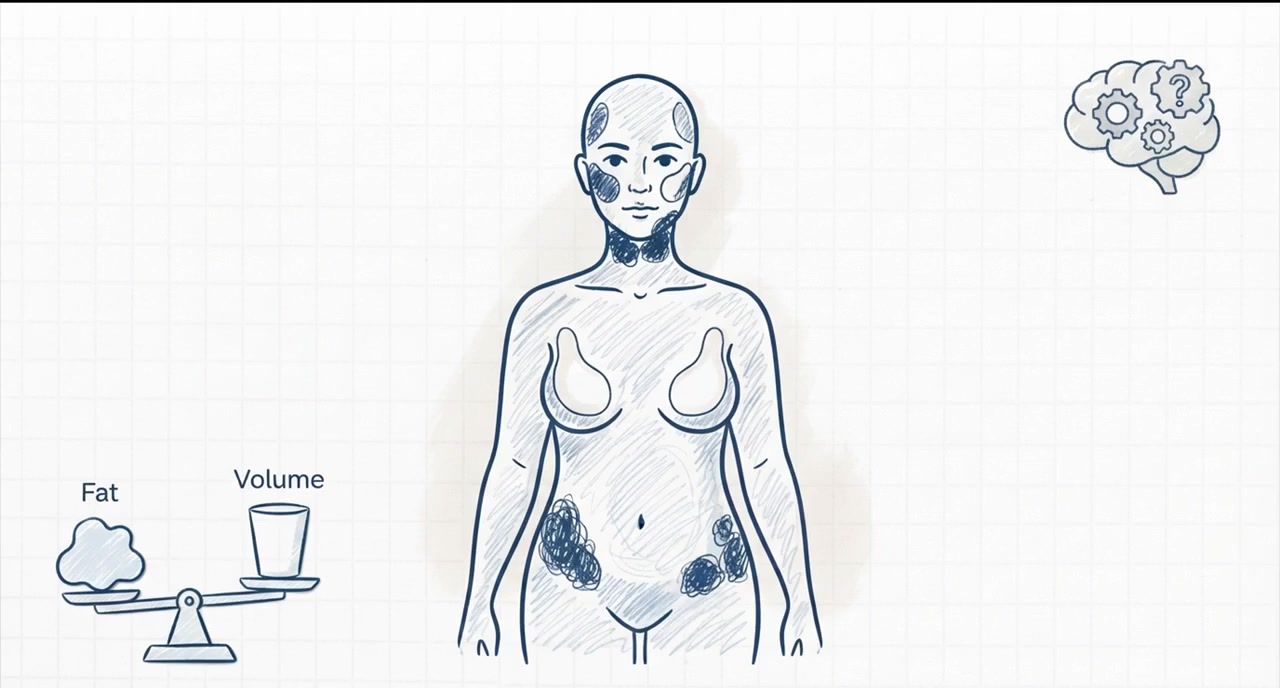
| Area after GLP-1 weight loss | What the loss does | Usual surgical answer | Trade-off |
|---|---|---|---|
| Face and mid-face | Volume depletion, hollowing | Autologous fat transfer, sometimes enriched | Partial graft retention; possible second stage |
| Neck and under the chin | Residual fat plus laxity | Targeted liposuction with or without energy tightening | Skin may not retract fully |
| Abdomen | Fat, loose skin, or both, often with muscle separation after pregnancy | Liposuction, tummy tuck, or a staged combination | Scar and recovery weeks versus a softer improvement |
| Flanks and waistline | Persistent fat that diet no longer shifts | Tumescent liposuction, frequently combined with the abdomen | Circumference change, not weight change |
| Arms and thighs | Fat plus laxity around the upper arm and inner thigh | Liposuction for fat; lift for skin | Lift scars; longer recovery |
| Whole trunk | Circumferential laxity after major loss | 360-degree body lift, sometimes with later contouring | Scar around the torso; two-stage planning is common |
| Abdomen, lower back, waistline and hips together | Circumferential loose skin and residual fat, not only the front of the abdomen | Extended (360°) tummy tuck, addressing all four regions in one operation | A scar that runs around the torso; staged contouring still common |
The weight-stability question, and why timing is clinical
Two things have to be true before a contouring plan is worth committing to: the weight has to be stable enough that the result will not be undermined by further loss or regain, and the surgical team has to be comfortable with the medication status. Published guidance from ASPS frames the second point as an emerging area rather than a settled rule — the panniculectomy study found GLP-1 use common and complications not increased overall, with wound-healing effects worth watching. That is why the medication question is asked in the consultation and not in a brochure: whether a patient pauses, continues or adjusts the drug is a decision for the prescribing clinician and the surgeon together. On the first point, the arithmetic is simple and unforgiving. Contouring is priced and planned around the body you have on the operating table; if you are still losing, the plan is a snapshot of a moving target, and a second operation becomes likely. Our guides on choosing between liposuction, a tummy tuck and contouring and on how much fat can be removed in one session explain what each operation can and cannot absorb in a single pass.
| Readiness question | Why it matters | What to have ready |
|---|---|---|
| How long has your weight been stable? | A still-moving weight makes a single-stage plan unreliable | A dated weight log for the previous months |
| What is your current BMI? | Practices enforce a threshold for outpatient safety, and published limits vary | Your height and weight, and the practice's stated threshold |
| Is the GLP-1 medication continuing, pausing or changing? | ASPS-reported data found GLP-1 use common and overall surgical risk unchanged, with subtle wound-healing effects | The prescribing clinician's view, in writing if possible |
| Is the problem fat, skin, or both? | It decides whether you are buying liposuction, excision, or both | An examination — no photograph settles this |
| Are you prepared for the recovery, not just the price? | Lifts and large-volume liposuction mean weeks of compression and restricted activity | Time off work, help at home, garment plan |
Skin tightening after major weight loss has a ceiling
The most common misconception in this group is that energy devices can substitute for skin removal. They cannot. Heating the dermis to trigger collagen contraction changes how tight the skin sits on the tissue underneath; it does not remove any skin, and after substantial weight loss there is often too much of it for contraction to close the gap. The published trade-off is unambiguous, and ASPS's assisted-liposuction page states it directly: if there is additional skin, excision with an abdominoplasty may be required. Where laxity is moderate, subdermal energy added to a liposuction case can improve the result — how that works, and at what temperatures, is covered in our guide to heat-based skin tightening. Where laxity is severe, the honest options are a lift, a tuck, or acceptance of a softer improvement. The published complication rates for both routes are set out in our article on complication rates as published, and they are worth reading before deciding that a bigger operation is the safer operation. Where the goal is contraction rather than excision, the notebook material names the platforms used to layer energy under the skin — Renuvion J-Plasma, BodyTite and the AYON system — and describes a 360° extended tummy tuck as the operation that addresses the abdomen, lower back, waistline and hips at once.
What it costs, and what to ask
Contouring after weight loss is usually the most expensive kind, because it often needs more than one area, sometimes more than one procedure, and frequently some volume restoration alongside removal. Published fee benchmarks are the place to start: ASPS puts the average liposuction surgeon's fee at $4,711 while stating it excludes anaesthesia, the operating room and related expenses; The Aesthetic Society's standard procedure cost is $2,764 for surgeon and facility fees together; and a tummy tuck is priced separately, as its own page at ASPS shows. Our cost anatomy guide and the Miami pricing guide cover the structure. Before booking, four questions are worth more than any advertised range: what is the all-in quote including garments and follow-ups, is this one stage or two, who manages the medication question, and what is the written revision policy. Our printable 50-question consultation checklist includes the pricing and candidacy sections in full. None of this substitutes for an examination: volume loss, laxity and wound-healing risk are individual findings, and only a board-certified plastic surgeon can assess whether contouring after weight loss is appropriate for you.
Frequently asked questions
Does weight loss from GLP-1 medication remove fat cells?
No. The medication shrinks fat cells across the whole body but leaves their number roughly unchanged, and it does not choose where the shrinkage lands. That is why a smaller body can still carry the same stubborn pockets under the chin, on the abdomen, arms and thighs, plus depleted volume in the face and breasts.
Does taking a GLP-1 medication make body contouring surgery riskier?
The published data is reassuring on the big risks. In an ASPS-reported study of panniculectomy patients, 21.7% were taking a GLP-1 medication before surgery, and researchers found the drugs did not increase overall surgical risk, though they noted subtle effects on wound healing that belong in the consent discussion.
Can skin tightening devices replace a tummy tuck after major weight loss?
They cannot remove skin. Heating the dermis triggers collagen contraction, which changes how tight the skin sits on the tissue underneath but removes nothing, and after substantial weight loss there is often too much skin for contraction to close the gap. Published guidance states that where there is additional skin, excision may be required.
Sources
Figures are published figures as of the access date (12 Sep 2026) and change over time. Notebook-material figures are reproduced as the supplied notebook material states them.
1. ASPS, press release: Weight Loss Medications May Affect Some Complications After Panniculectomy — https://plasticsurgery.org/news/press-releases/weight-loss-medications-may-affect-some-complications-after-panniculectomy
2. ASPS, press release: Lift Procedures Led Growth as Demand for Restoration Drove Plastic Surgery in 2025 — https://www.plasticsurgery.org/news/press-releases/lift-procedures-led-growth-as-demand-for-restoration-drove-plastic-surgery-in-2025-new-asps-report-reveals
3. ASPS, Liposuction Candidates — https://www.plasticsurgery.org/cosmetic-procedures/liposuction/candidates
4. ASPS, Liposuction Cost — https://www.plasticsurgery.org/cosmetic-procedures/liposuction/cost
5. ASPS, Tummy Tuck Cost — https://www.plasticsurgery.org/cosmetic-procedures/tummy-tuck/cost
6. ASPS, Tummy Tuck Risks and Safety — https://www.plasticsurgery.org/cosmetic-procedures/tummy-tuck/risks-safety
7. Mayo Clinic, Tummy tuck — https://www.mayoclinic.org/tests-procedures/tummy-tuck/about/pac-20384892
8. The Aesthetic Society, Liposuction — Associated Costs — https://www.theaestheticsociety.org/procedures/body/liposuction/associated-costs
9. ISAPS, Global Survey 2023 press release — https://www.isaps.org/media/k3ghhyyr/global-survey-2023-press-release.pdf
10. ASPS Practice Advisory on Liposuction: Executive Summary — https://www.plasticsurgery.org/documents/medical-professionals/health-policy/key-issues/executive-summary-on-liposuction.pdf
11. Notebook source material for this site: video overview on post-GLP-1 body contouring (461-second transcript; on-screen title cards "Post-Ozempic Body Shift" and "Preservation Aesthetics"), which supplied the volume-loss pattern and preservation-aesthetics framing.
Medical-safety note: This article is general information about published data on surgery after weight loss. It is not medical advice and it does not predict an individual result. Decisions about pausing, continuing or changing a GLP-1 medication before surgery belong to your prescribing clinician and your surgeon, and only a board-certified plastic surgeon who examines you can assess whether body contouring is appropriate.