What the 3M Facial Strategy Map Shows
The closing section of this deck moves from mechanism to clinical translation, and the first stop is the face. Slide 11 is titled "Clinical Translation: 3M Facial Rejuvenation" and it does not present a single technique. It presents a map. The centre of the slide is a cutaway block of facial anatomy built from four stacked layers — dermis, subcutaneous tissue, muscle and bone — and beside each layer the slide names a different graft preparation with a different job. The 3M label stands for Multi-type, Multi-method and Multi-layer, and the slide defines it in one line: a precision approach rather than a uniform filler.
The short version
- The 3M facial strategy map stands for multi-type, multi-method and multi-layer, described as a precision approach rather than a uniform filler.
- Nanofat combined with SVF-gel is placed in the dermis, targeting skin elasticity, dermal thickness and structural infraorbital dark circles.
- Microfat goes into the subcutaneous tissue and muscle for volume transition, described as a graded change rather than bulk.
- High-density Macrofat and adipose matrix are placed in the deep compartments on bone as a structural foundation.
- The outcomes panel lists smoother contours, improved long-term retention and zero major vascular complications in targeted studies.
- Small parcels spread across several planes sit closer to recipient tissue than one large bolus, which is the slide's survival argument.
Read against the earlier slides in the deck, this is the clinical expression of everything about graft survival that came before it. A fat graft does not have a blood supply at the moment it is placed, so survival depends on how quickly the recipient bed can revascularise the tissue. Where the tissue is placed, how finely it is divided, and how much of the inflammatory and regenerative fraction travels with it all change that equation. The facial map is where the deck shows those variables being assigned deliberately to different depths rather than mixed into one volume.
The Four Layers and What the Slide Places in Each
The slide's anatomical panel is the most concrete part of it, so it is worth reproducing faithfully before interpreting anything. The superficial layer, meaning the dermis, receives nanofat combined with SVF-gel. The slide states the target plainly: skin elasticity, dermal thickness, and structural infraorbital dark circles. The mid-planes, which the slide labels as subcutaneous tissue and muscle, receive microfat, described as a placement for volume transition rather than bulk. The deep compartments, resting on the bone, receive high-density Macrofat and adipose matrix, described as a structural foundation.
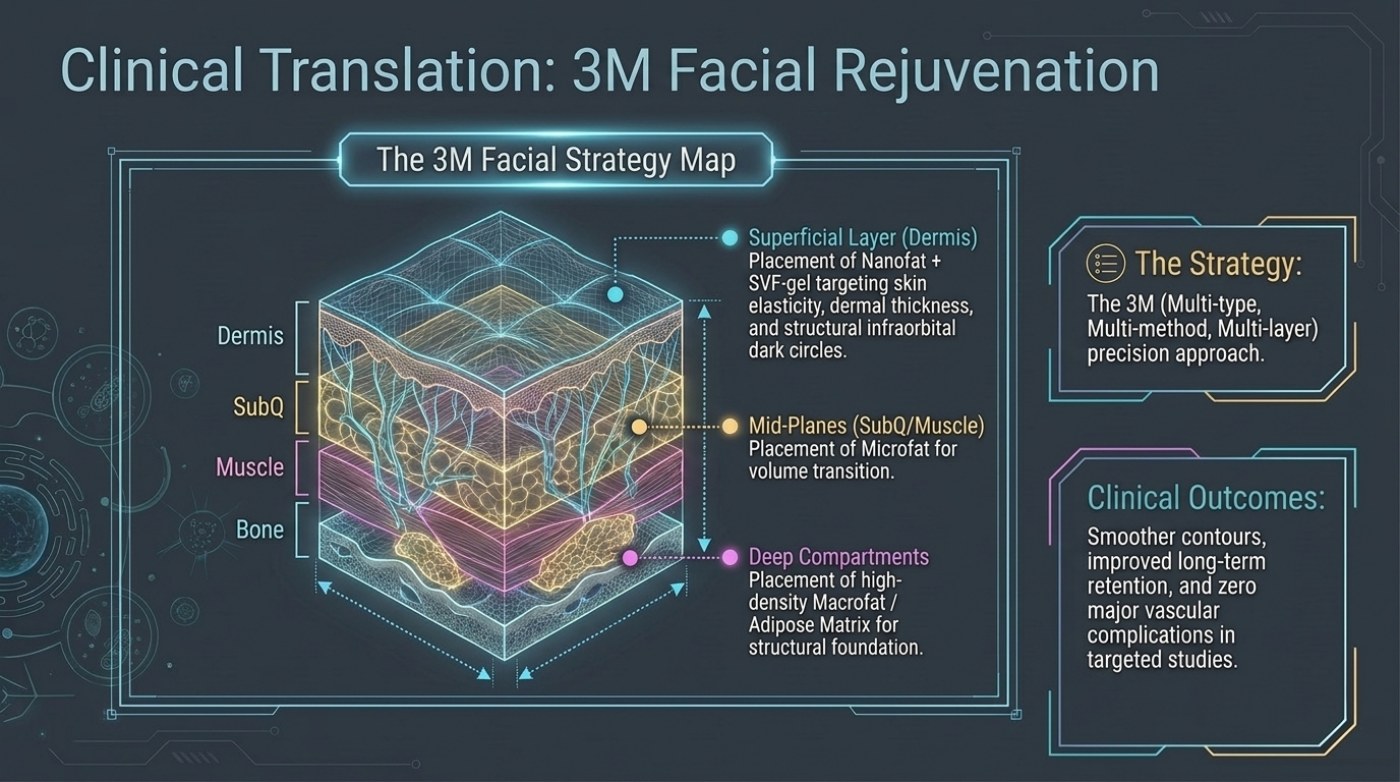
The logic of the four-layer split is easier to see as a table than as prose, because each row pairs a physical depth with a graft type, a target, and a rationale.
| Anatomic layer (as labelled on the slide) | Preparation placed | Stated target | Rationale on the slide |
|---|---|---|---|
| Superficial layer (dermis) | Nanofat plus SVF-gel | Skin elasticity, dermal thickness, structural infraorbital dark circles | Targets the skin envelope itself rather than volume |
| Mid-planes (subcutaneous tissue) | Microfat | Volume transition | Small parcels of fat for a graded change in contour |
| Mid-planes (muscle) | Microfat | Volume transition | Same prepared graft, deeper recipient plane |
| Deep compartments (on bone) | High-density Macrofat / adipose matrix | Structural foundation | Larger-volume graft placed where it is loaded by structure |
Why “Multi-Type” Is the Load-Bearing Word
The three parts of the 3M label do different work, and the slide's right-hand panel treats them as one definition, so it is worth separating them. Multi-type means more than one graft preparation is used in the same session — here, at least three: nanofat, SVF-gel, microfat, and the high-density Macrofat or adipose matrix in the deepest plane. Multi-method means the preparation techniques differ, from mechanical emulsification to cell-enriched fractions. Multi-layer means the delivery planes differ, from intradermal to subperiosteal. Remove any one of the three and the strategy stops being what the slide describes.
That distinction matters because of how facial fat grafting is often discussed in marketing language, where "fat transfer" is treated as one product with one price per area. The slide's structure implies the opposite: the graft behaviour in the dermis is not the behaviour of the same tissue under the muscle, and the preparation is chosen accordingly. The earlier slides in this deck provide the reason — graft survival depends on the recipient bed, and different beds supply different conditions.
| Component of the 3M label | What the slide means by it | Evidence of it on the slide |
|---|---|---|
| Multi-type | Several distinct graft preparations in one plan | Nanofat, SVF-gel, microfat, high-density Macrofat / adipose matrix |
| Multi-method | Preparation method matched to the target tissue | Emulsified versus cell-enriched versus unprocessed graft descriptions |
| Multi-layer | Delivery at several depths in the same region | Dermis, subcutaneous tissue, muscle, and the plane on bone |
| Precision approach | The combination, not any single element | The slide's own summary line describing the strategy |
What the Slide Records as Outcomes — and How to Read It
The Clinical Outcomes panel on the right of slide 11 lists three items: smoother contours, improved long-term retention, and zero major vascular complications in targeted studies. The last of those carries its own qualifier in the slide text. "Targeted studies" is not the same as a broad registry or a randomised comparison, and it is the phrase the deck chose; anyone reading the claim should read the qualifier with it. The same is true of "improved long-term retention," which the slide asserts as an outcome of the layered approach without attaching a figure, a follow-up interval or a comparator on this slide.
Placed beside slide 14, which is where the deck puts its retention percentages, the omission here looks deliberate: the facial slide is a strategy map, and the numbers appear later in the regulatory and commercial comparison. What the slide does give is a mechanism for why layering would help. Fat placed in small parcels across several planes sits closer to more recipient tissue than a single large bolus, and the deeper planes — muscle and the compartment on bone — are relatively immobile and well perfused compared with a mobile subcutaneous pocket. That is a survival argument, not an outcome measurement, and the deck presents it as the reasoning behind the map rather than as proof of it.
| Claim on the outcomes panel | Exactly as the slide states it | What a careful reader should note |
|---|---|---|
| Smoother contours | Listed as a clinical outcome of the 3M approach | Qualitative; no measurement method given on the slide |
| Improved long-term retention | Listed as a clinical outcome of the 3M approach | No percentage, follow-up duration or comparator on this slide; the deck's retention figures appear on the regulatory slide |
| Zero major vascular complications | Stated with the qualifier "in targeted studies" | Scope is limited by the slide's own wording; it does not describe a general complication rate |
The most defensible way to use a slide like this is as a description of how the technique is structured, and as a list of what the authors of the source material chose to assert. The structure is checkable — which preparations, which planes — and that is what makes the slide useful when comparing what different published protocols actually do.
Frequently Asked Questions
What does the “3M” in the slide title stand for?
The slide defines it as Multi-type, Multi-method and Multi-layer, and describes the combination as a precision approach. Multi-type means several graft preparations in one plan, multi-method means the preparation technique differs by target, and multi-layer means delivery at more than one depth.
Which graft goes into which facial layer on this slide?
Nanofat and SVF-gel go into the superficial layer, meaning the dermis, where the slide targets elasticity, dermal thickness and structural infraorbital dark circles. Microfat goes into the mid-planes, the subcutaneous tissue and muscle, for volume transition. High-density macroat and adipose matrix go into the deep compartments on bone as a structural foundation.
Does the slide promise a vascular complication rate?
No. It states zero major vascular complications in targeted studies, and the qualifier is part of the sentence. That wording describes the studies the source material draws on rather than a general population rate, and no complication rate should be read into it beyond what the slide says.
This is published information, not medical advice — a board-certified surgeon must assess whether a procedure suits you.
Related Reading
- Why Transplanted Fat Survives — or Does Not
- Verifying Surgeon Credentials and Facility Accreditation
- Liposuction vs Non-Surgical Fat Reduction
Estimating and comparing your own situation: credentials verifier pre-op checklist.