Three families, three different jobs
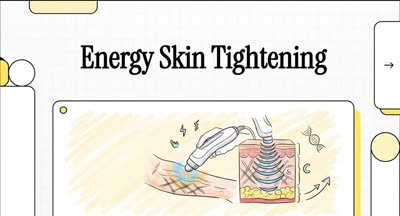
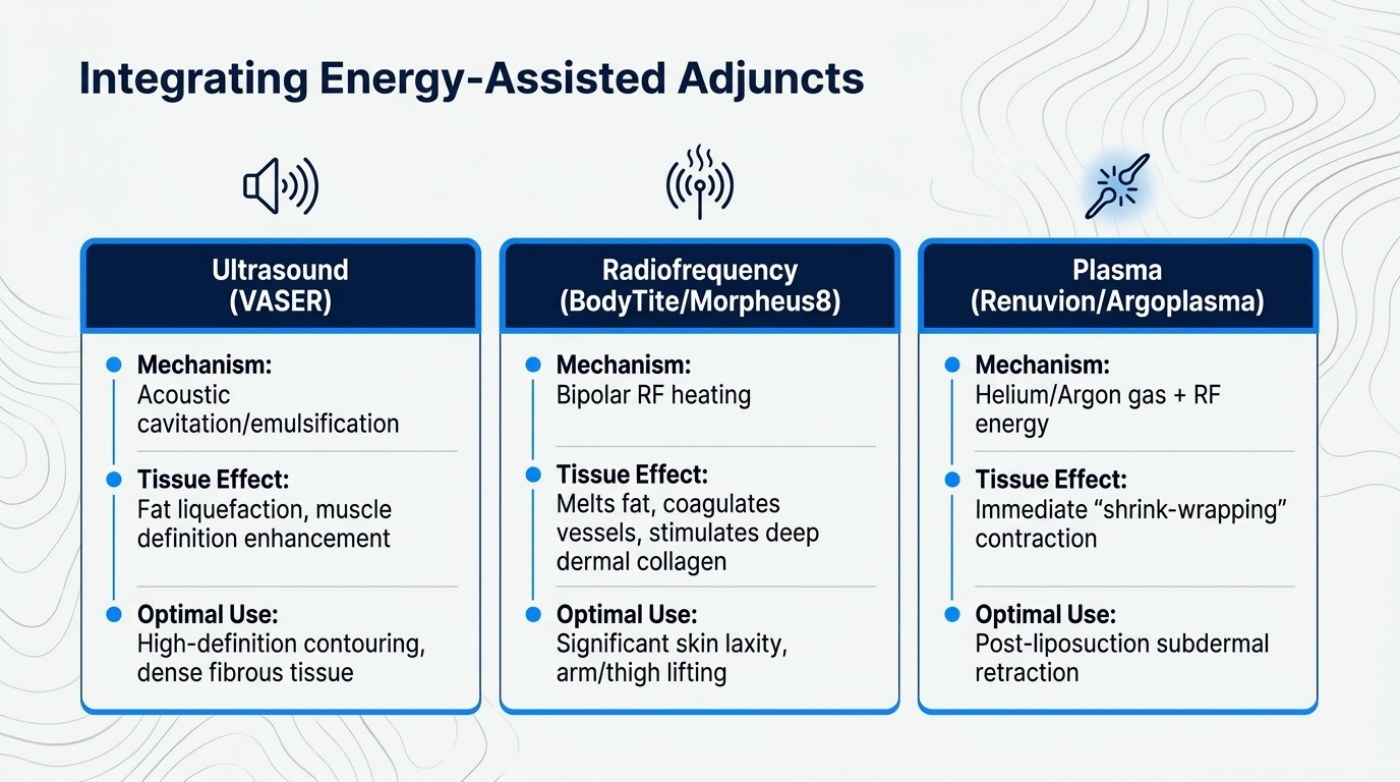
Removing fat does not tighten skin, and that fact is the reason energy-assisted adjuncts exist. The deck slide “Integrating Energy-Assisted Adjuncts” sets out three families side by side, and the most useful thing about the layout is that it does not present them as competitors. Ultrasound, radiofrequency and plasma are separated by mechanism, by tissue effect and by what the source material says each is best used for. Only the first of the three is primarily a fat-removal tool; the other two are aimed at what happens to the skin envelope afterwards. If you have been weighing up facial liposuction for a home around Miami, FL, this guide covers how it actually works, what it tends to cost, and where the results usually fall short.
The short version
- Energy-assisted liposuction covers three separate families, ultrasound, radiofrequency and plasma, each with a different mechanism and job.
- VASER ultrasound uses acoustic cavitation to liquefy fat before aspiration, which the source pairs with high-definition contouring of dense fibrous tissue.
- Radiofrequency platforms such as BodyTite and Morpheus8 melt fat, coagulate vessels and stimulate deep dermal collagen.
- Plasma devices like Renuvion and Argoplasma combine helium or argon gas with radiofrequency for immediate shrink-wrapping of the subdermal layer.
- In a 56-patient contralateral study, blood loss fell by more than 50% with the energy-assisted technique.
- Thermal safety pairs a subdermal target near 65 °C with a 42 °C surface cap, where pooled thermal injury sits near 1.64%.
Ultrasound (VASER): emulsify, then remove
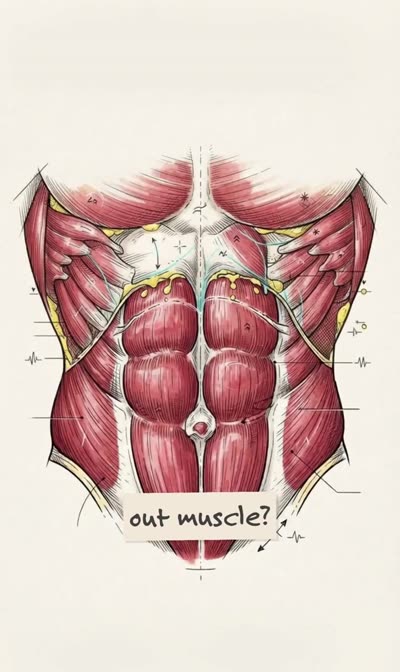
The slide gives ultrasound-assisted liposuction the mechanism “acoustic cavitation/emulsification” and the tissue effect “fat liquefaction, muscle definition enhancement,” with an optimal use of “high-definition contouring, dense fibrous tissue.” The sequence matters: the ultrasonic energy is delivered before aspiration, liquefying fat so that it can be drawn out more gently and more selectively, and the published literature on ultrasound-assisted work describes slower treatment with an emphasis on sparing vessels and nerves. The last part of the slide’s entry is the one that is easy to misread. “Muscle definition enhancement” is not a claim that muscle is built; it means the fat overlying muscle boundaries can be removed precisely enough that the grooves between muscle groups become visible. Our published etching guide makes the same distinction in its opening line: high-definition liposuction does not build muscle, it removes fat in two layers so the muscle a patient already has can be seen.
Radiofrequency (BodyTite/Morpheus8): heat with an address
The second column describes radiofrequency-assisted work as “bipolar RF heating” whose tissue effect is to “melt fat, coagulate vessels, stimulate deep dermal collagen,” with an optimal use of “significant skin laxity, arm/thigh lifting.” Three effects are bundled here and they are worth separating. Melting fat is the removal part. Coagulating vessels is a bleeding-control effect, and it is the one with the clearest published footprint: in a prospective study of 56 patients who received equal volumes of traditional and laser-assisted liposuction at two contralateral sites, blood loss was reduced by more than 50% with the energy technique. Stimulating deep dermal collagen is the tightening part, and it is the slowest — the immediate contraction on the table is geometry, while new collagen laid down over the following weeks and months is biology that cannot be hurried. The name check on the slide points to two different instruments in the same family: a bipolar radiofrequency device and a fractional radiofrequency microneedling platform. Both are sold as tightening, and a 100-patient study measured 84,939 J on average for one radiofrequency-assisted technique against 44,195 J for another (P < 0.001). Same family name, very different energy delivered.
Plasma (Renuvion/Argoplasma): shrink-wrapping the layer under the skin
The third column pairs “helium/argon gas + RF energy” with the tissue effect “immediate ‘shrink-wrapping’ contraction” and the optimal use “post-liposuction subdermal retraction.” This is the narrowest indication on the slide and the most explicit about timing: it is positioned as something that follows fat removal, acting on the subdermal plane rather than on bulk fat. Heat delivered through ionised gas is very superficial and very fast, which is the source of both its appeal and its operator-dependence — there is little margin between the contraction being sought and the surface being damaged.
The numbers that decide whether any of this is safe
Every family on this slide is a heat source, and the published thermal guidance applies to all three. The notebook material behind our skin-tightening guide puts the working subdermal target at roughly 65 °C and the hard surface limit at 42 °C, monitored in real time with infrared surface sensing, with the operating room held at 20–23 °C ambient, 30–60% relative humidity and more than 20 positive-pressure air exchanges an hour so the heat devices generate can dissipate. The gap between 65 and 42 is the entire safety margin, and it is why thermal injury appears as its own line in published complication data — radiofrequency-assisted liposuction pooled at roughly 1.64% for thermal injury alongside roughly 3.93% for seroma in one systematic review. The deck’s own companion slide on localized adverse events lists strict thermoguidence maintaining skin below 42 °C and continuous room climate control of 20–23 °C as the answer to burns.
The three families as the slide presents them
| Family (device named on the slide) | Mechanism | Tissue effect | Stated optimal use |
|---|---|---|---|
| Ultrasound (VASER) | Acoustic cavitation / emulsification | Fat liquefaction, muscle definition enhancement | High-definition contouring, dense fibrous tissue |
| Radiofrequency (BodyTite/Morpheus8) | Bipolar RF heating | Melts fat, coagulates vessels, stimulates deep dermal collagen | Significant skin laxity, arm/thigh lifting |
| Plasma (Renuvion/Argoplasma) | Helium/argon gas + RF energy | Immediate “shrink-wrapping” contraction | Post-liposuction subdermal retraction |
Thermal limits and published energy figures
| Figure | Value | Source |
|---|---|---|
| Subdermal contraction target | About 65 °C, with 65–80 °C described as the working band | Notebook source material for this topic |
| Skin-surface safety limit | 42 °C, monitored continuously | Notebook source material; mirrored in the deck’s thermal-injury slide |
| Operating-room environment | 20–23 °C ambient, 30–60% humidity, >20 positive-pressure air exchanges per hour | Notebook source material |
| Energy delivered by two RF-assisted techniques | 84,939 J vs 44,195 J on average (P < 0.001), 100 patients | Published prospective study |
| Blood loss, energy-assisted vs traditional | Reduced by more than 50% (56 patients, contralateral sites) | Published contralateral comparison |
| Thermal injury and seroma with RF-assisted liposuction | About 1.64% and about 3.93% pooled | Systematic review of contemporary techniques |
Matching the adjunct to the presentation
| Presentation | Family the slide would point to | What the adjunct adds | What to weigh |
|---|---|---|---|
| Dense fibrous tissue, definition-focused case | Ultrasound (VASER) | Emulsification before aspiration; access to fibrous areas | Slower treatment; pass count rises if fat is not fully emulsified |
| Marked skin laxity, arm or thigh lifting | Radiofrequency | Vessel coagulation and dermal collagen stimulation | Thermal injury risk if surface temperature is not monitored |
| Contour needs refinement after fat removal | Plasma | Superficial subdermal contraction directly under the skin | Very thin heat layer; strongly operator-dependent |
FAQ: energy-assisted adjuncts
Does an energy adjunct replace skin-tightening surgery?
No. It works on the skin the patient has, by contracting collagen and triggering new collagen over the following months. Where laxity is severe, published sources are direct that liposuction’s ability to address skin laxity is limited and that residual redundant skin may need excision — ASPS states that where there is additional skin it might require excision with an abdominoplasty. The slide’s own framing is consistent: radiofrequency is listed for significant laxity and arm/thigh lifting, not as a substitute for a lift.
Why does the same technique name hide such different results?
Because the family name describes the energy type, not the dose. Two radiofrequency-assisted techniques in a 100-patient study differed by roughly a factor of two in joules delivered, and both were called radiofrequency tightening. Temperature control, energy setting, the number of passes and the depth of delivery all sit inside the same label. That is why the numbers worth asking about are operational — how surface temperature is monitored, what the room is held at, and who sets the device parameters.
Which adjunct does the deck put first?
The slide does not rank them; it separates them by job. Ultrasound appears first because it acts on fat before removal, while radiofrequency and plasma act on the tissue envelope afterwards. The deck’s own synthesis slide treats energy assistance as one term among five, alongside patient selection, volume limits, micro-sculpting and post-operative care, and states that true high-definition results come from mastery of anatomy and safety benchmarks rather than from the cannula or the laser alone.
This is published information, not medical advice — a board-certified surgeon must assess whether a procedure suits you.
Related reading
Three published guides on this site cover adjacent parts of the same protocol:
- Heat-Based Skin Tightening After Liposuction: What the Numbers Mean — the temperature targets behind every energy family
- High-Definition Liposuction: How Muscle Etching Actually Works — the fat-removal work the adjuncts follow
- Liposuction Risks and Complication Rates as Published — pooled thermal-injury and seroma figures