The deck's closing argument
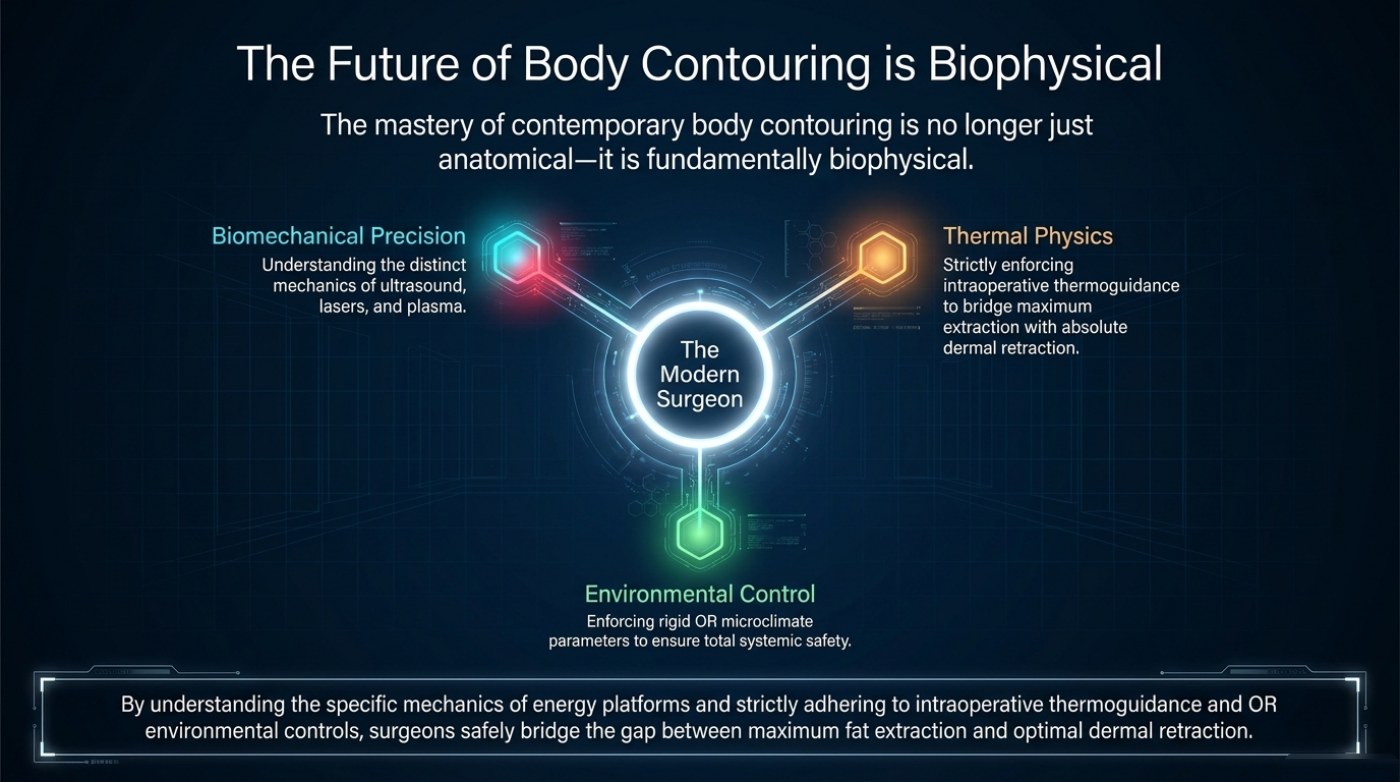
The tenth slide does not introduce a new technology. It closes the deck by naming what the preceding nine pages have in common, and the claim is in the title: the mastery of contemporary body contouring is no longer just anatomical, it is fundamentally biophysical. The diagram puts the modern surgeon at the centre with three disciplines radiating from that circle — biomechanical precision, thermal physics and environmental control — and the closing paragraph states what they add up to: by understanding the specific mechanics of energy platforms and strictly adhering to intraoperative thermoguidance and operating-room environmental controls, surgeons safely bridge the gap between maximum fat extraction and optimal dermal retraction. This is written for homeowners around Miami, FL who are looking into body contour services and want the honest version rather than a sales page.
The short version
- The deck's closing argument is that body contouring is now biophysical as well as anatomical, resting on three disciplines.
- The three disciplines are biomechanical precision, thermal physics and environmental control of the operating room.
- The thermal figures are a 65 °C subdermal target, a band up to 80 °C and a 42 °C surface limit.
- Environmental control sets an ambient range of 20 °C to 23 °C and more than 20 air exchanges hourly.
- Fat removal does not tighten skin, so the thermal target and surface cap are what make tightening a separate physical event.
It is a summary slide, so its value is in the structure rather than the detail. Every figure the deck uses lives inside one of the three disciplines: the wavelength and cavitation physics sit in biomechanical precision, the 65 °C subdermal target and the 42 °C surface cap sit in thermal physics, and the ambient band, humidity range, positive pressure and air-exchange minimum sit in environmental control.
| Discipline | Wording on the slide | Deck material it draws on |
|---|---|---|
| Biomechanical precision | Understanding the distinct mechanics of ultrasound, lasers and plasma | The emulsification and physics columns of the modality matrix |
| Thermal physics | Strictly enforcing intraoperative thermoguidance to bridge maximum extraction with absolute dermal retraction | The 65 °C subdermal target, the 42 °C surface cap and the two-phase collagen response |
| Environmental control | Enforcing rigid operating-room microclimate parameters to ensure total systemic safety | Ambient temperature, humidity, positive pressure and air-exchange requirements |
What "biophysical" is doing in that sentence
The word choice is deliberate. An anatomical approach to body contouring asks where the fat is and what shape the surface should be. The deck's closing claim is that the modern version of the operation also requires knowing what the energy does to tissue at a physical level and controlling the conditions under which it happens. Anatomy decides the plan; physics decides whether the plan is achievable without injury.
Our published material on this topic reaches the same conclusion from the numbers up. Fat removal does not tighten skin — the thermal target and the surface limit are what make tightening a separate, physical event rather than a consequence of removing volume. The published figures behind that guide are the same ones this deck builds on: a subdermal target at 65 °C, a working band described up to 80 °C, a surface limit of 42 °C, an ambient range of 20 °C to 23 °C and a minimum of more than 20 air exchanges per hour. They are reproduced as the numbers the technique is described with, not as independently re-measured thresholds for an individual patient.
Why the three disciplines are listed together
It would be simpler to treat delivery physics, thermal safety and room conditions as three unrelated subjects. The slide puts them in one diagram because each one constrains the others. An energy platform that emulsifies fat efficiently still puts a heat load into the tissue and the room. A subdermal target above 65 °C is only usable if the surface is held below 42 °C at the same time. The surface limit and the room's ambient band are part of the same heat balance, because the room is what absorbs the device's heat output while the patient's core temperature has to stay stable.
| Constraint | Where it comes from | What it limits |
|---|---|---|
| Fat must be emulsified before it can be extracted | Biomechanical precision | Which modality can carry a plan built around a large volume |
| Subdermal tissue must reach a minimum temperature | Thermal physics | Whether the tightening effect is achievable at all on a given area |
| The cutaneous surface must stay below its limit | Thermal physics, monitored intraoperatively | How much energy can be delivered in one pass, and how long a session can run |
| The operating room must hold its parameters | Environmental control | Whether the heat load can be dissipated without losing the patient's thermal stability |
Read this way, the closing slide is not a motto. It is a statement about where the failure modes live: in the mechanics of the platform, in the thermal gradient between the surface and the subdermal layer, and in a room whose conditions have to hold for the duration of the case.
What the deck does and does not claim
The closing paragraph uses the word safely and the phrase maximum fat extraction with optimal dermal retraction. Neither is a promise about an individual result, and the deck supplies no numbers in this slide to support either. The figures it relies on were published on the earlier pages, and their limits were already visible there: the thermal thresholds have no named study attached, the risk reduction associated with temperature capping is stated as a figure from the source material, and the modality ratings are relative words rather than measurements.
| The slide asserts | The slide does not assert |
|---|---|
| That the operation is now biophysical as well as anatomical | That any particular platform is superior for a particular patient |
| That intraoperative thermoguidance is part of the technique, not an accessory | A percentage of retraction, or how long any retraction persists |
| That operating-room conditions belong to the safety protocol | That holding the conditions guarantees an outcome or removes the risk of a complication |
| That understanding the mechanics is a requirement of the work | Anything about candidacy, suitability or who should have a procedure |
The last row is the one worth carrying out of the deck. A framework that describes mechanisms, temperatures and room conditions is a framework for informed conversations, not a substitute for one. Published complication data for aesthetic liposuction varies widely between sources, our own guide on risks and published rates notes, and how much of it applies to a single patient depends on factors no slide covers.
Questions this slide raises
What is the practical difference between an anatomical and a biophysical approach?
The planning is still anatomical — which areas, which volumes, which contours. What the deck adds is that the plan is executed through physics: emulsification, thermal contraction, and the heat balance of the room. The closing slide's claim is that a plan which ignores those mechanisms is incomplete, not that anatomy matters less.
Which of the three disciplines matters most?
The slide lists them without ranking them, and the constraint table is the reason: each one limits what the other two can do. Enforcing a temperature window without monitoring does not produce the effect; monitoring without a stop condition does not protect the surface; and neither holds for a long case if the room cannot absorb the heat the devices put into it.
Does the deck say the technique is risk-free?
No page of it does, and the closing paragraph's use of the word safely refers to the protocol described above it — thermoguidance and environmental controls — rather than to an absence of risk. Published complication rates for liposuction are documented across multiple sources and differ substantially between them, which is the subject of its own guide on this site. What the deck argues is that the thermal and environmental controls are how the technique is executed, not that executing it well removes every risk.
This is published information, not medical advice — a board-certified surgeon must assess whether a procedure suits you.
Related Guides
Three guides that carry the closing argument further:
- Heat-Based Skin Tightening After Liposuction: What the Numbers Mean — the thermal target and surface cap, and the cases where excision is the honest answer.
- AI, Robotics and Data in Body Contouring: What Changes, What Does Not — which planning and sensing claims have support and which are vendor claims.
- Liposuction Risks and Complication Rates as Published — why the published numbers differ, and how to read them.