The Slide That Closes the Argument
The final slide of the deck is titled "Moving Beyond Basic Whole-Cell Grafting," and it is structured as a hub with four spokes. The hub in the centre carries the title; the four spokes each name a direction the field is moving in. A band across the bottom carries the deck's final takeaway. After thirteen slides of mechanism, translation, safety and regulation, this is where the source material states what it thinks the next phase looks like — and the answer is not a better cannula or a bigger syringe. It is a change in what is transplanted and how it is placed. If you are here looking into body contour services, the sections below walk through the process from the first quote to the finished job.
The short version
- The closing slide names four directions for fat transfer: cell-free precision, priming, scaffolding and digital precision.
- Cell-free precision means ADSC-exosome therapies delivering miRNA without the oncological risk of live cells.
- Priming uses hypoxic preconditioning to raise VEGF expression before injection, a preprocessing step rather than a different product.
- Scaffolding delivers cells on decellularised adipose matrices or GelMA to anchor them in the poorly supplied bed.
- The final takeaway says cell-assisted lipotransfer is transitioning from an empirical surgical art into a mechanism-driven tissue engineering platform.
The four spokes are not four competing techniques. They address different problems in the same pipeline: what carries the regenerative signal, what state the tissue is in when it is transplanted, where it sits in the recipient bed, and how the placement is planned. Read together with the regulatory slide that precedes it, they also read as a set of partial answers to the constraints the deck has just described.
The Four Directions, as the Slide Names Them
Each spoke on the slide is a short paragraph. Reproducing them faithfully matters, because the wording is careful about what is being delivered and what risk is being avoided in each case.
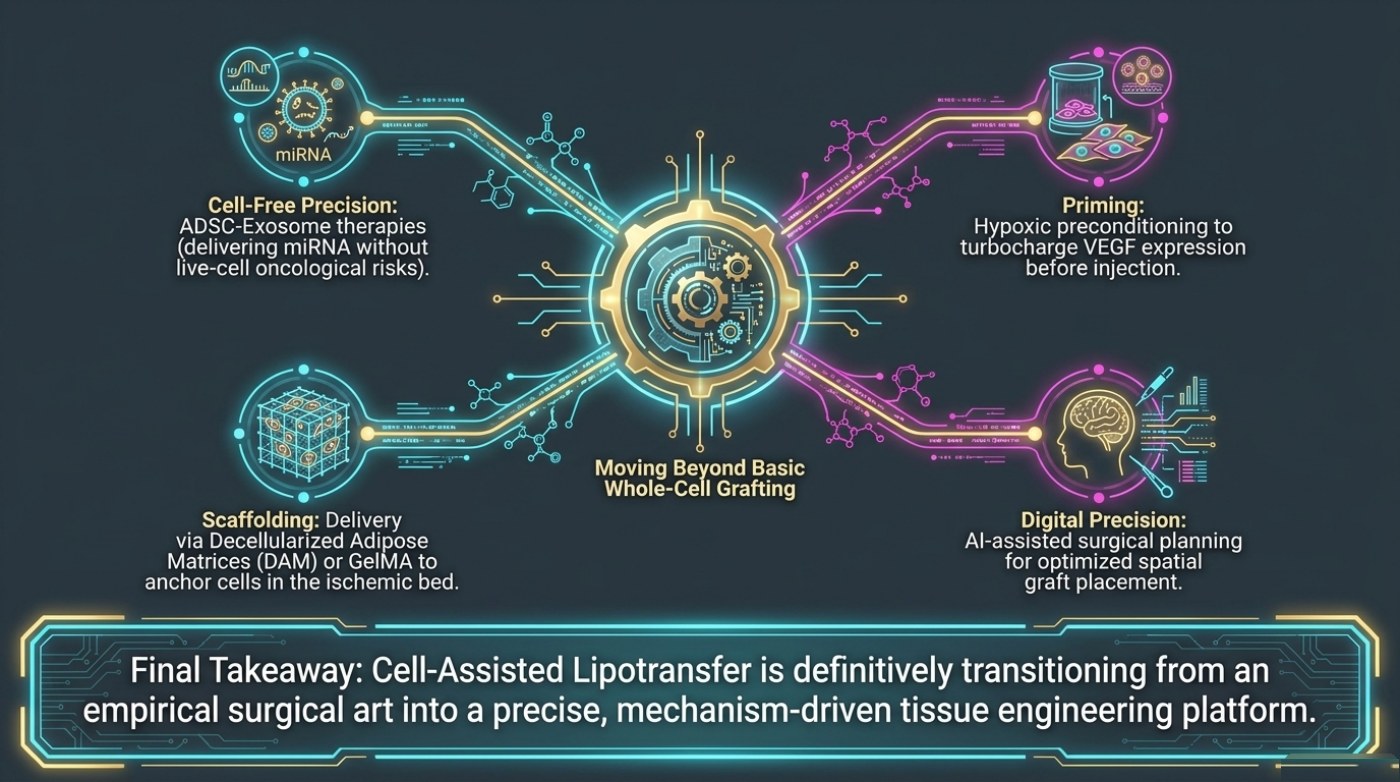
The first spoke is cell-free precision: ADSC-exosome therapies delivering miRNA without live-cell oncological risks. That last clause is the deck answering its own earlier safety slide. The tension on slide 13 was between laboratory evidence that a live cell population can influence oncogenic signalling pathways and clinical evidence that patients treated with it did not show increased recurrence. An exosome carries the signalling cargo without carrying a living cell that could persist in the recipient bed, so the spoke frames cell-free delivery as a way to keep the mechanism and reduce the concern. The slide states that as the rationale for the direction, not as a resolved safety claim.
The second spoke is priming: hypoxic preconditioning to turbocharge VEGF expression before injection. This is a preprocessing step rather than a different product. If the recipient bed is short of blood supply in the first days after grafting, and if VEGF is the signal that drives the revascularisation the tissue needs, then exposing the cells to low oxygen before they are injected is a way of asking them to produce more of that signal in advance. The slide uses the word turbocharge, which is its own framing.
The third spoke is scaffolding: delivery via decellularised adipose matrices, abbreviated DAM, or GelMA, to anchor cells in the ischaemic bed. A liquid graft in a soft recipient plane can migrate before it is revascularised, which is one reason retention is never complete. A scaffold provides a physical structure for the cells to occupy, and the slide names two materials — a biological matrix stripped of cells, and a synthetic gel — as delivery vehicles rather than as grafts in their own right.
The fourth spoke is digital precision: AI-assisted surgical planning for optimised spatial graft placement. This is the one spoke that does not change the tissue at all. It changes where and how it is put, which connects directly to the layered facial map on slide 11 and to the deck's recurring theme that where a graft sits determines whether it survives.
| Direction | Exactly what the slide says | What it changes in the pipeline | Named materials or methods |
|---|---|---|---|
| Cell-free precision | ADSC-exosome therapies delivering miRNA without live-cell oncological risks | What carries the regenerative signal | ADSC-derived exosomes; miRNA cargo |
| Priming | Hypoxic preconditioning to turbocharge VEGF expression before injection | The state of the cells at the moment of transfer | Low-oxygen exposure before injection |
| Scaffolding | Delivery via decellularised adipose matrices or GelMA to anchor cells in the ischaemic bed | Where the cells sit and how long they stay put | Decellularised adipose matrices (DAM); GelMA |
| Digital precision | AI-assisted surgical planning for optimised spatial graft placement | How placement is planned beforehand | AI-assisted planning |
How the Four Directions Answer the Earlier Constraints
The four spokes land differently against the two routes the deck described on the previous slide. Scaffolding and digital planning apply to either route, because they change placement and delivery mechanics rather than the preparation. Cell-free exosome therapy and priming both sidestep the question of what is transplanted at all — one by removing the living cell, the other by altering it before it goes in. That is why the closing slide reads as a route around the SVF-versus-ADSC fork rather than a choice between its two arms.
| Constraint the deck raised earlier | Spoke that addresses it | How the slide frames the answer |
|---|---|---|
| Live-cell oncological concern (slide 13) | Cell-free precision | Deliver the miRNA cargo without live cells |
| Slow revascularisation of the recipient bed | Priming | Increase VEGF expression before injection |
| Graft migration from a soft, poorly supplied bed | Scaffolding | Physical matrices to anchor the cells |
| Placement decisions made by eye | Digital precision | AI-assisted planning for spatial graft placement |
| Variable yield and variable quality between routes | All four, indirectly | Each reduces reliance on what a given donor or operator provides |
The Final Takeaway, and What It Does Not Claim
The band across the bottom of the slide reads: Cell-Assisted Lipotransfer is definitively transitioning from an empirical surgical art into a precise, mechanism-driven tissue engineering platform. The word to notice is transitioning. It is present continuous. The slide is describing a direction of travel, and the four spokes are stated as directions rather than as established routine. Nothing on the slide reports a clinical outcome for any of the four, and nothing on it claims that any of them has replaced the techniques the deck opened with.
That reading is consistent with the rest of the deck. The content slides gave mechanisms; the scar and wound slide gave two indications outside cosmetics; the oncological slide gave a conditional guideline and the long-term evidence behind it; the regulatory slide gave the cost and consistency trade between two routes. This closing slide names four directions and does not claim any of them is standard. The evidence that would settle that question is the long-term, multi-centre follow-up the deck asked for two slides earlier.
One point carries over from the safety discussion. Wherever this work moves, and whichever of the four directions proves practical, long-term surveillance remains the published practice after fat grafting in patients with a relevant history. Nothing on this slide changes that, and no direction named here removes the need for follow-up.
For anyone reading a clinic's marketing against this slide, the useful discipline is to notice which spoke a claim is borrowing from. Scaffolding, priming and cell-free preparations are research directions with defined mechanisms; digital planning is a planning tool. Mixing them into one promise, or treating any of them as an outcome already delivered, goes beyond what the source material says.
Frequently Asked Questions
What are the four directions on the closing slide?
Cell-free precision, meaning ADSC-exosome therapies delivering miRNA without live-cell oncological risks; priming, meaning hypoxic preconditioning to increase VEGF expression before injection; scaffolding, meaning delivery via decellularised adipose matrices or GelMA to anchor cells in the ischaemic bed; and digital precision, meaning AI-assisted surgical planning for optimised spatial graft placement.
Why does the slide pair cell-free therapy with oncological risk?
Because the deck's oncological slide sets up a tension between laboratory evidence involving live ADSCs and long-term human data. The closing slide frames delivering the exosomal miRNA cargo without live cells as the way to keep the regenerative signalling mechanism while addressing that concern. The slide states it as the rationale for the direction, not as a settled safety finding.
Is the deck claiming these four methods are already standard practice?
No. The final takeaway says cell-assisted lipotransfer is transitioning from an empirical surgical art into a mechanism-driven tissue engineering platform — a direction of travel rather than a completed change. The four spokes are presented as directions the field is moving in, and the slide reports no clinical outcomes for them.
This is published information, not medical advice — a board-certified surgeon must assess whether a procedure suits you.
Related Reading
- Why Transplanted Fat Survives — or Does Not
- AI, Robotics and Data in Body Contouring: What Changes
- Liposuction vs Non-Surgical Fat Reduction
Estimating and comparing your own situation: 50 questions checklist quote comparison.