The slide titled "Paradigm Shift Matrix: Traditional vs. HDL" is the most portable page in the deck, because it is a four-row comparison that a patient can carry into a consultation. It sets out four categories — core philosophy, target layers, cannula usage and primary outcomes — and gives the traditional column and the high-definition column a single line each. The whole argument of high-definition liposuction is compressed into those four lines, and reading them as a progression rather than as four separate facts is what makes the slide useful. This is written for homeowners around Miami, FL who are looking into facial liposuction and want the honest version rather than a sales page.
The short version
- The matrix sets out four lines, core philosophy, target layers, cannula usage and primary outcomes, for traditional and high-definition liposuction.
- Traditional liposuction pursues global fat reduction in the deep adipose tissue only, using a standard bore on one plane.
- High-definition liposuction works across superficial, deep and transitional layers to build three-dimensional anatomical contouring.
- The high-definition column uses micro-diameter instruments crossed in more than one direction to trace muscle boundaries.
- Published figures put contour deformity at 2.35% and record overall complications rising from 1.1% to 3.7% above five litres.
The short version is that the two columns are answering different questions. The traditional column answers how much fat can be removed from an area. The high-definition column answers which layer the fat comes from, in what pattern, and what the surface is supposed to look like afterwards. Those are not competing answers to one question; they are answers to two different ones, and the deck's point is that the second question costs more to answer in every sense. Nothing below is a recommendation for any individual, and none of the figures predicts a personal result.
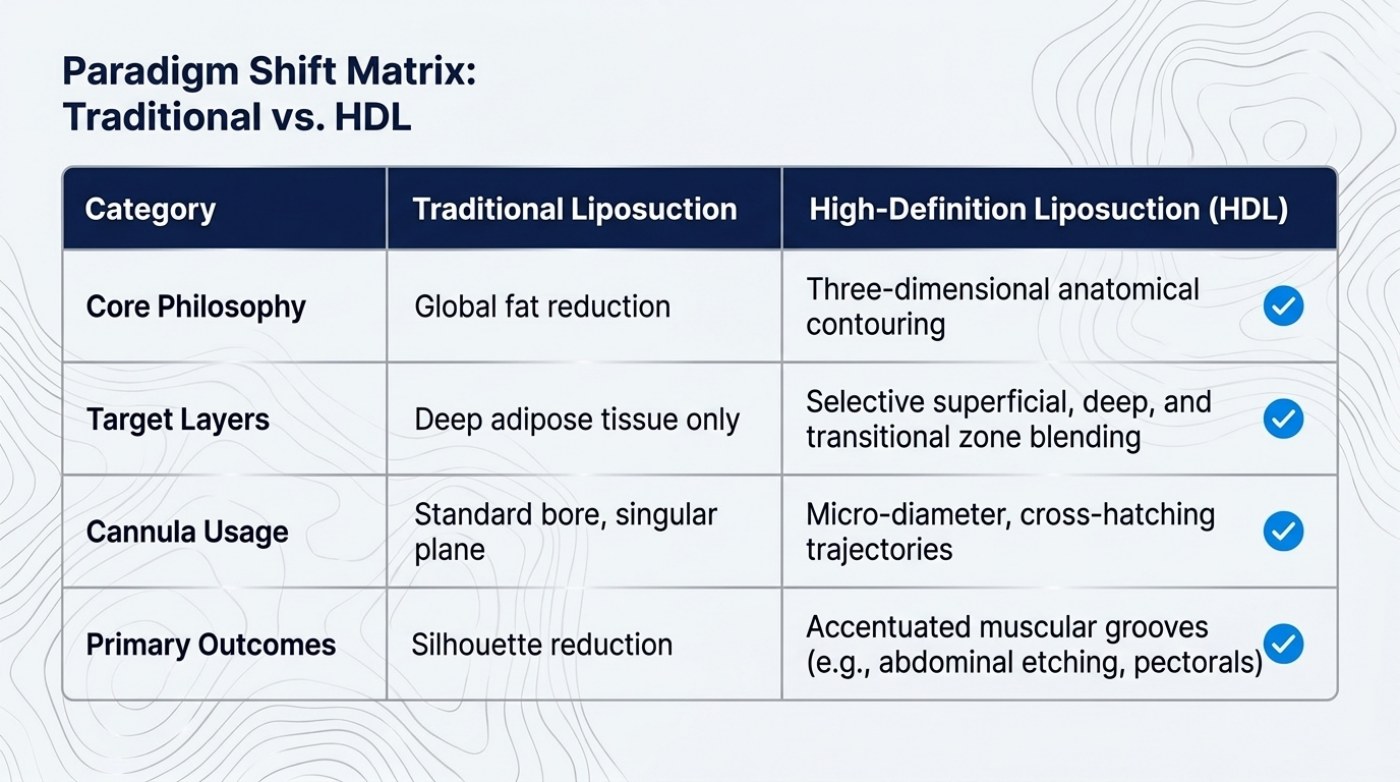
The matrix, exactly as the slide presents it
Copied without embellishment, the matrix compares the two approaches across the four categories. Every claim in the right-hand column carries a check mark on the slide, which is a design choice rather than a clinical statement, and it is worth remembering that the traditional column is not a failed technique — it is the technique that the high-definition column was built on top of.
| Category | Traditional liposuction | High-definition liposuction (HDL) |
|---|---|---|
| Core philosophy | Global fat reduction | Three-dimensional anatomical contouring |
| Target layers | Deep adipose tissue only | Selective superficial, deep, and transitional zone blending |
| Cannula usage | Standard bore, singular plane | Micro-diameter, cross-hatching trajectories |
| Primary outcomes | Silhouette reduction | Accentuated muscular grooves (for example, abdominal etching and pectorals) |
Core philosophy: reduction versus three-dimensional contouring
Global fat reduction is a one-number objective. It is satisfied when the treated region is smaller, and success or failure can be described in volume terms alone. Three-dimensional anatomical contouring is a shape objective. It is satisfied when the surface reads as a particular structure — which means it can fail even when the volume change is exactly what was planned, because a smaller region with an uneven surface has not met the goal.
That single difference in objective explains why the other three rows exist. If the target is a shape rather than a number, then the layer the fat comes from matters, the direction the instrument travels matters, and the visible result is judged on definition rather than on circumference. It also explains why the high-definition column is harder to deliver: a shape objective has more ways to be wrong than a volume objective, and most of them are visible.
Target layers: deep tissue only versus selective blending
The traditional column works in the deep adipose tissue only, which leaves the superficial layer intact as padding over the result. The high-definition column works across three depths — superficial, deep, and the transitional zone between them — with the transitional work described as blending rather than removal. The slide's fourth slide in the deck, which maps the layer architecture, shows why the word blending is load-bearing: the fat immediately under the skin is what supports the surface, and the fat between muscle groups is what produces the shadow that makes definition read as anatomy rather than as a hard-edged channel.
Working in the superficial layer is the part of the technique that carries the most visible risk. The instruments are millimetres from skin that has to sit flat afterwards, and over-thinning that layer is the route to the irregularity that pooled published series describe as the most commonly reported complication of liposuction. The site's published risk guide puts contour deformity at 2.35% in a 39-study meta-analysis and notes that modality-specific pooling shows a wide spread between techniques. The layer approach in the matrix is not ambition; it is the reason the risk profile moves.
Cannula usage and primary outcomes
Standard bore on a singular plane is a description of an instrument and a direction of travel: a larger-diameter instrument moved through one plane, which is an efficient way to remove volume and a blunt way to shape a surface. Micro-diameter instruments crossed in more than one direction do the opposite. They are slower per pass, they demand more judgement about where each pass goes, and they make it possible to follow a muscle boundary instead of averaging across it.
The outcomes row is where the two columns finally look least alike. Silhouette reduction is a change in outline. Accentuated muscular grooves — the slide gives abdominal etching and pectorals as examples — are a change in surface detail that depends on muscle already being present and on skin being able to settle onto the new contour. That dependency is the honest limit of the right-hand column, and the published guidance on this site says the same thing in a different way: definition is a subtraction, so the more muscle a patient already carries, the more there is to reveal.
| Category | What the traditional column accepts | What the HDL column commits to | Where the added difficulty sits |
|---|---|---|---|
| Core philosophy | A smaller silhouette | A contour that reads in three dimensions | Requires a plan drawn against muscle anatomy before the case begins |
| Target layers | Deep fat removed; superficial fat left as padding | Superficial thinning plus deep extraction plus blending between them | The superficial layer sits millimetres from the skin that must support itself afterwards |
| Cannula usage | One plane, standard-diameter instrument | Small-diameter instruments crossed in more than one direction | More passes near the surface, so contour irregularity becomes the failure mode |
| Primary outcomes | Volume change is the visible result | Muscle boundaries become the visible result | Depends on muscle already being present and skin being able to contract |
Where the two columns agree more than they differ
The matrix is a comparison slide, so it emphasises the gap. In practice the two columns share most of their foundation. Both depend on the same anatomy, both are subject to the same published complication categories, and both are governed by the same volume arithmetic: the site's published risk guide records the overall complication rate rising from 1.1% to 3.7% above the five-litre aspirate line, with seroma the main driver, and that threshold applies to a definition case as much as to a reduction case. Whole-trunk definition work sits near that line rather than comfortably beneath it.
Both columns also share the same constraint on skin. Neither removes it, and neither guarantees that it will contract. That is why the deck later separates the fat question from the skin question, and why the site's own guidance keeps pointing to excision as the answer when laxity is the dominant problem rather than the fat itself.
| Presentation | Column whose objective matches the goal | Why |
|---|---|---|
| Localised fat, an athletic baseline, reasonable elasticity | High-definition | There is muscle definition to reveal and skin that can settle onto it |
| Fat to move, no interest in surface detail | Traditional | The objective is volume change, not contour |
| A large volume across the trunk | Neither as a single session | Published rates step up above five litres of aspirate; staging is the published answer |
| Significant loose skin | Excision, not contouring of either kind | Removing fat does not remove skin |
Frequently asked questions
Is traditional liposuction simply an outdated version of HDL?
No, and the matrix does not claim that. Traditional liposuction is the technique the high-definition approach was developed on top of, and it remains the appropriate objective when the goal is a change in volume rather than a change in surface detail. The matrix describes two different objectives rather than a good technique and a bad one.
Why does the layer row matter so much?
Because the superficial fat layer is both the material that blunts a contour and the padding that protects the skin. Removing some of it is what makes muscle boundaries visible; removing too much of it is what produces dimpling and unevenness. The traditional column avoids that risk by leaving the layer alone, which is also why its result stays soft at the surface.
Do the two approaches carry different published risk?
They carry different risk profiles rather than a simple ranking. Pooled published data on this site put contour deformity at 2.35% across a 39-study meta-analysis and show a wide spread between techniques in modality-specific pooling, while volume remains the strongest single lever regardless of technique — the overall rate steps up from 1.1% to 3.7% above five litres of aspirate. Which profile applies in a given case is an assessment for an examining surgeon.
Related reading
- High-Definition Liposuction: How Muscle Etching Actually Works
- Liposuction vs Tummy Tuck vs Body Contouring: Who Each One Suits
- How Much Fat Can Be Removed in One Liposuction Session?
This is published information, not medical advice — a board-certified surgeon must assess whether a procedure suits you.