Two products behind one phrase
The preparation slide in deck drop2_3 exists because of the warning on the slide before it. If the term cell-assisted lipotransfer covers more than one product, then a figure quoted for it is only meaningful once the product is named. So the briefing puts uncultured stromal vascular fraction on one side, culture-expanded adipose-derived stem cells on the other, and compares them across four lines: composition, processing, regulatory status and clinical yield. If you have been weighing up body contour services for a home around Miami, FL, this guide covers how it actually works, what it tends to cost, and where the results usually fall short.
The short version
- The preparation slide separates uncultured stromal vascular fraction from culture-expanded adipose-derived stem cells across composition, processing, regulation and yield.
- Stromal vascular fraction is a heterogeneous mix containing 1 to 10% adipose-derived stem cells, used fresh on the day of a procedure.
- Culture-expanded cells are grown over one to three weeks under GMP conditions to more than 90% purity.
- The reported mean volume retention gains are approximately 17.0% for stromal vascular fraction and 64.6% for culture-expanded cells.
- Uncultured fraction is minimally manipulated autologous tissue, while culture-expanded cells are an Advanced Therapy Medicinal Product requiring an IND.
The two columns are different kinds of thing rather than two grades of the same thing. One is a cell mixture used on the day of a procedure. The other is a cultured product grown over weeks and subject to a different regulatory pathway. The yield figures at the bottom of each column — approximately 17.0% and approximately 64.6% mean volume retention gain — belong to those columns and to nothing else.
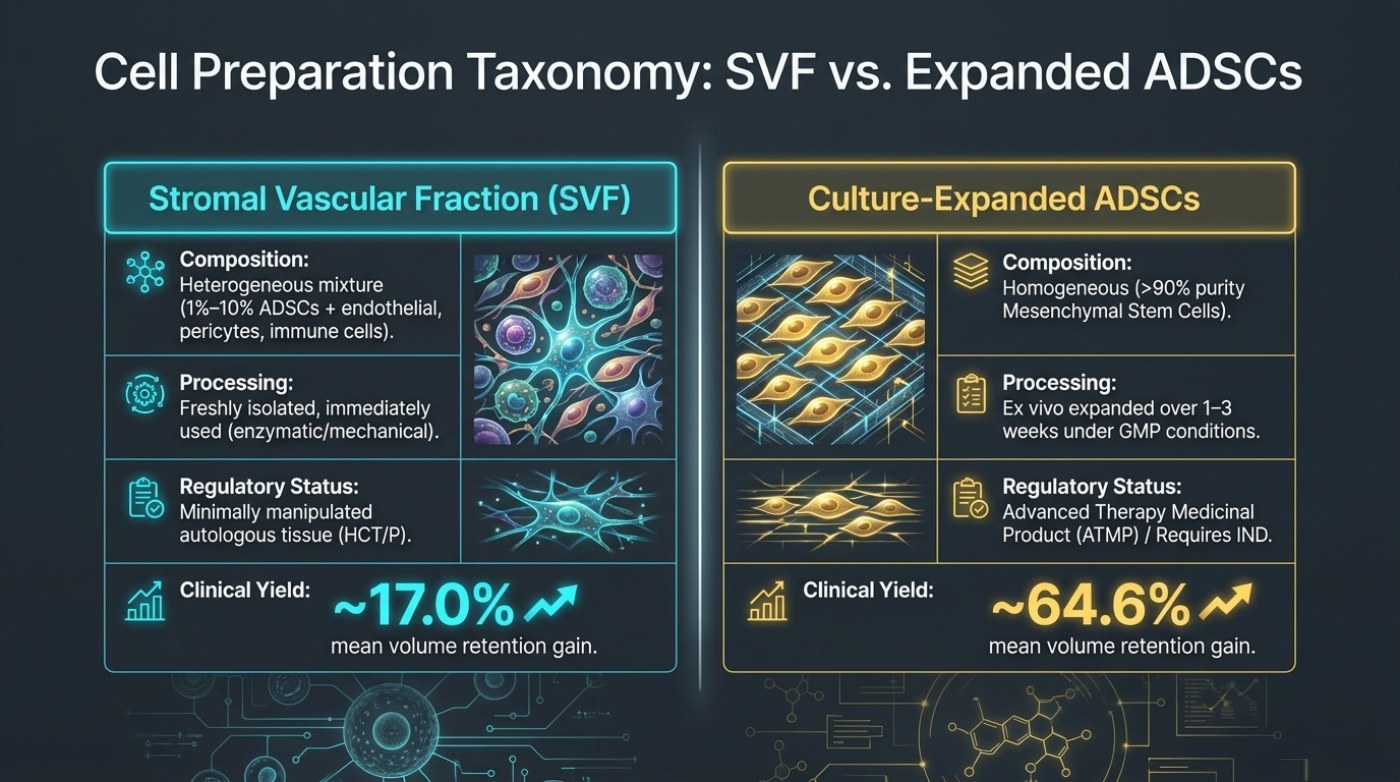
| Line of comparison | Stromal vascular fraction (SVF) | Culture-expanded ADSCs |
|---|---|---|
| Composition | Heterogeneous mixture: 1–10% ADSCs plus endothelial cells, pericytes and immune cells | Homogeneous, more than 90% purity mesenchymal stem cells |
| Processing | Freshly isolated and used immediately, by enzymatic or mechanical means | Expanded ex vivo over 1–3 weeks under GMP conditions |
| Regulatory status | Minimally manipulated autologous tissue (HCT/P) | Advanced Therapy Medicinal Product (ATMP) / requires IND |
| Reported clinical yield | ~17.0% mean volume retention gain | ~64.6% mean volume retention gain |
Composition: a mixture against a culture
On the stromal vascular fraction side the slide gives a range rather than a figure: 1–10% of the cells are adipose-derived stem cells, and the remainder are endothelial cells, pericytes and immune cells. On the cultured side the target is a purity threshold above 90% mesenchymal stem cells. It is tempting to read the second column as the first column cleaned up, and the deck does not support that reading. The cultured product is not the fraction with the other cells removed; it is a different composition, arrived at by selection and multiplication in a laboratory.
That has a practical consequence for anyone comparing the two. When a source describes enrichment without saying which of these products it means, the composition behind the claim is unknown. Our published guide to fat survival draws the same distinction for readers, describing the uncultured fraction as a fresh cell mix in which roughly 1–10% of cells are stem or stromal cells, against culture-expanded cells grown to more than 90% purity.
Processing: same day against one to three weeks
The processing line is where the two routes diverge most plainly. Stromal vascular fraction is freshly isolated and immediately used, and the slide allows for either enzymatic or mechanical isolation. Culture-expanded cells are grown ex vivo over one to three weeks under GMP conditions. That is not only a technical difference. It changes the number of visits, the scheduling, and the amount of laboratory work attached to a procedure that began as a single fat harvest.
Regulatory status: a tissue against a medicinal product
The third row is the one most often left out of comparisons written for the public. Uncultured stromal vascular fraction is described as minimally manipulated autologous tissue, in the HCT/P category. Culture-expanded cells are described as an Advanced Therapy Medicinal Product, and the slide notes that this requires an IND. Those are two different regimes, and they follow from the processing step rather than from where the cells came from: the same patient’s own tissue, handled differently, becomes a different regulatory object.
Put the four lines together and the comparison reads as a checklist rather than a verdict. Nothing in it says which route is right for a given person; it says what each route is, what it asks of the person receiving it, and what it reports.
| Practical question | Stromal vascular fraction (SVF) | Culture-expanded ADSCs |
|---|---|---|
| Sequence of the route | One stage: isolate and use immediately | Two stages: one to three weeks of expansion precede transfer |
| Where the cells are handled | In the procedural setting, at the time of the harvest | In a laboratory under GMP conditions |
| What the product is, legally | Minimally manipulated autologous tissue | Advanced Therapy Medicinal Product |
| What the yield figure describes | ~17.0% mean volume retention gain | ~64.6% mean volume retention gain |
Reading a 17.0% and a 64.6% figure
Both figures are described as mean volume retention gain, which is the first thing to hold on to. They are averages, and they are averages of gains rather than of final outcomes. A mean describes the middle of a distribution of comparisons, so it does not tell a patient what their own graft will do, and the two numbers do not even describe the same schedule of treatment.
The second caution is comparability. The site’s published guide notes that reviews comparing enriched grafting with conventional grafting report improvements in retention while study designs, cell preparation and cell dose vary so much between them that a single percentage does not transfer to an individual case. The figure on this slide is the briefing’s own, attributed to source material rather than to a named study.
The trade is what the slide actually puts on show. The lower figure is attached to a product used on the day of a procedure, with no laboratory phase. The higher figure requires one to three weeks of expansion before anything can be transferred. Whatever the yield difference means, it is not available at the same number of visits, the same cost or under the same rules, and the deck sets them side by side so that the trade stays visible.
What the slide does not say
It does not say the cultured route is better for patients. It reports mean retention gains from source material and attaches them to two named products. It does not say either route is free of risk, and it does not say one route suits every recipient site. The briefing’s subject is preparing tissue to survive an interval, which is a different question from which area is being treated.
Frequently asked questions
Which of the two routes gives better results?
The briefing’s figures attach the larger mean volume retention gain — approximately 64.6% against approximately 17.0% — to culture-expanded cells. Both are described as mean gains in source material rather than as outcomes a patient can expect, and the cultured route adds a one to three week laboratory phase and a different regulatory pathway.
Is the stromal vascular fraction a stem cell product?
It contains stem cells, but only a minority of them. The slide puts the proportion at 1–10%, with endothelial cells, pericytes and immune cells making up the rest. That is why the deck treats precise product definition as critical when retention data is being read.
Why does regulatory status appear in a biological comparison?
Because the processing step determines it. Freshly isolated, minimally manipulated tissue and a product grown in culture for weeks are treated as different things, and the difference follows from the expansion period rather than from where the cells came from.
This is published information, not medical advice — a board-certified surgeon must assess whether a procedure suits you.
Related reading
The preparation question above leads into these articles.
- Why Transplanted Fat Survives — or Does Not — the site’s guide to the avascular phase and the reported retention gains attributed to enriched grafts
- Liposuction Cost Anatomy — what the separate fee lines in a quote cover, which matters once a laboratory phase is added
- Liposuction Risks and Complication Rates as Published — why published complication figures differ so widely depending on the source
Two tools on this site are worth running before a consultation: the quote comparison tool and the cost estimator.