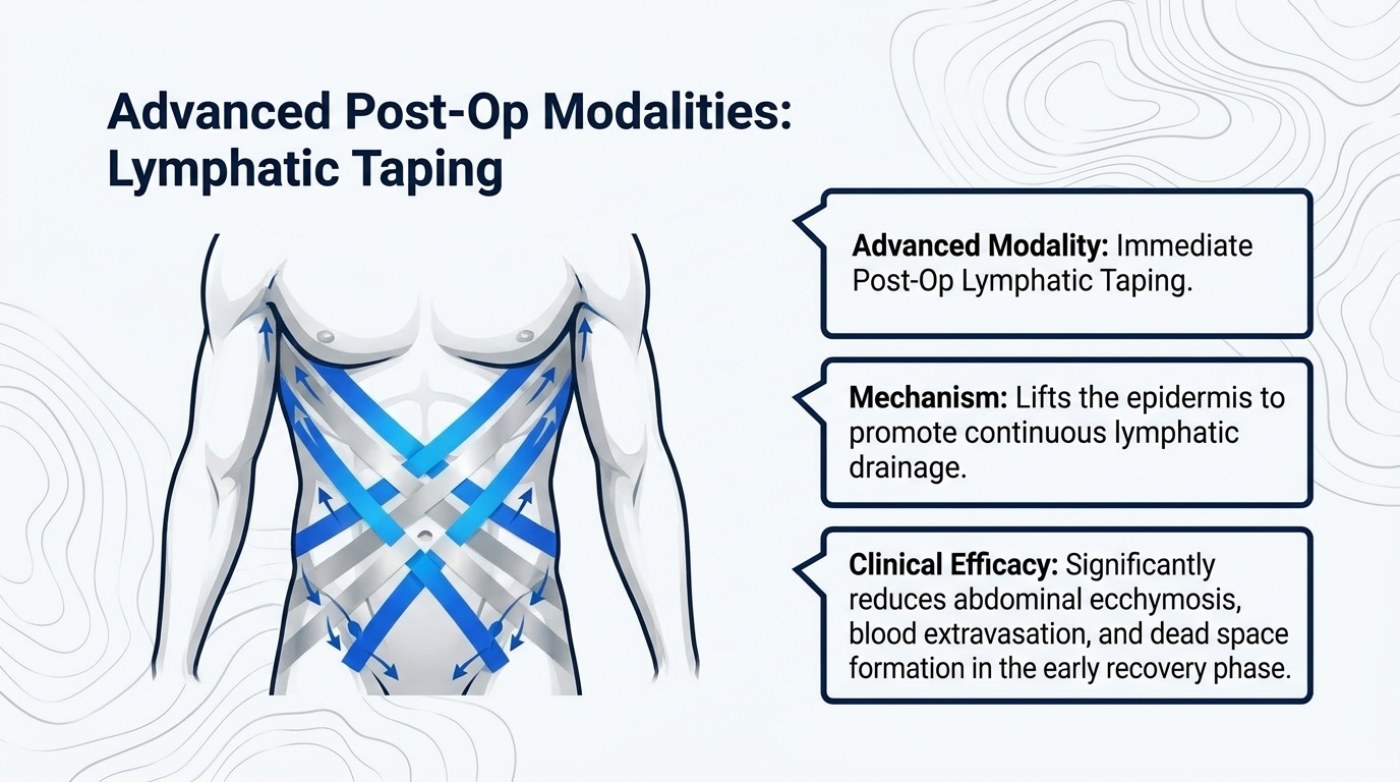
Recovery after liposuction is usually described in milestones — when swelling drops, when compression can be reduced, when exercise resumes. A clinical teaching deck adds a modality that sits earlier in that sequence than most patients expect: immediate post-operative lymphatic taping, applied as a recovery tool in its own right rather than as an afterthought. The slide gives it three lines — what it is, how it is said to work, and what it is claimed to change in the early phase — and each line is worth unpacking, because the modality is often misunderstood as decorative bandaging when the deck frames it as a drainage intervention. This is written for homeowners around Miami, FL who are looking into facial liposuction and want the honest version rather than a sales page.
The short version
- Immediate post-operative lymphatic taping is a recovery intervention that lifts the epidermis to support continuous lymphatic drainage.
- The deck states taping significantly reduces abdominal ecchymosis, blood extravasation and dead space formation during the early recovery phase.
- Taping is applied at the first opportunity after surgery, so it acts while bruising and dead space are still forming.
- The slide presents taping as a continuously acting surface-level layer, not a replacement for compression garments or hands-on drainage sessions.
- No percentage is attached to taping efficacy; the deck states the mechanism and a qualitative early-phase claim only.
The distinction matters in a field where the first two weeks set the conditions for everything that follows. Fluid that is not moved collects; skin that does not settle redrapes unevenly. Taping, in the deck's account, is aimed squarely at the fluid side of that equation.
What the modality is
The deck names it plainly: immediate post-operative lymphatic taping, applied at the first opportunity after surgery rather than days later. The word immediate carries the argument — the intervention is positioned to act while the early recovery phase is still unfolding, when ecchymosis, extravasated blood and dead space are actively forming rather than already established.
| Element | As stated in the source deck |
|---|---|
| Modality | Immediate post-op lymphatic taping |
| Mechanism | Lifts the epidermis to promote continuous lymphatic drainage |
| Stated clinical efficacy | Significantly reduces abdominal ecchymosis, blood extravasation and dead space formation in the early recovery phase |
| Timing | Immediate post-operative application |
The proposed mechanism: lifting the epidermis
The mechanism the deck describes is mechanical, not pharmacological. The tape lifts the epidermis — raising the most superficial layer away from the tissue beneath it — and the deck states that this lift promotes continuous lymphatic drainage. In plain terms, the creation of a small amount of space at the surface is said to give lymph a route it would not otherwise have in tissue that has been undermined, infiltrated with tumescent fluid and then compressed by a garment.
Because the effect is described as continuous, the modality occupies a different role from hands-on drainage sessions, which happen at intervals. The deck does not claim the tape replaces manual lymphatic drainage or compression; it positions taping as a continuously acting layer within a broader recovery programme, and the slide is careful to describe mechanism and efficacy separately rather than merging them.
What the deck says it changes in the early phase
The stated clinical efficacy is specific and worth quoting closely: significantly reduced abdominal ecchymosis, blood extravasation and dead space formation in the early recovery phase. Three distinct targets are named, and they are related but not identical.
Ecchymosis is bruising — discolouration caused by blood outside the vessels in the soft tissues. Blood extravasation is the leakage itself, the movement of blood out of the vessels into surrounding tissue. Dead space formation is the cavity that remains where fat has been removed and tissue has not yet re-adhered. The deck's claim is that taping acts on all three in the same early window, which is consistent with its stated mechanism: if lifting the epidermis maintains a drainage route, fluid and blood have somewhere to go instead of pooling, and less pooling means less dead space becoming established.
Taping beside the other early-phase tools
Taping does not appear in the deck in isolation. It sits alongside the drainage and compression routes the deck develops on neighbouring slides, and the modalities target different things.
| Early-phase tool | Primary target | Phase it belongs to |
|---|---|---|
| Lymphatic taping (deck) | Epidermal lift to support continuous drainage; ecchymosis, extravasation, dead space | Immediate post-op onward |
| Manual lymphatic drainage (deck) | Accelerated fluid clearance | Initiated in the first week |
| Compression garments (deck) | Dead space control, edema, skin redraping | High compression weeks 1–2, then moderated |
| Closed-suction drainage (deck) | Post-operative fluid accumulation in higher-volume cases | Tailored to the case |
The comparison clarifies the deck's logic: taping is not a substitute for compression or hands-on drainage but an additional surface-level mechanism, useful precisely because it is continuous. Where a garment delivers uniform pressure and a therapist delivers intermittent technique, taping is pitched as a persistent lift.
There is also a practical argument for layering the modalities rather than choosing between them. Each acts on a different part of the fluid problem: a garment compresses the tissue from outside, a therapist moves fluid through technique at intervals, a drain provides an exit route, and tape is said to hold the surface open between all of those. The deck presents them as a stack of complementary mechanisms operating across the same early window, which is a more modest claim than the idea that any one of them carries the whole recovery.
The published baseline that any recovery intervention is measured against is the seroma and haematoma data: pooled seroma rates of roughly 0.65% to 2%, haematoma rates of about 0.27% to 1%, and higher seroma pooling in specific modality subgroups. The deck's taping slide makes no numerical efficacy claim of its own; its contributions are qualitative and phase-specific, so it is reported here as the deck states it rather than translated into a percentage.
Frequently asked questions
Is lymphatic taping the same as compression?
No. The deck describes compression as pressure that controls dead space and edema, and taping as a lift of the epidermis that supports continuous drainage. They are listed as separate mechanisms acting in the same early phase, not as variants of one another.
Does the deck give a success rate for taping?
It does not. The slide states the mechanism and a qualitative efficacy claim about ecchymosis, blood extravasation and dead space in the early phase. No percentage appears on the slide, so none is attached here.
Why does timing matter so much in the deck's account?
Because the three targets it names — bruising, blood extravasation and dead space — are described as forming in the early recovery phase. Applying the modality immediately is what puts it in contact with a process that is still active.
This is published information, not medical advice — a board-certified surgeon must assess whether a procedure suits you.
Related reading
- Compression garments and lymphatic massage after liposuction — how the pressure and drainage routines fit together
- Liposuction recovery week by week — the timeline this early-phase modality sits inside
- High-definition liposuction: how muscle etching works — why surface-level recovery care matters more in sculpting