The Tension the Slide Is Built Around
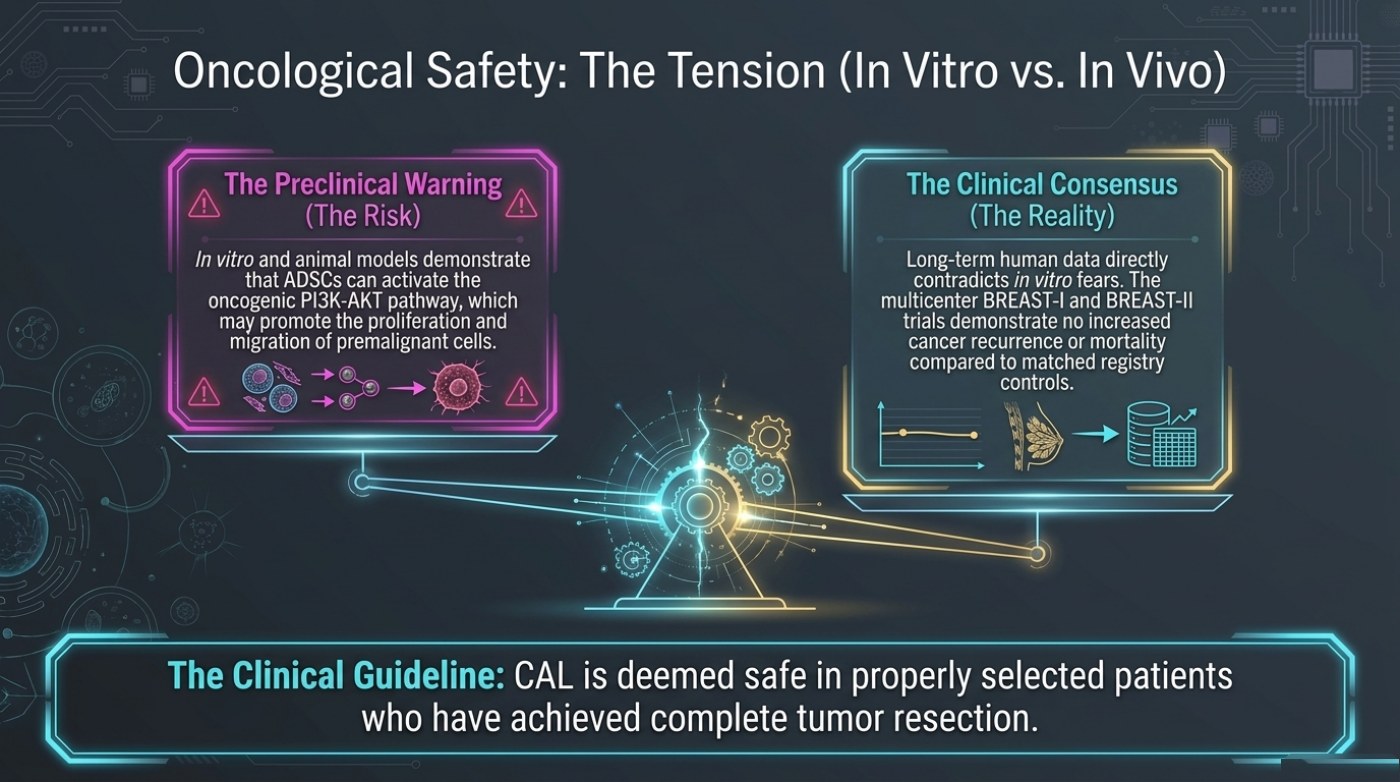
Slide 13 is the one slide in this deck that addresses risk head-on, and its title states the structure: "Oncological Safety: The Tension (In Vitro vs. In Vivo)." Two panels face each other across the slide. On the left, in warning colours, is what the deck calls the preclinical warning; on the right, in cooler tones, is what it calls the clinical consensus. A band across the bottom carries the guideline the deck draws from the two. This is written for homeowners around Miami, FL who are looking into body contour services and want the honest version rather than a sales page.
The short version
- The slide sets a preclinical warning against a clinical consensus, framing the oncological safety question as a difference in scope.
- In vitro and animal models show ADSCs can activate the oncogenic PI3K-AKT pathway, which may promote premalignant cell proliferation.
- The slide says the multicentre BREAST-I and BREAST-II trials found no increased cancer recurrence or mortality versus matched registry controls.
- Its guideline deems CAL safe in properly selected patients who have achieved complete tumour resection, a conditional judgement.
- Long-term surveillance remains the published practice after fat grafting in patients with a history of breast cancer.
That layout is a fair description of how the question is actually argued in the literature. Laboratory work and animal models can show what a cell population is capable of under controlled conditions. Clinical follow-up can only show what happened to patients who were treated. Those two kinds of evidence answer different questions, and when they appear to disagree, the disagreement is usually about scope rather than about fact. The slide is worth reading on its own terms, and the claims below are reported exactly as the slide states them.
The Preclinical Warning, as the Slide States It
The left panel reads: in vitro and animal models demonstrate that ADSCs can activate the oncogenic PI3K-AKT pathway, which may promote the proliferation and migration of premalignant cells. Three words in that sentence carry the weight. "In vitro and animal models" sets the setting. "Can" describes capability rather than what happened. "May promote" is the modal the slide chose for the consequence. The pathway named, PI3K-AKT, is one of the most frequently activated signalling routes in human cancer, which is precisely why the question gets asked at all when a cell population that secretes growth and angiogenic factors is placed into a recipient bed.
It is important not to soften that panel, because softening it in either direction would misrepresent the source. What the slide says is that the capability exists in laboratory conditions and that a causal chain leading to a clinical risk has been hypothesised. What it does not say is that the effect was observed in patients.
The Clinical Consensus, as the Slide States It
The right panel reads: long-term human data directly contradicts in vitro fears, and the multicentre BREAST-I and BREAST-II trials demonstrate no increased cancer recurrence or mortality compared to matched registry controls. The comparison group in that sentence is the part to hold onto. A matched registry control is a comparison against patients who were not treated with the same technique but who were otherwise comparable, which is a stronger design than a case series reporting no recurrences. The reported endpoints are recurrence and mortality, the two outcomes that would matter most if the preclinical concern translated into clinical reality.
The bottom band states the clinical guideline as the slide gives it: CAL is deemed safe in properly selected patients who have achieved complete tumour resection. Each clause is doing work. "Deemed safe" describes a professional judgement made on the available evidence, not a property of the technique. "Properly selected" and "who have achieved complete tumour resection" are the eligibility conditions the slide attaches, and they are not decorative — they define the population the judgement was made about. A reader should take the whole sentence or none of it.
| Panel | Exactly as the slide states it | Scope the wording sets |
|---|---|---|
| The preclinical warning (in vitro / animal) | ADSCs can activate the oncogenic PI3K-AKT pathway, which may promote the proliferation and migration of premalignant cells | Laboratory and animal work; capability and hypothesis, not observed patient outcomes |
| The clinical consensus (in vivo / human) | Long-term human data directly contradicts in vitro fears; the multicentre BREAST-I and BREAST-II trials show no increased cancer recurrence or mortality versus matched registry controls | Long-term human follow-up with a matched comparison group; endpoints are recurrence and mortality |
| The clinical guideline | CAL is deemed safe in properly selected patients who have achieved complete tumour resection | Conditional on selection and on complete tumour resection |
How to Hold Both Panels at Once
The temptation with a slide like this is to pick a side. The slide itself does not. It presents the laboratory finding as a real finding, presents the clinical follow-up as the evidence that bears on patients, and then states a guideline that is explicitly conditional on who is selected. Read that way, the two panels are not in contradiction; they are at different levels of evidence, and the deck is using the tension between them to explain why the safety question is asked at all.
One point the slide does not supply, and which belongs with any discussion of it: whatever any single trial reports, long-term surveillance remains the published practice after fat grafting in patients with a history of breast cancer. Surveillance is how the long-term data the slide cites was generated in the first place, and it is what keeps the evidence base current. Nothing on the slide supports reading the guideline as a guarantee for an individual patient, and the deck does not present it that way. The eligibility conditions and the need for continued follow-up are the parts of this slide that carry over into individual decisions, and those are decisions for a qualified surgeon with the full clinical picture.
One more distinction is worth keeping separate. The slide's two panels address different populations: the laboratory work concerns cells under experimental conditions, while the clinical evidence concerns patients who had already undergone tumour resection and reconstruction, and the guideline is narrower still. Reading the panels at the same level of generality is where summaries of this evidence most often go wrong, in either direction.
| Element on the slide | What it supports | What it does not support |
|---|---|---|
| PI3K-AKT activation in vitro and in animal models | That a mechanistic concern exists and warrants investigation | That the effect occurs in treated patients |
| BREAST-I and BREAST-II versus matched registry controls | That the published long-term human comparison showed no increase in recurrence or mortality | That any individual outcome is assured |
| Deemed safe in properly selected patients after complete tumour resection | A conditional professional judgement in a defined population | A general clearance, or applicability outside those conditions |
| Continued long-term surveillance as published practice | Ongoing monitoring after treatment | That monitoring can be discontinued |
Frequently Asked Questions
What does the slide actually say about the PI3K-AKT pathway?
It says that in vitro and animal models demonstrate that ADSCs can activate the oncogenic PI3K-AKT pathway, which may promote the proliferation and migration of premalignant cells. The wording describes laboratory capability and a hypothesised consequence rather than an outcome measured in patients.
What do BREAST-I and BREAST-II show on this slide?
The slide states that the multicentre BREAST-I and BREAST-II trials demonstrate no increased cancer recurrence or mortality compared to matched registry controls, and that long-term human data directly contradicts the in vitro fears. Those are the trial outcomes as the source material reports them.
Does this slide mean the question is settled for every patient?
No. The slide states a conditional guideline — CAL is deemed safe in properly selected patients who have achieved complete tumour resection — and that wording is specific about the population. Long-term surveillance remains the published practice after treatment, and individual assessment belongs with a qualified surgeon, not with a slide.
This is published information, not medical advice — a board-certified surgeon must assess whether a procedure suits you.
Related Reading
- Why Transplanted Fat Survives — or Does Not
- Verifying Surgeon Credentials and Facility Accreditation
- Liposuction Risks and Complication Rates as Published
Estimating and comparing your own situation: risk and volume limits credentials verifier.