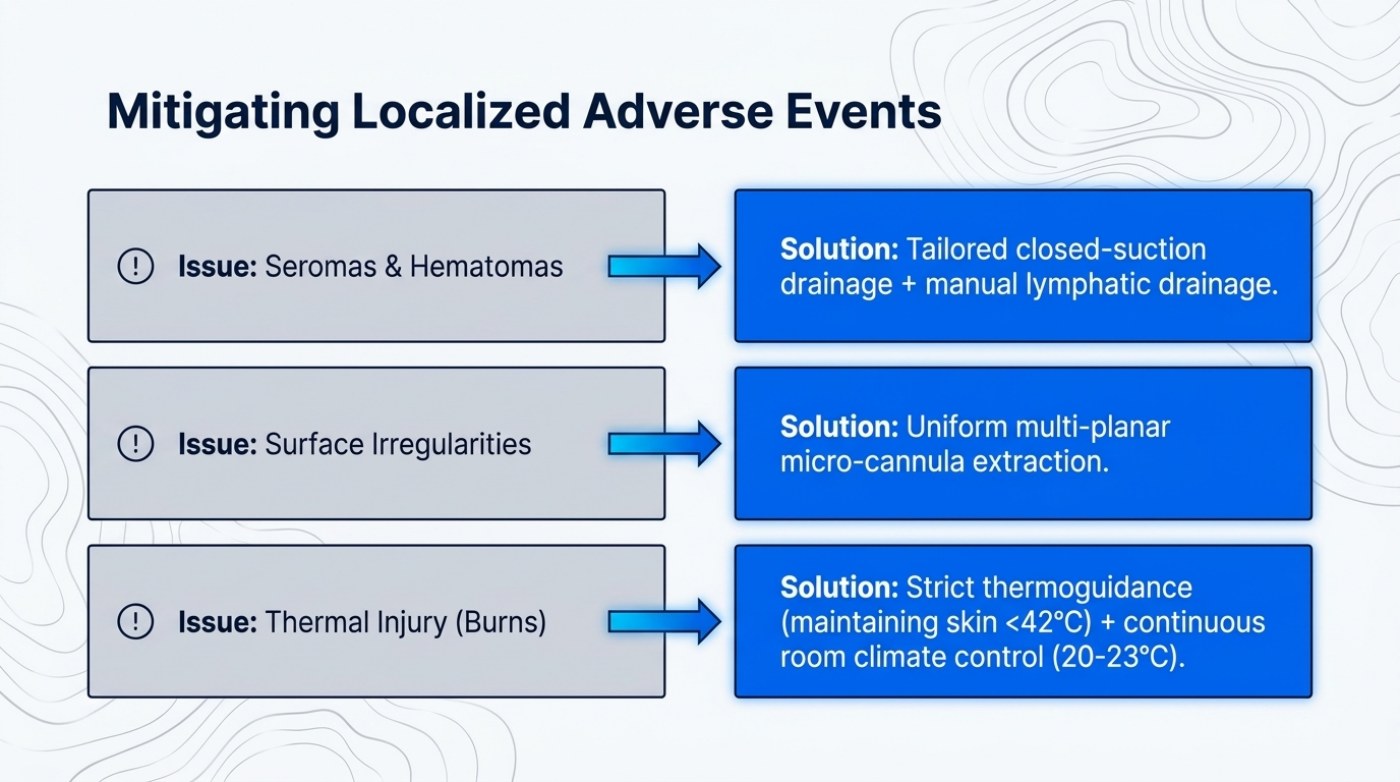
Most of what goes wrong after liposuction is not dramatic. A clinical teaching deck on high-definition liposuction (HDL) gives an entire slide to three local adverse events — seromas and hematomas, surface irregularities, and thermal injury — because these are the complications that recur in practice, and because each one has a distinct mechanism that points to a distinct counter-measure. The slide is built as a simple matrix: the issue on the left, the response on the right. Read beside the published complication literature, that matrix is less a worst-case list than a map of where attention has to sit — on fluid, on the evenness of removal, and on heat. Most homeowners who read this are comparing facial liposuction options around Miami, FL, so what follows sticks to the details that change in practice.
The short version
- The deck addresses three local adverse events after liposuction: seromas and hematomas, surface irregularities and thermal injury.
- Fluid collections are met with tailored closed-suction drainage plus manual lymphatic drainage, matching the response to the mechanism.
- Uneven removal is countered by uniform multi-planar extraction through micro-cannulas to keep the tissue interface even.
- Heat is managed by keeping skin below 42 °C and holding the room climate between 20 and 23 °C continuously.
- Contour irregularity is the most commonly reported complication in pooled data, at about 2.35% in one meta-analysis.
What follows works through the deck's three pairings one at a time, then sets them against the complication rates that appear in the peer-reviewed literature. The aim is to make the link between a mechanism and its mitigation legible, not to reduce any of it to a single number.
The deck's three pairings
The source deck states each issue and its solution as a matched pair, and the pairing is the point: a counter-measure only means something against the mechanism it addresses.
| Issue | Named mechanism | Counter-measure as stated in the source deck |
|---|---|---|
| Seromas & hematomas | Fluid and blood collecting in the space left behind after fat removal | Tailored closed-suction drainage + manual lymphatic drainage |
| Surface irregularities | Uneven removal across tissue planes, leaving ridges and depressions | Uniform multi-planar micro-cannula extraction |
| Thermal injury (burns) | Heat delivered to tissue beyond what skin can tolerate | Strict thermoguidance (maintaining skin <42°C) + continuous room climate control (20–23°C) |
Two of the three rows carry a number, and both numbers are framed in the deck as operating limits rather than outcomes: a skin temperature to stay under, and a room-temperature band to stay within. That framing is worth noticing, because it treats prevention as a set of constraints on the procedure rather than a promise about the result.
Seromas and hematomas: fluid and blood where fat used to be
A seroma is a collection of lymphatic fluid in the dead space that remains after fat is removed; a hematoma is the blood equivalent. Both are among the most frequently reported local events after liposuction, and both track with how much was removed and how much tissue was undermined. The deck's response is deliberately two-part: closed-suction drainage tailored to the case, plus manual lymphatic drainage.
Tailoring matters because a high-volume aspirate over a large undermined area behaves differently from a small, targeted etch, and one drainage strategy does not fit both. Published rates for seroma in pooled analyses run from roughly 0.65% to 2%, and climb in specific modality subgroups: a systematic review of contemporary liposuction techniques pooled seroma at about 3.93% for radiofrequency-assisted liposuction. Haematoma sits lower, at about 0.27% to 1% depending on the pooled set and its definitions.
Surface irregularities: the case for uniform multi-planar extraction
The second row is a mechanical problem rather than a fluid one. If fat is removed unevenly — deep in one spot, shallow in the next — the surface casts a shadow the eye reads as a ridge or a dent. The deck's counter-measure is uniform, multi-planar extraction through micro-diameter cannulas: the same cross-hatching logic that appears earlier in the deck's cannula-dynamics material, applied specifically to keep the tissue interface even.
The published data support the direction of travel. Contour irregularity is the most commonly reported complication in every pooled dataset — about 2.35% in one meta-analysis and 2% in another — and modality-specific pooling shows a wide spread, with roughly 0.12% for ultrasound-assisted liposuction against roughly 3.36% for traditional suction-assisted liposuction. The figure moves with technique, not with the patient alone.
Thermal injury and the 42°C line
The third row concerns energy-adjunct devices, which raise tissue temperature to liquefy fat, coagulate vessels, or contract collagen. The benefit and the hazard come from the same mechanism, which is why the deck pairs the device with strict thermoguidance rather than treating heat as a free input. The stated operating envelope is a skin temperature kept below 42°C, combined with continuous control of the room climate between 20 and 23°C.
In the published literature thermal injury is rare but visible. A systematic review of contemporary techniques pooled thermal burn at about 1.64% for radiofrequency-assisted liposuction — low in absolute terms, but the highest of the modality-specific events that review reported. That is the number the deck's 42°C constraint is aimed at.
Where the published rates sit
The three local events the deck names map onto published complication tables with reasonable clarity. The rates below are population-level figures from named publications, useful as a magnitude check rather than as any individual's probability.
| Event | Published rate | Source data set |
|---|---|---|
| Seroma | 0.65% (Comerci); 2% (Aljerian); ≈3.93% RF-assisted | Pooled meta-analyses; systematic review of contemporary techniques |
| Haematoma | 0.27% (Comerci); 1% (Aljerian) | Both meta-analyses |
| Contour deformity / irregularity | 2.35% (Comerci); 2% (Aljerian) | Both meta-analyses |
| Thermal injury (RF-assisted) | ≈1.64% | Systematic review of contemporary techniques |
| Overall complications | 2.62% (39 studies) / 12% (60 studies) / 1.16% (registry) | Comerci et al.; Aljerian et al.; Saad et al. |
Two readings follow. First, the events the deck singles out are, in published terms, the common ones — seroma and contour irregularity recur as the most frequent entries in pooled datasets, while thermal injury is rare and modality-specific. Second, the same event can carry different numbers in different publications because the studies define a complication differently; a treated area with slight rippling counts in one analysis and not in another.
Frequently asked questions
Is a seroma a sign something went wrong?
Not necessarily. A seroma is a recognised local event after liposuction and appears in every pooled dataset, usually at a low single-digit rate. The deck treats it as a problem to be managed with drainage and lymphatic support rather than as an aberration, which matches how the published literature reports it.
Do thermal burns only happen with laser devices?
The mechanism is heat, so it applies to any energy-adjunct that raises tissue temperature — ultrasound, radiofrequency and plasma included. Published pooling shows thermal injury concentrated around radiofrequency-assisted techniques, at about 1.64% in one systematic review, which is why the deck links thermoguidance to a specific skin-temperature limit.
Does the 42°C figure come from a study?
The source deck states it as an operating limit for thermoguidance and as part of a room-climate range of 20 to 23°C. This article reports it as the deck's stated constraint, not as a study finding.
This is published information, not medical advice — a board-certified surgeon must assess whether a procedure suits you.
Related reading
- Liposuction risks and complication rates as published — the full rate table, with the source behind every number
- Compression garments and lymphatic massage after liposuction — the routine that supports fluid management in the recovery weeks
- Heat-based skin tightening: what the numbers mean — the subdermal temperature targets behind energy-assist devices