Three of the four mechanisms in this presentation are described in the language of chemistry: growth factors released, immune states shifted, intracellular proteins raised and suppressed. The fourth is described in the language of physics. Titled Mechanism 4: Intercellular Mitochondrial Transfer, it sets out a route by which one cell physically hands working components to another — not a signal that persuades a neighbour to change, but a transfer of material along a physical connection.
The short version
- The fourth mechanism in the deck describes mitochondrial transfer as a physical rescue circuit rather than chemical signalling.
- ADSCs build tunnelling nanotubes to connect directly with stressed, hypoxic recipient cells, including macrophages, adipocytes and endothelial cells.
- The slide says functional mitochondria cross the nanotube to restore the recipient cell's bioenergetic function under ischemic and oxidative stress.
- Thymosin beta-4 pre-treatment is described as enhancing the transfer through the Rac and F-actin pathway in laboratory work.
- Published reviews describe volume loss across conventional grafting of between 30% and 80%, tying the mechanism to harvest variables.
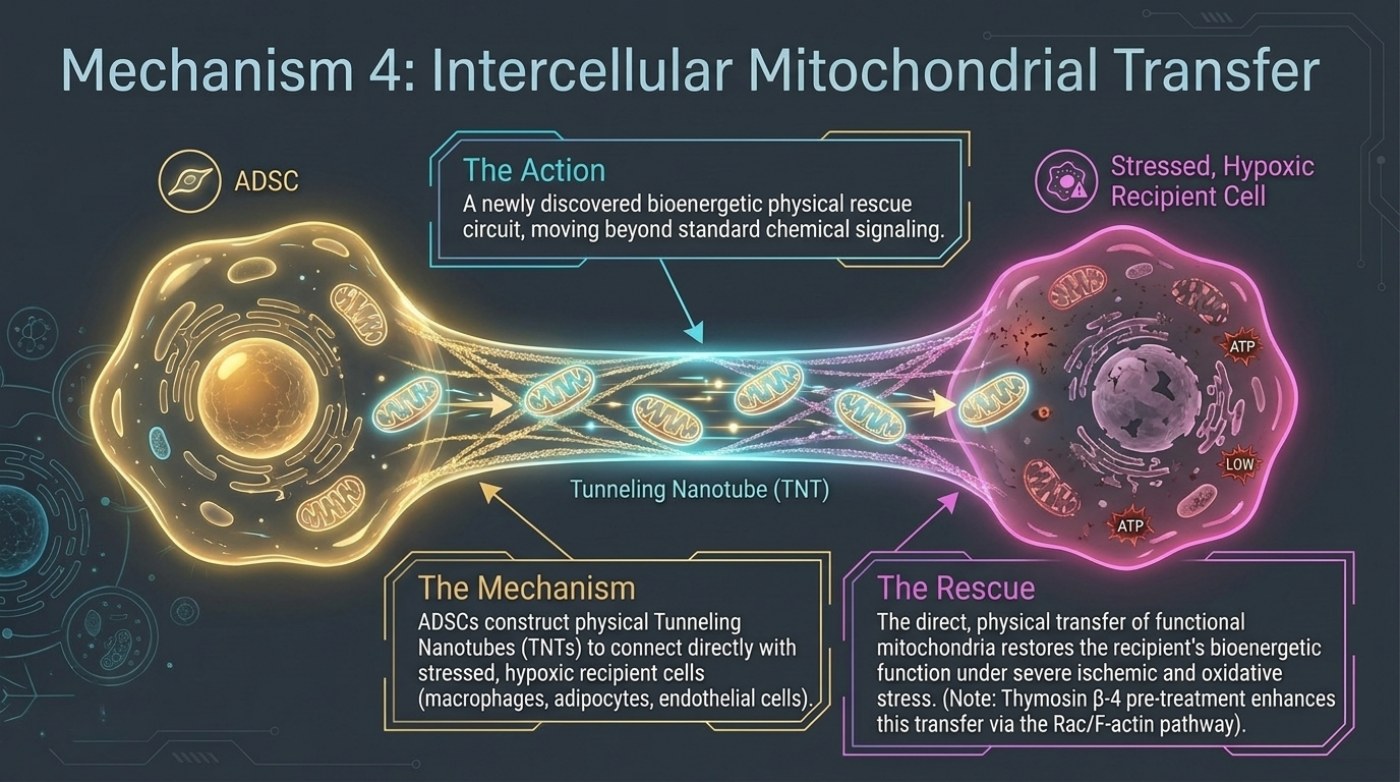
The slide presents this as a recent addition to the picture. Its "Action" panel calls it a newly discovered bioenergetic physical rescue circuit, "moving beyond standard chemical signaling". The graphic is a wide, luminous bridge between two cells. On the left, a golden cell labelled ADSC. On the right, a magenta cell labelled "Stressed, Hypoxic Recipient Cell", containing small starbursts marked ATP and marked LOW. Along the bridge, small bean-shaped structures are shown in transit. The bridge itself is labelled "Tunneling Nanotube (TNT)".
Chemical signalling and physical transfer are not the same thing
The distinction the slide is drawing is worth taking slowly, because it is the reason this mechanism is presented separately from the others. In chemical signalling, a cell releases a molecule and that molecule interacts with receptors on another cell, changing what the receiving cell does with its own resources. In the transfer described here, the receiving cell is not being told what to do — it is being given something it can no longer make enough of for itself. The slide's phrase for the outcome is a restoration of the recipient's bioenergetic function.
The recipient matters as much as the transfer. The slide names the cells on the receiving end: macrophages, adipocytes and endothelial cells. Those are three of the cell types that a graft depends on — the immune cells that shape the local environment, the fat cells that are the point of the transfer, and the vessel-lining cells that will reconnect the graft to a blood supply. A mechanism that supports all three is doing work across the same ground the other three mechanisms cover.
| Feature | Chemical signalling (mechanisms 1-3) | Physical transfer (this slide) |
|---|---|---|
| What crosses the gap | Released factors, vesicles and signals | Functional mitochondria moved along a physical connection |
| How the connection is made | No direct connection required; signals diffuse to target cells | ADSCs construct physical tunnelling nanotubes (TNTs) to connect directly with recipient cells |
| What the recipient contributes | Responds to the signal with its own machinery | Receives working components it cannot supply itself under stress |
| Slide's framing | Described as standard chemical signalling | Described as a bioenergetic physical rescue circuit |
| Named recipient cells | Endothelial cells, progenitor cells, immune cells, fibroblasts | Macrophages, adipocytes, endothelial cells |
The four panels on the slide
The Action panel frames the mechanism as a bioenergetic physical rescue circuit, moving beyond standard chemical signalling. The Mechanism panel states that ADSCs construct physical tunnelling nanotubes to connect directly with stressed, hypoxic recipient cells — the three cell types named above. The Rescue panel describes the direct, physical transfer of functional mitochondria as restoring the recipient's bioenergetic function under severe ischemic and oxidative stress. And a parenthetical note at the foot of that panel adds a condition: Thymosin β-4 pre-treatment enhances this transfer via the Rac/F-actin pathway.
That last line is the most specific thing on the slide, and it is also the one that sits furthest from clinical practice. It describes a laboratory observation about a pre-treatment that increases the efficiency of the transfer, and it names the intracellular route — Rac, and the actin cytoskeleton — through which the nanotubes are extended. Nothing on the slide indicates that this is anything other than a mechanism finding.
| Panel | Slide wording | What it contributes |
|---|---|---|
| The Action | A newly discovered bioenergetic physical rescue circuit, moving beyond standard chemical signaling | Positions the mechanism as distinct from the growth-factor and immune-signalling routes |
| The Mechanism | ADSCs construct physical tunnelling nanotubes (TNTs) to connect directly with stressed, hypoxic recipient cells (macrophages, adipocytes, endothelial cells) | Names the structure and the three recipient cell types |
| The Rescue | The direct, physical transfer of functional mitochondria restores the recipient's bioenergetic function under severe ischemic and oxidative stress | States the intended effect on the receiving cell |
| Parenthetical note | Thymosin β-4 pre-treatment enhances this transfer via the Rac/F-actin pathway | Records that the transfer efficiency is described as modifiable in laboratory work |
What "bioenergetic" means here
The word is doing a specific job on this slide. Mitochondria are the structures inside cells that produce most of the chemical energy the cell runs on, and ATP — adenosine triphosphate — is the molecule that carries that energy to wherever it is needed. The slide labels the recipient cell's ATP as low, which is what "stressed, hypoxic" looks like at the level of a cell's energy books: not enough oxygen, therefore not enough energy production, therefore a cell that is struggling to do the ordinary maintenance work of staying alive.
Two kinds of stress are named in the Rescue panel. Ischemic stress means a shortage of blood supply, which is the defining condition of a freshly placed graft. Oxidative stress means damage caused by reactive molecules produced under those conditions. The claim on the slide is that handing over working mitochondria addresses the first and blunts the second, because a cell that can generate energy is better able to manage the damaging by-products of a poor oxygen supply.
| Term | As used on the slide | Plain-language note |
|---|---|---|
| Tunnelling nanotube (TNT) | The physical structure the ADSC builds to connect directly with a stressed recipient cell | A fine, actin-based tube between cells, long enough to move material across |
| Mitochondria | The functional components transferred along the nanotube | The cell's energy-producing structures, not merely a signal |
| ATP | Marked LOW on the recipient cell in the diagram | The molecule that carries usable energy inside a cell |
| Ischemic stress | Named as one of the two stresses the transfer addresses | Stress caused by inadequate blood supply — the condition of a graft before revascularisation |
| Oxidative stress | Named alongside ischemic stress | Damage from reactive molecules generated when oxygen supply is poor |
| Thymosin β-4 | Described as a pre-treatment that enhances the transfer | A laboratory observation, not a clinical protocol |
| Rac / F-actin pathway | The route the slide says the enhancement works through | Signalling that reorganises the cell's actin skeleton so a nanotube can extend |
How this sits with the rest of the deck
The site's guide to why transplanted fat survives already lists this mechanism among the events described in the source material, alongside pro-angiogenic growth-factor secretion and the shift of macrophages toward the anti-inflammatory M2 phenotype. It describes the shared premise this way: a grafted fat cell has no blood supply when it lands, the cells that survive the first days do so by diffusion alone, and everything that happens before the fat reaches its destination is a survival variable.
Mitochondrial transfer is the mechanism in the deck that sits closest to that premise, because it addresses the transplant's defining problem directly — a cell in an ischemic bed with insufficient energy to wait. It is also the mechanism with the least clinical translation behind it, and the slide says as much by calling it newly discovered. Our fat-graft guide notes that published reviews describe reported volume loss across conventional grafting of between 30% and 80%, and that harvesting variables are documented determinants of how much of the graft arrives intact: a three-patient comparison reported adipocyte counts 47% higher immediately after harvest at −250 mmHg than at −760 mmHg, with better viability at day seven. A mechanism that depends on recipient cells being alive enough to accept a transfer is only as good as the cells that survived the harvest in the first place.
Frequently asked questions
Is mitochondrial transfer something patients can be offered now?
No. The slide describes it as a newly discovered biological circuit and describes the enhancing pre-treatment as a laboratory observation. Nothing in the presentation describes a clinical service, a dose or a schedule, and the site's fat-graft guide places cell-level mechanisms of this kind in the research literature rather than in established aesthetic protocols.
How is this different from the angiogenesis mechanism?
The angiogenesis slide is about reconnecting the graft to a blood supply from outside — the host's vessels growing in. This slide is about keeping the graft's own cells and their neighbours functional while that connection is being made. They address the same window from opposite ends: one restores supply, the other maintains demand-side capacity.
Why does the slide mention a pre-treatment at all?
Because the transfer efficiency is described as modifiable. The note records that Thymosin β-4 increases the transfer through the Rac/F-actin pathway in laboratory work. That is a finding about the mechanism, not guidance about what should be done before a procedure — the site does not publish dosing or preparation instructions of any kind.
Related reading
Why Transplanted Fat Survives — or Does Not — the avascular phase, harvest settings and enrichment routes in one guide.
Liposuction Risks and Complication Rates as Published — the pooled figures, with a named source behind each one.
Liposuction vs Tummy Tuck vs Body Contouring — three different services that get grouped as one, and who each one suits.
This is published information, not medical advice — a board-certified surgeon must assess whether a procedure suits you.