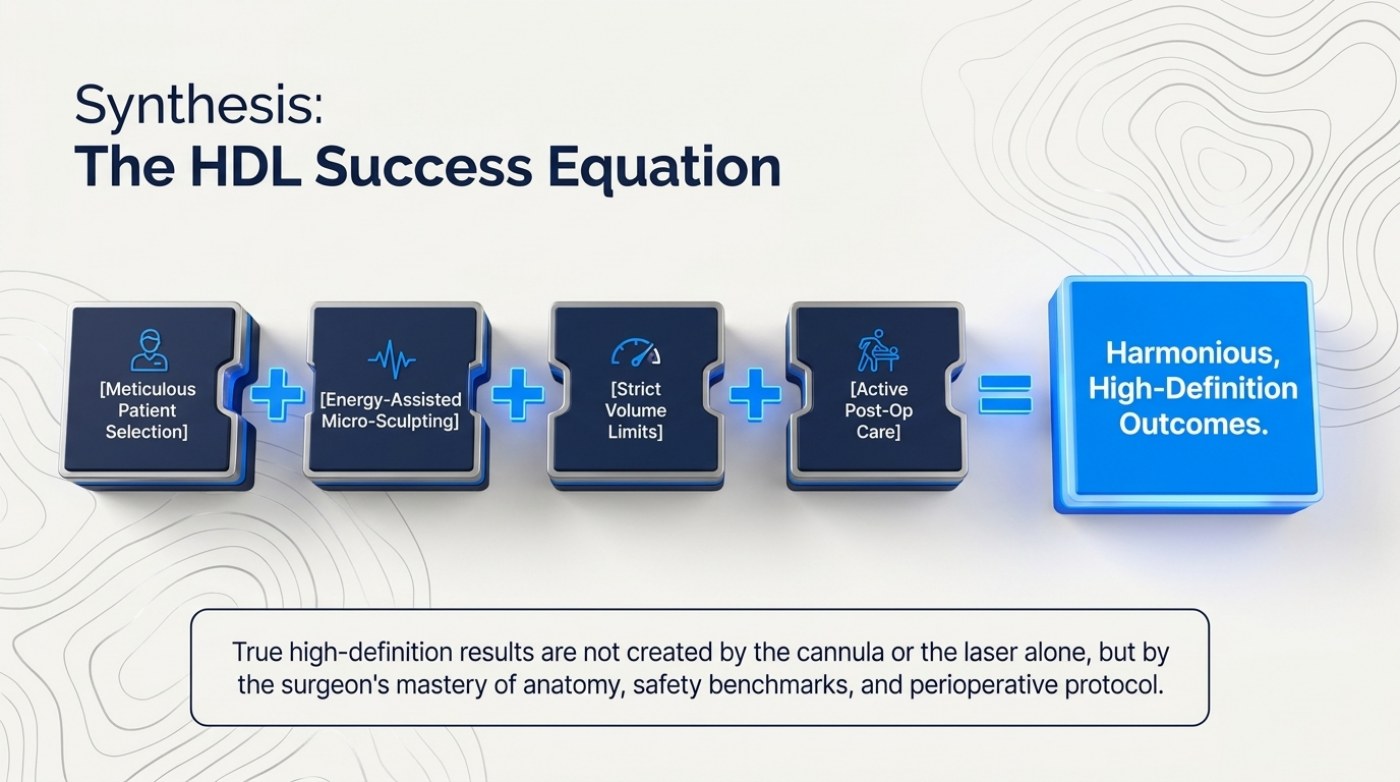
A long clinical deck on high-definition liposuction ends on one slide, and the slide is an equation rather than a summary. Four terms on the left — meticulous patient selection, energy-assisted micro-sculpting, strict volume limits, and active post-op care — and a single result on the right: harmonious, high-definition outcomes. Below the equation, the deck states its thesis outright: true high-definition results are not created by the cannula or the laser alone, but by the surgeon's mastery of anatomy, safety benchmarks and perioperative protocol. Most homeowners who read this are comparing facial liposuction options around Miami, FL, so what follows sticks to the details that change in practice.
The short version
- The success equation is four terms: meticulous patient selection, energy-assisted micro-sculpting, strict volume limits and active post-op care.
- The deck states that high-definition results come from surgical judgement and protocol rather than from the device alone.
- Pooled contour irregularity is about 0.12% for ultrasound-assisted liposuction against about 3.36% for traditional suction-assisted work.
- Patient selection is the term with no pooled figure attached, and the deck places it first in the ranking.
- Active post-op care covers immediate taping, lymphatic drainage from week one and a phased compression schedule running six weeks.
That is a useful closing argument because it demotes the technology. The deck's earlier slides cover devices in detail — ultrasound, radiofrequency, plasma — yet the synthesis places none of them first. The equation is a claim about what actually governs outcomes: selection, technique, restraint and follow-through, in that order.
The equation, term by term
| Term in the deck equation | What it governs | Where the deck develops it |
|---|---|---|
| Meticulous patient selection | Whether the procedure suits the individual at all | Framed as the first term; screening precedes technique |
| Energy-assisted micro-sculpting | How fat is removed and muscle definition traced | Device adjuncts and cannula trajectories |
| Strict volume limits | How much can be removed before risk rises | Aspirate-volume thresholds and staging |
| Active post-op care | How the result is protected during recovery | Drainage, taping, lymphatic drainage, compression |
| = Harmonious, high-definition outcomes | The stated result of all four together | The slide's right-hand side |
Term one: meticulous patient selection
The equation opens with selection, which is the term no device can supply. A procedure that suits one person's anatomy, tissue quality and expectations may be the wrong procedure for another, and the deck places that judgement ahead of everything technical. This is the term that determines whether the other three are even relevant on a given case.
Term two: energy-assisted micro-sculpting
The second term is the technology, and the deck names it as a contributor rather than a cause. Energy-assisted micro-sculpting covers the device adjuncts the deck details elsewhere — ultrasound, radiofrequency and plasma — working through micro-diameter cannulas to remove fat and trace definition. The published modality data show the technique moves outcomes: contour irregularity pooled at roughly 0.12% for ultrasound-assisted liposuction against roughly 3.36% for traditional suction-assisted liposuction, and thermal injury pooled at about 1.64% for radiofrequency-assisted liposuction. Technique is real, but the deck still places it after selection.
Term three: strict volume limits
The third term is restraint. The deck treats aspirate volume as a hard constraint rather than a matter of ambition, and the published literature supports the framing sharply: the ASPS TOPS analysis of more than 4,500 patients found the overall complication rate rising from 1.1% to 3.7% above the five-litre aspirate line, with seroma the most common complication overall. Volume also interacts with the first two terms — a targeted etch and a high-volume aspirate are different procedures with different risk profiles, which is why the deck pairs volume limits with staging.
Term four: active post-op care
The final term is the one patients control most directly. The deck's post-operative material covers immediate taping, manual lymphatic drainage begun in the first week, drain or non-drain protocols chosen by volume, and a phased compression schedule running six weeks. None of it is passive; the word the equation uses is active. Published seroma rates, the most volume-sensitive local event in the pooled data, sit directly against this term.
Why the deck puts the cannula last
The closing line is the deck's own summary of its argument, and it is worth taking at face value: the cannula and the laser are tools, and the variable that decides the outcome is the judgement applied around them — anatomical mastery, adherence to safety benchmarks, and perioperative protocol. The equation is really a ranking, and technology sits third of four.
Read as advice about how to evaluate a provider, that ranking is more useful than any single percentage on the earlier slides. The published complication figures tell you what the population-level rates are; the equation tells you which inputs a patient can actually ask about. Selection, technique, volume discipline and aftercare are all discussable in a consultation, and all four appear in the deck's own safety material rather than in the device marketing.
Two of the four terms also have published benchmarks that can be used as a check on the conversation, which is the most concrete value the equation offers to someone reading it before a consultation.
| Equation term | Published benchmark tied to it | Source data set |
|---|---|---|
| Energy-assisted micro-sculpting | Contour irregularity: ≈0.12% ultrasound-assisted vs ≈3.36% suction-assisted | Systematic review of contemporary techniques |
| Energy-assisted micro-sculpting | Thermal injury: ≈1.64% radiofrequency-assisted | Same systematic review |
| Strict volume limits | Overall complications rise from 1.1% to 3.7% above the five-litre aspirate line | ASPS TOPS analysis, 4,500+ patients |
| Active post-op care | Seroma, the most volume-sensitive local event: ≈0.65% to 2% pooled | Comerci et al.; Aljerian et al. |
| Meticulous patient selection | No pooled figure — framed qualitatively in the deck | Source deck slide |
That table is the equation in usable form. It shows which terms carry population-level data and which are matters of judgement, and it makes the deck's closing emphasis easier to accept: the term with no percentage attached is the one the deck places first.
Frequently asked questions
What is the HDL success equation?
It is the closing synthesis of the source deck: meticulous patient selection, plus energy-assisted micro-sculpting, plus strict volume limits, plus active post-op care, equals harmonious high-definition outcomes. Each of the four is developed on earlier slides in the same deck.
Does the deck say a specific device produces high-definition results?
No. Its closing line states that true high-definition results are not created by the cannula or the laser alone, but by the surgeon's mastery of anatomy, safety benchmarks and perioperative protocol. The device is a tool within the equation, not its cause.
Which of the four terms has published numbers attached?
Volume limits and technique both do. The overall complication rate in the ASPS TOPS analysis rose from 1.1% to 3.7% above the five-litre aspirate line, and modality-specific pooling reports contour irregularity at about 0.12% for ultrasound-assisted liposuction versus about 3.36% for suction-assisted. Patient selection and post-op care are framed qualitatively in the deck.
This is published information, not medical advice — a board-certified surgeon must assess whether a procedure suits you.
Related reading
- High-definition liposuction: how muscle etching works — the two-pass technique behind the equation's second term
- How much fat can be removed in one session — what the deck's strict volume limits mean in published practice
- Liposuction risks and complication rates as published — the benchmark data the equation's safety terms rest on