Everything in the first four mechanisms meets a harder test when the recipient site has been irradiated. A fat graft placed into a breast reconstructed after mastectomy does not land in normal subcutaneous tissue; it lands in a bed that radiation has left fibrotic, poorly vascularised and mechanically stiff. The slide that closes this stretch of the presentation, titled Clinical Translation: Breast Reconstruction, is the deck's first move from mechanism to application — and the first place it puts numbers against outcomes rather than pathways.
The short version
- A post-mastectomy radiation bed is fibrotic, poorly vascularised and mechanically stiff, making it close to the worst case for graft survival.
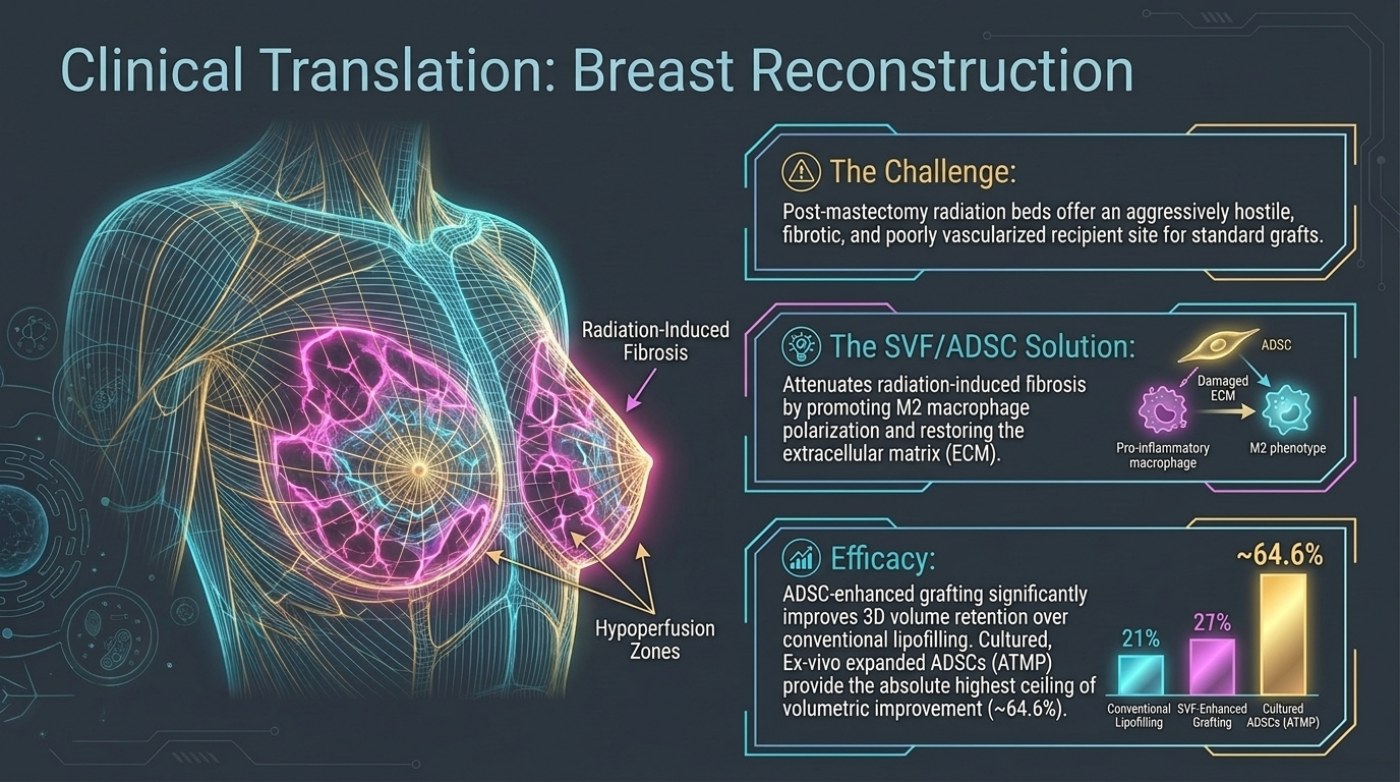
- The slide states the SVF and ADSC solution attenuates radiation-induced fibrosis by promoting M2 macrophage polarisation and restoring the extracellular matrix.
- The efficacy chart reports volumetric improvement of 21% for conventional lipofilling, 27% with SVF and about 64.6% for cultured ADSCs.
- Uncultured stromal vascular fraction is roughly 1 to 10 percent stem or stromal cells, processed and used the same day.
- Culture-expanded adipose-derived stem cells are grown under GMP conditions to more than 90 percent purity and treated as an advanced therapy.
The slide is built in three stacked panels on the right, with a wireframe figure of a torso on the left. Two magenta, glowing regions on the chest are marked with arrows: one labelled "Radiation-Induced Fibrosis" and two labelled "Hypoperfusion Zones". The panels answer them in order — The Challenge, The SVF/ADSC Solution, and Efficacy, the last carrying a three-bar chart.
The challenge: a recipient site that fights back
The Challenge panel states the problem without hedging: post-mastectomy radiation beds offer an aggressively hostile, fibrotic and poorly vascularised recipient site for standard grafts. Each of those three adjectives maps onto a mechanism the deck has already described. Fibrotic means the tissue has been replaced by stiff collagenous scar, which is exactly the remodelling outcome the immunomodulation slide describes cells trying to prevent. Poorly vascularised means fewer capillaries to grow from and lower capillary density to start with, which is what the angiogenesis slide is about. And a hostile environment is what the avascular window in the anti-apoptosis slide describes in general terms, made worse.
Put together, an irradiated breast bed is close to the worst case for the arithmetic of graft survival. The two arrows on the slide's figure mark it out — zones of hypoperfusion where a graft will struggle to be reached by new vessels in time, and regions of radiation-induced fibrosis where the tissue's mechanical properties have changed.
| Site feature named on the slide | What it means in practice | Which mechanism from this deck it stresses |
|---|---|---|
| Aggressively hostile recipient site | An environment unfavourable to a freshly transferred graft, with little tolerance for delay | The acute inflammatory phase (immunomodulation) |
| Fibrotic bed | Stiff, collagen-rich scar tissue in place of normal subcutaneous fat | The anti-fibrotic arm of immunomodulation (Smad2 suppression, collagen I/III over-deposition) |
| Poorly vascularised | Fewer existing capillaries to sprout from, and a longer route for new vessels | Rapid angiogenesis, and the length of the avascular window |
| Hypoperfusion zones (labelled on the figure) | Regions where blood flow is already reduced before any graft is placed | Anti-apoptosis — the cells must tolerate deprivation for longer |
The solution described: SVF/ADSC in an irradiated bed
The second panel states the claim in a single sentence: the SVF/ADSC solution attenuates radiation-induced fibrosis by promoting M2 macrophage polarisation and restoring the extracellular matrix (ECM). A small inset diagram shows an ADSC above a damaged ECM, with a pro-inflammatory macrophage transitioning to an M2 phenotype — the same transition shown on the immunomodulation slide, applied here to a specific clinical problem.
Two terms in that sentence carry the weight. M2 macrophage polarisation is the shift toward the anti-inflammatory, tissue-healing state described earlier in the deck; the argument is that this shift is what allows a fibrotic bed to remodel rather than continue to scar. The extracellular matrix is the scaffold of proteins and polysaccharides that surrounds cells and gives tissue its structure; radiation damages it, and "restoring the ECM" is the slide's description of what the enriched graft is meant to support.
The differences between the cell preparations named on the chart are set out in our guide to why transplanted fat survives. Uncultured stromal vascular fraction is a fresh, heterogeneous cell mix in which roughly 1–10% of cells are stem or stromal cells, processed and used the same day, and classified as minimally manipulated autologous tissue. Culture-expanded adipose-derived stem cells are grown outside the body under GMP conditions to greater than 90% purity, and are treated as an advanced therapy medicinal product, which in the United States means an investigational new drug framework. Same biological idea, two very different levels of processing — and, as the efficacy chart suggests, two very different reported results.
| Term | As used on the slide | Plain-language note |
|---|---|---|
| Radiation-induced fibrosis | The condition the SVF/ADSC solution is described as attenuating | Stiff, collagen-dense tissue that develops after radiotherapy, marked on the slide's figure across the treated chest |
| Hypoperfusion zones | Labelled regions of reduced blood flow on the figure | Areas where the graft's supply of oxygen and nutrients is already compromised |
| M2 macrophage polarisation | Named as the route by which fibrosis is attenuated | The shift to the anti-inflammatory, tissue-healing macrophage state described on the immunomodulation slide |
| Extracellular matrix (ECM) | Described as being restored | The structural scaffold around cells; damaged by radiation |
| SVF (stromal vascular fraction) | One of the three arms of the efficacy chart | A fresh, heterogeneous cell mix from the same harvest, roughly 1–10% stem or stromal cells |
| ATMP (advanced therapy medicinal product) | The regulatory label attached to the cultured arm of the chart | The classification applied to culture-expanded cells, with its own manufacturing and cost requirements |
The efficacy chart, read carefully
The third panel is the only part of this slide that puts numbers on outcomes. Its text states that ADSC-enhanced grafting significantly improves 3D volume retention over conventional lipofilling, and that cultured, ex vivo-expanded ADSCs (ATMP) provide the absolute highest ceiling of volumetric improvement. The chart beneath carries three bars: conventional lipofilling at 21%, SVF-enhanced grafting at 27%, and cultured ADSCs (ATMP) at approximately 64.6%.
Two cautions belong with those figures. First, the labelling is volumetric improvement in 3D volume retention, not a retention percentage for an individual patient — the axis is a comparison between approaches, and the numbers are the source material's. Second, the magnitude of the gap is itself the story: the jump from 27% to roughly 64.6% is the difference between an uncultured, minimally manipulated cell mix and a laboratory-expanded cell population, and the site's fat-graft guide makes the same point when it reports retention gains above 60% attributed to culture-expanded cells in the source material while cautioning that published systematic reviews note that study designs, cell preparation and dose vary so much between them that a single percentage does not transfer to an individual patient.
| Approach | Reported volumetric improvement (slide chart) | What is added | Process and regulatory profile |
|---|---|---|---|
| Conventional lipofilling | 21% | Nothing — harvested fat only | Established technique; same-session procedure |
| SVF-enhanced grafting | 27% | Uncultured stromal vascular fraction from the same harvest, mixed back into the graft | Minimally manipulated autologous tissue; no laboratory expansion step |
| Cultured ADSCs (ATMP) | ~64.6% | Adipose-derived stem cells expanded ex vivo | Grown under GMP conditions, greater than 90% purity; advanced therapy medicinal product status |
What the surrounding evidence base says, and does not
The natural question about fat grafting anywhere near breast tissue is oncological safety, and it is a legitimate one rather than a hypothetical. Our fat-graft survival guide records that the source material for this site cites the long-term BREAST-I and BREAST-II trial experience as showing safety where tumour resection is complete, while stressing that pre-operative risk screening remains essential. The guide's own instruction is to take the screening question seriously rather than the reassurance — and it notes that where fat is placed near breast tissue, a patient's imaging history is part of the conversation.
The same guide describes the broader evidence as directional rather than definitive. Systematic reviews and meta-analyses have compared adipose-derived cell-enriched grafting with conventional grafting and reported improvements in retention, while noting that heterogeneity between studies limits how far any single figure travels. It also records that the destination changes the arithmetic: facial grafting is judged on symmetry and skin quality with small, precisely layered volumes, while breast and buttock transfer move larger volumes into a space where the graft must establish a blood supply across a wider area — which is why staging is more common there.
What this slide does not claim is equally important. It reports a comparison between approaches in source material; it does not promise that a reconstruction will achieve any particular volume, that a single procedure will be sufficient, or that any individual's irradiated bed will respond the way the chart's third bar suggests. Reconstruction after mastectomy is a multi-stage, multidisciplinary process, and a fat-grafting step sits inside that process rather than replacing any part of it.
Frequently asked questions
Is fat grafting used in breast reconstruction a cosmetic procedure?
It is a reconstructive application, which is one reason the deck separates this slide from the aesthetic applications that follow it. The clinical problem being addressed — contour and volume in a chest wall that radiation has changed — is a reconstructive one, and the regulatory and evidence standards discussed in the surrounding literature are different from those that apply to aesthetic fat transfer.
Why does culturing the cells change the result so much?
The slide's chart shows the largest reported improvement in the cultured arm, and the explanation offered elsewhere in the deck is cell number and purity: culture expansion produces a homogeneous population at greater than 90% purity, against roughly 1–10% stem or stromal cells in an uncultured stromal vascular fraction. The trade-off is process: a laboratory step, an advanced-therapy regulatory classification, a two-stage procedure and a substantially higher cost and scheduling burden.
Does the 21%, 27% and 64.6% comparison apply to me?
No. Those figures are the source material's comparison between three approaches in its own data, and they are reported here as published information. Our fat-graft survival guide states the honest framing directly: retention, safety and suitability vary between individuals, and only a board-certified plastic surgeon who examines you can assess whether fat transfer, with or without cell enrichment, is appropriate in your case.
Related reading
Why Transplanted Fat Survives — or Does Not — cell preparation routes, regulatory status and the retention figures behind the chart above.
Liposuction vs Tummy Tuck vs Body Contouring — fat removal, skin removal and muscle repair are three different services, not one.
Verifying Surgeon Credentials and Facility Accreditation — how to check the claims that matter on a reconstructive or aesthetic plan.
This is published information, not medical advice — a board-certified surgeon must assess whether a procedure suits you.