A fork in the road from one harvest
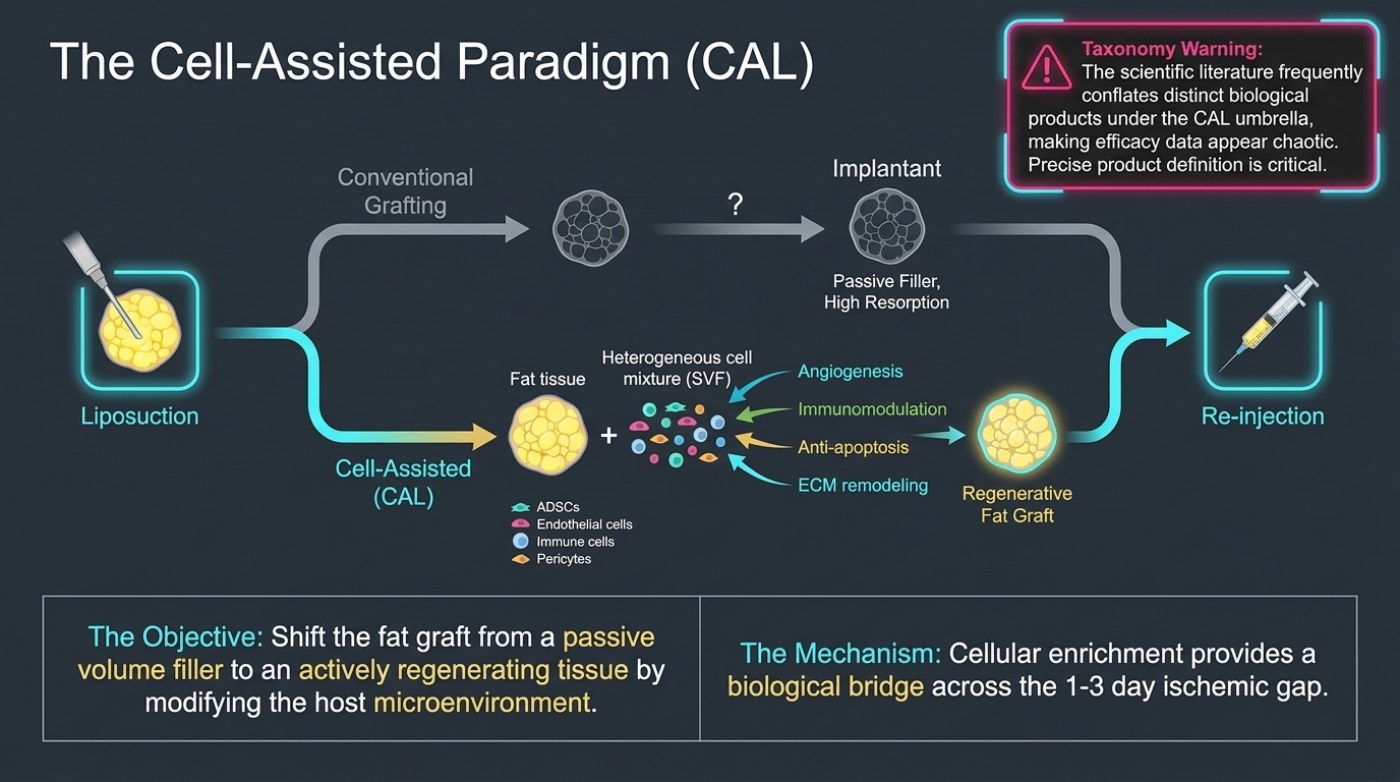
The paradigm slide in deck drop2_3 splits a single harvest into two destinations. On the upper path, labelled conventional grafting, harvested fat is transferred as it is: the slide settles the description into two words, passive filler, and gives the outcome two more, high resorption. Between that graft and the implant sits a question mark, which is the deck’s way of saying that what happens next is not determined in advance.
The short version
- The paradigm slide splits one harvest into conventional grafting, a passive filler with high resorption, and cell-assisted lipotransfer.
- Its stated objective is shifting the graft from a passive filler to an actively regenerating tissue by modifying the host microenvironment.
- Four labels leave the cell mixture: angiogenesis, immunomodulation, anti-apoptosis and ECM remodelling.
- The cell mixture contains adipose-derived stem cells, endothelial cells, immune cells and pericytes, with only a minority being stem cells.
- The slide describes cellular enrichment as a biological bridge across the one to three day ischemic gap.
The lower path is the one the slide is about. Fat tissue is combined with a heterogeneous cell mixture, labelled SVF, and the result is described as a regenerative fat graft rather than a filler. Four arrows leave the cell mixture carrying the labels the briefing returns to later: angiogenesis, immunomodulation, anti-apoptosis and ECM remodelling. The same harvest, then, but not the same product. This is written for homeowners around Miami, FL who are looking into body contour services and want the honest version rather than a sales page.
| Path | What is transferred | Described outcome | Where the uncertainty sits |
|---|---|---|---|
| Conventional grafting | Harvested fat tissue alone | Passive filler, high resorption | The question mark between grafting and implant |
| Cell-assisted (CAL) | Fat tissue plus a heterogeneous cell mixture (SVF) | Regenerative fat graft | Which cells, prepared how — the taxonomy slide |
The objective, in the slide’s own words
The first of the two closing boxes states the objective directly: shift the fat graft from a passive volume filler to an actively regenerating tissue by modifying the host microenvironment. Note the verb. The graft is not described as replacing the host tissue or as overriding what the body does with it. It is described as changing the environment it is placed into, and the target of that change is the tissue around the graft as much as the graft itself.
That is a narrower claim than the marketing language that usually surrounds this subject, and it is worth holding on to. Nothing on the slide says the graft becomes self-sustaining or that enrichment replaces careful placement. It says the transferred tissue is given an active role in the environment it lands in, instead of being asked to hold volume passively while the body decides its fate. The difference between the two paths on the slide is therefore not the volume of fat that is moved. It is what accompanies it, and what that accompaniment is expected to do during the first days after transfer.
What is in the cell mixture
The legend beneath the cell mixture names four populations: adipose-derived stem cells, endothelial cells, immune cells and pericytes. The briefing does not assign a separate task to each one, and the slide does not either — its four mechanism labels sit beside the mixture as a whole. The reasonable reading is that the populations act together, and that the labels describe aggregate actions rather than four ingredients with four separate jobs.
| Action label on the slide | What it names | Why a graft needs it |
|---|---|---|
| Angiogenesis | New vessel formation in and around the graft | Until vessels arrive, the tissue has no perfusion at all |
| Immunomodulation | A shift in the local immune response | The graft’s first days are an inflammatory event |
| Anti-apoptosis | Signals that keep stressed cells from dying | Viability is the quantity the resorption curve tracks |
| ECM remodelling | Reorganisation of the scaffold around the cells | The graft has to hold its shape, not only stay alive |
The biological bridge across a short window
The second closing box gives the mechanism in one sentence: cellular enrichment provides a biological bridge across the 1–3 day ischemic gap. That is the only number on the page, and it is the same window the resorption curve draws its steepest section through. The two slides make one argument from two directions — one showing the gap, the other naming a way across it.
Read that way, the added cells are not a volume product. They are described as support that operates during the interval in which the graft cannot support itself, and the four labels name different kinds of support rather than four different results. No retention percentage is attached to the bridge on this slide. That comes on the preparation slide, and it depends on which of two products is used, which is exactly the distinction the briefing goes on to draw. The gap is named in days because it is short enough to be bridged, and long enough to matter to tissue that receives no support at all.
The deck’s warning about its own literature
In the top corner sits a red-bordered box in which the briefing turns on its own field. The taxonomy warning states that the scientific literature frequently conflates distinct biological products under the CAL umbrella, making efficacy data appear chaotic, and it concludes that precise product definition is critical. That is an unusual thing for material of this kind to say about its own subject, and it is the most useful sentence in the set for anyone trying to read a commercial comparison.
It explains why two sources can quote different retention figures for the same phrase and both be reporting what they actually measured. If one enriched a graft with freshly isolated cells and another with cells grown in a laboratory for weeks, the word cell-assisted covers both while the products are not the same thing. The briefing’s next slide separates them and gives each its own figure.
What a paradigm is not
A method described as a paradigm is a framing, not a result. The slide does not claim that enrichment removes variability, that it works in every recipient site, or that it makes the grafting technique itself irrelevant. It describes a change in what the transferred tissue is asked to do: instead of holding volume passively, it is given cells that act on its surroundings while it waits for a blood supply to form.
Frequently asked questions
Is cell-assisted lipotransfer the same as a fat graft with stem cells added?
Not exactly, and the distinction matters. The mixture on the slide is heterogeneous: it contains adipose-derived stem cells alongside endothelial cells, immune cells and pericytes, and only a minority of its cells are stem or stromal cells. Describing the whole mixture as a stem cell treatment overstates what is transferred.
Why is the ischemic gap measured in days?
Because the graft’s problem is acute rather than chronic. Until new capillaries reach the tissue it survives without perfusion, and the briefing places that interval at roughly one to three days. That is the window its cellular support is described as bridging.
Does the deck say how much volume this preserves?
Not on this slide. The mechanism slide is about how the support is meant to work; the retention figures appear on the preparation slide, separated by product. Combining the two would be the conflation the deck explicitly warns against.
This is published information, not medical advice — a board-certified surgeon must assess whether a procedure suits you.
Related reading
The paradigm described above connects to the material below.
- Why Transplanted Fat Survives — or Does Not — the site’s guide to enrichment, including which preparations are minimally manipulated and which are cultured
- How Much Fat Can Be Removed in One Liposuction Session? — the published positions on volume limits, which condition how much graft is available to enrich
- Liposuction vs Non-Surgical Fat Reduction — why reducing fat and transferring it are different procedures with different evidence bases
Two tools on this site are worth running before a consultation: the pre-operative checklist and the 50-question consultation checklist.