A briefing written for specialists, read by everyone
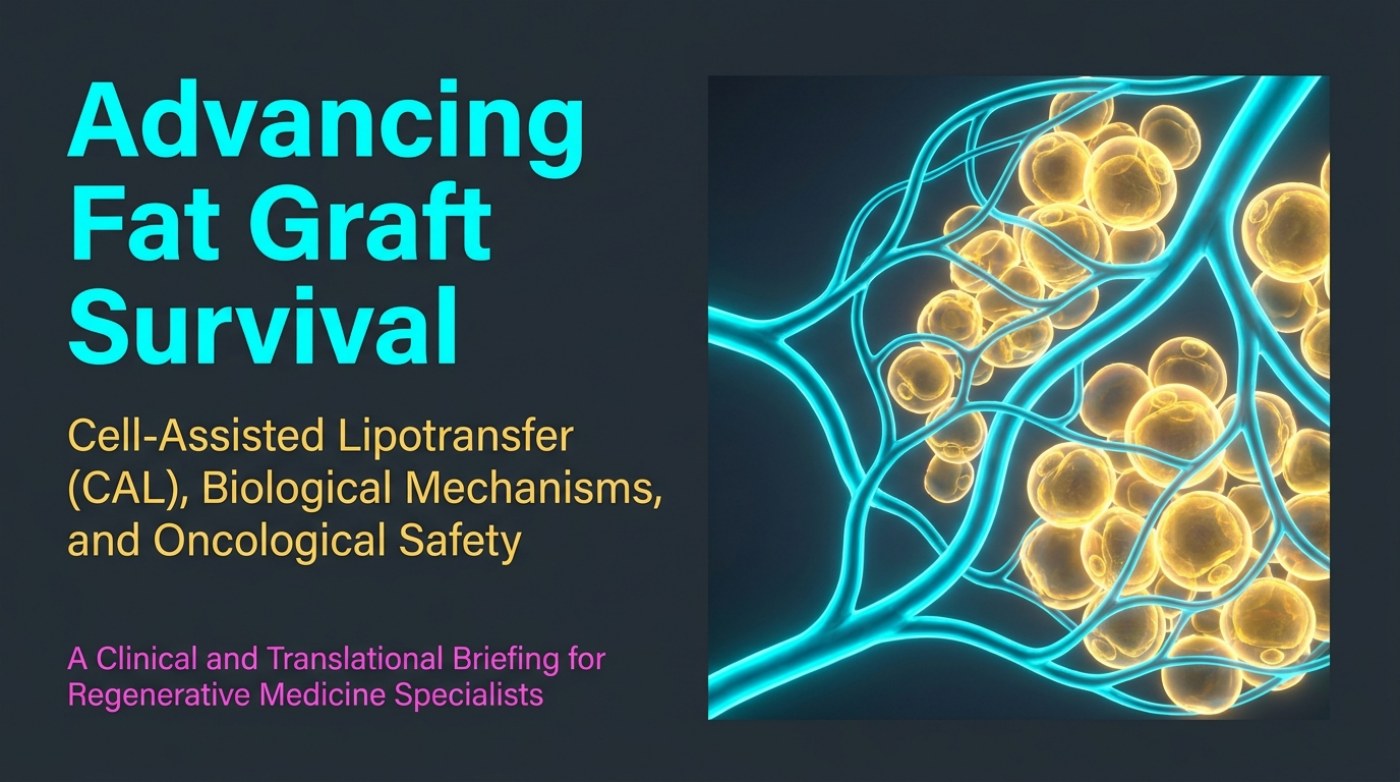
Deck drop2_3 is titled “Advancing Fat Graft Survival — Cell-Assisted Lipotransfer (CAL), Biological Mechanisms, and Oncological Safety”, and its cover labels itself a clinical and translational briefing for regenerative medicine specialists. That label is a scope statement as much as a description. It says the argument is about biology and about safety in the same breath, and it says the material assumes a reader who already handles transplanted tissue. The cover illustration carries the thesis in one frame: a cluster of fat cells threaded through a branching vessel network. Fat survives when vessels reach it.
The short version
- The briefing's central claim is that lost graft volume is a predictable result of placing tissue without a blood supply.
- The briefing organises the argument into four strands: the resorption problem, the cell-assisted paradigm, preparation taxonomy and mechanisms.
- It calls the failure of conventional grafting a structural timeline problem rather than a question of technique.
- The briefing's taxonomy warning says the literature conflates distinct biological products under the CAL umbrella, making efficacy data look chaotic.
- The two routes it separates are uncultured stromal vascular fraction, roughly 1 to 10% stem cells, and culture-expanded cells above 90% purity.
Read end to end, the fifteen slides make a single claim. The volume a fat graft loses is not a matter of luck or operator feel; it is the predictable result of placing living tissue somewhere it has no blood supply, and then waiting. Everything that follows — the resorption curve, the cell-assisted method, the comparison of two cell preparations, the four rescue mechanisms — unpacks that one sentence.
Four strands, one argument
The briefing divides that claim into four strands, each handled on its own slide. Seeing them separately first makes the rest of the material easier to hold together, because the strands answer different questions and the answers are not interchangeable.
| Strand | The question it answers | Deck section |
|---|---|---|
| The resorption problem | How much of a conventional graft is lost, and why does it happen when it does | “The Biological Crisis of Graft Resorption” |
| The cell-assisted paradigm | What changes when the graft carries the patient’s own support cells | “The Cell-Assisted Paradigm (CAL)” |
| Preparation taxonomy | Which cells, prepared how, and at what reported yield | “Cell Preparation Taxonomy: SVF vs. Expanded ADSCs” |
| Mechanisms | How added cells are supposed to keep tissue alive | Four labelled pathways on the mechanism slide |
The first strand measures the problem and gives it a schedule. The second describes the alternative: rather than a passive volume filler, a graft that arrives with its own support cells mixed in. The third does something unusual for material of this kind — it separates two products that the literature often treats as one, and attaches a different reported retention gain to each. The fourth explains what the added cells are supposed to be doing while the graft has no blood supply. Safety runs across all four rather than sitting in a section of its own.
A timeline problem, not a technique problem
The hinge of the whole briefing is a single line on its resorption slide, which calls the failure of conventional grafting a structural timeline problem. That phrasing moves the conversation away from the idea that a steadier hand fixes everything. If the limiting factor is the interval before new capillaries form, the interesting question is not which instrument is better in the abstract but whether that interval can be shortened or survived.
Our published guide to fat survival describes the same avascular phase in patient-facing terms: a grafted fat cell has no blood supply when it lands, and the cells that make it through the first days do so by diffusion alone. The harvesting variables that condition that outcome are published too, and they are ordinary settings rather than secrets. A harvesting pressure of roughly 400 mmHg with cannulas near 3 mm is the range the source material gives for protecting cell integrity, and the guide states the stakes just as plainly: in conventional transfers, as much as 80% of the transferred fat is lost.
| Figure | What it describes |
|---|---|
| 30% to 80% | Reported volume loss across conventional grafting in published reviews |
| As much as 80% | Loss stated for conventional transfers in the source material |
| Roughly 1–10% | Share of adipose-derived stem cells in an uncultured stromal vascular fraction |
| Greater than 90% | Purity targeted for culture-expanded adipose-derived stem cells |
| Roughly 400 mmHg and 3 mm | Harvest pressure and cannula diameter cited for protecting cell integrity |
Those figures are deliberately ranged, and the deck follows the same discipline. Its cover promises advancement of survival, not a percentage, and the retention figures it does carry are attached to named products rather than to the phrase cell-assisted lipotransfer as a whole.
Why safety shares the title
Oncological safety sits in the same sentence as the biological mechanisms, and that placement is a choice. Material that treated cell enrichment as a straightforward upgrade would leave safety to a later page. This briefing does not. It separates the two preparation routes, and part of that separation is regulatory: whether tissue is minimally manipulated or grown in culture changes what the material legally is, and the deck says so on the slide where the two products are compared.
The briefing also names a problem in its own field. Its taxonomy warning states that the literature conflates distinct biological products under the CAL umbrella, making efficacy data appear chaotic, and concludes that precise product definition is critical. That warning is why this set of articles runs one slide at a time rather than as a single combined overview. A merged summary would blur the distinction the briefing exists to draw.
What the briefing does not claim
It does not claim that enrichment removes variability, that it works in every recipient site, or that one preparation suits everyone. The two routes differ in composition, in how long they take, in what they cost and in which regulatory pathway they sit on. It also does not claim that any figure in it transfers to an individual. A mean or a median describes the middle of a set of results, not the future of one graft in one person.
For a reader who is not a specialist, the useful output of the whole briefing is a set of questions rather than a decision. Which product is being proposed: uncultured cells or expanded ones? What reported retention range is attached to it, and from which source? Is the tissue minimally manipulated or grown in a laboratory over weeks? What happens if the volume settles below target? Those questions are answered by a surgeon who can examine you, not by a deck, an article or a calculator.
Frequently asked questions
Does cell-assisted lipotransfer mean the graft is guaranteed to survive?
No. The briefing’s own framing is a gap of days that the tissue has to be carried across, and the published retention data it cites is ranged rather than fixed. Enrichment is described as support for the graft, not as a removal of variability, and no practitioner can honestly promise a specific final volume.
Is cell-assisted lipotransfer one procedure?
No, and that is the briefing’s explicit warning. The term covers at least two different products — uncultured stromal vascular fraction and culture-expanded adipose-derived stem cells — with different compositions, processing times and regulatory status. Any retention figure should be tied to a named product.
Why does a specialist briefing matter to a patient?
Because the questions it generates are the ones worth asking in a consultation: which cells, prepared how, over what period, with what reported retention, and what the plan is if the result settles short of target.
This is published information, not medical advice — a board-certified surgeon must assess whether a procedure suits you.
Related reading
The strands above are covered in more depth in the articles below.
- Why Transplanted Fat Survives — or Does Not — the patient-facing guide to the avascular phase, harvesting variables and cell enrichment
- Liposuction Risks and Complication Rates as Published — why published complication figures differ so widely between sources
- How to Choose a Plastic Surgeon — the credential and accreditation questions that apply twice when fat is both harvested and replaced
Two tools on this site are worth running before a consultation: the credentials verifier and the 50-question consultation checklist.