Why a fat-removal operation needs a clot protocol
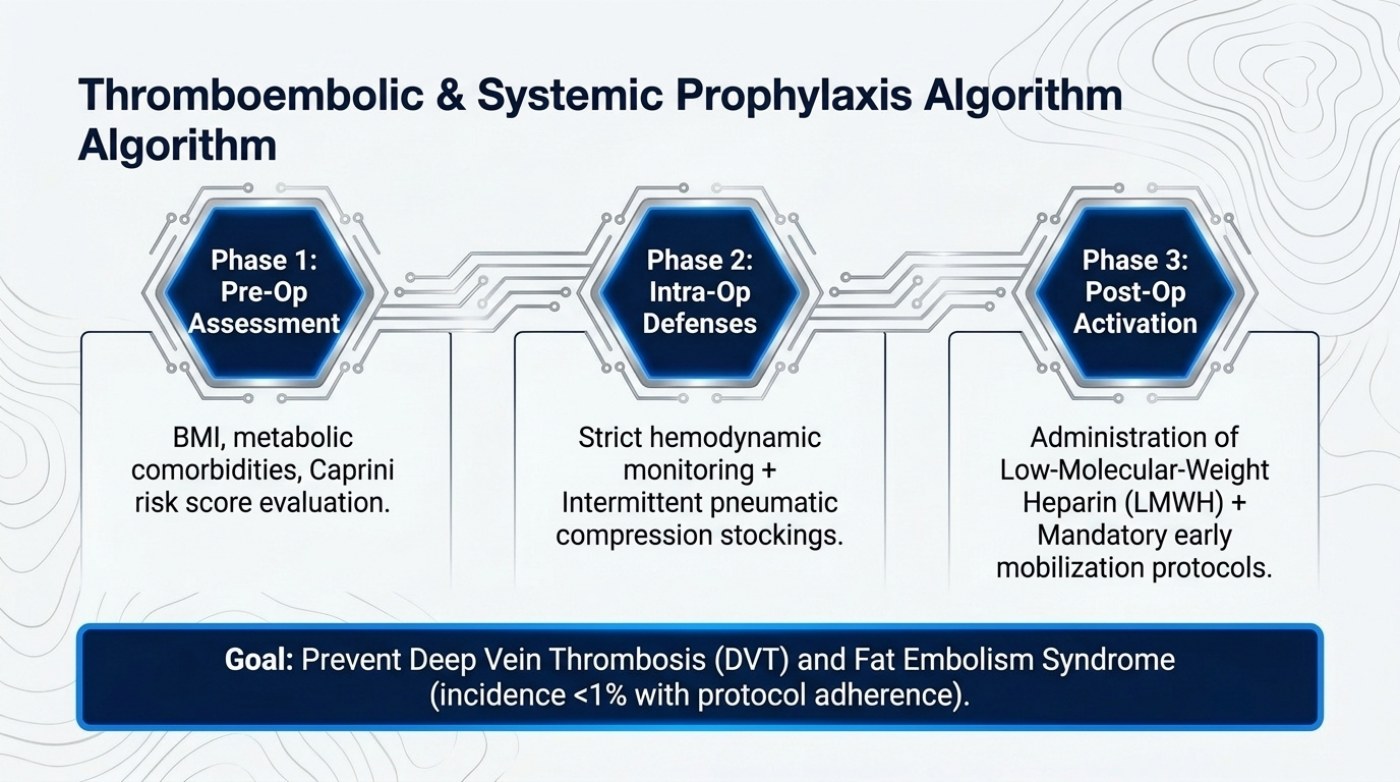
Deep vein thrombosis is not the complication people expect from liposuction, and the published record is the reason protocols exist anyway: it is rare, it is heavily influenced by how long a case runs and how many areas are treated at once, and when it happens the consequences are severe. The deck slide “Thromboembolic & Systemic Prophylaxis Algorithm” answers that with a three-phase structure. Each phase is a different kind of control — assessment before the operation, mechanical defence during it, and pharmacological plus behavioural activation afterwards — and the slide states the purpose underneath all three: “Prevent Deep Vein Thrombosis (DVT) and Fat Embolism Syndrome (incidence <1% with protocol adherence).” The qualifier is doing real work. The figure is presented as an outcome of adherence, not as a property of the procedure. Most homeowners who read this are comparing facial liposuction options around Miami, FL, so what follows sticks to the details that change in practice.
The short version
- The slide sets out a three-phase clot protocol: pre-operative assessment, intra-operative mechanical defence and post-operative activation.
- Phase one records body mass index, metabolic comorbidities and a Caprini risk score before the operative plan is set.
- The slide goal is a deep vein thrombosis and fat embolism incidence below 1% with protocol adherence.
- Combined procedures carried a 0.20% venous thromboembolism rate against 0.04% for solitary procedures in 129,007 patients.
- Standardised prophylaxis moved venous thromboembolism from 2.1% to 0.5% in a body-contouring patient-safety analysis.
Phase 1: pre-operative assessment
The first hexagon is labelled “Pre-Op Assessment” and the text beneath it reads “BMI, metabolic comorbidities, Caprini risk score evaluation.” Three inputs, one purpose: deciding how much clot risk a particular patient brings to the table before any decision is made about how much work to do. Body mass index and metabolic conditions such as diabetes appear repeatedly in published liposuction risk data — registry analysis of 69,424 patients reported diabetes and being underweight as independent factors correlating with higher complication risk, and the ASPS TOPS analysis found a significant interaction between volume and BMI, with lower-BMI patients showing a more exponential rise in risk as aspirate volume increased. The Caprini score is a structured risk-assessment instrument, and naming it on the slide is significant: it converts a judgement into a number that can be recorded, compared and acted on.
Phase 2: intra-operative defences
The middle phase is “Strict hemodynamic monitoring + Intermittent pneumatic compression stockings.” These two measures attack the problem from opposite directions. Monitoring manages the fluid and circulatory picture as the case proceeds, and it is the phase where the aspirate volume slide and this one meet: published guidance directs surgeons to account for maintenance requirements, pre-existing deficits, intraoperative losses and third-space deficits with accurate intake and output monitoring, to estimate blood loss and confirm it with pre- and post-operative haemoglobin, and to preserve core temperature with warming devices. Intermittent pneumatic compression is mechanical rather than pharmacological — the stockings cycle pressure to keep blood moving in the legs during the hours a patient is immobile on the table. ASPS’s practice advisory recommends intraoperative intermittent pneumatic compression for moderate- to high-risk patients, with low-molecular-weight heparin reserved for higher-risk patients, and positioning patients to maximise popliteal flow. Nothing in that sequence is a substitute for the others; each addresses a different part of the same mechanism.
Phase 3: post-operative activation
The third hexagon is “Post-Op Activation,” with “Administration of Low-Molecular-Weight Heparin (LMWH) + Mandatory early mobilization protocols.” This is the phase patients experience directly, and the word “mandatory” sets the tone: getting up and moving in the early recovery period is treated on the slide as part of the protocol rather than as encouragement. Published cosmetic-surgery data give the phase its context. Registry analysis of 129,007 patients found combined procedures carried a 0.20% venous thromboembolism rate against 0.04% for solitary procedures, and a patient-safety analysis of standardised prophylaxis protocols in body contouring reported venous thromboembolism rates falling from 2.1% to 0.5% — a change in a single outcome that tracks a change in process rather than in surgical skill.
What the slide’s “<1%” figure sits beside
The slide gives its goal as an incidence below 1% with protocol adherence, and it is not attributed on the slide to a named study, so it should be read as the source material’s stated target rather than a published cohort result. Published pooled figures for the same endpoint are considerably lower than 1% on average: Comerci’s meta-analysis of 39 studies and 29,368 patients reported pooled venous thromboembolism risk at 0.017% (95% CI 0.0060–0.053), and modern pooled estimates place death from liposuction at roughly 0.02%, most commonly from venous thromboembolism. The same paper reports mortality of up to 15% once venous thromboembolism occurs, which is the asymmetry that justifies the whole algorithm: an event rare enough to be measured in hundredths of a percent, fatal in a substantial minority of the cases where it does appear. A historical benchmark shows how far the pendulum has moved — a 2000 census survey of cosmetic surgeons computed a mortality rate of 1 in 5,224 procedures for the late 1990s, identifying pulmonary embolism as a leading cause.
The algorithm as the slide sets it out
| Phase | Measures on the slide | What the phase controls |
|---|---|---|
| Phase 1 — Pre-Op Assessment | BMI, metabolic comorbidities, Caprini risk score evaluation | How much risk the patient brings before the operative plan is set |
| Phase 2 — Intra-Op Defenses | Strict hemodynamic monitoring plus intermittent pneumatic compression stockings | Circulatory and fluid stability during immobility on the table |
| Phase 3 — Post-Op Activation | Low-molecular-weight heparin (LMWH) plus mandatory early mobilisation protocols | The window after surgery when clot risk is still raised |
| Goal stated on the slide | Prevent DVT and fat embolism syndrome, “incidence <1% with protocol adherence” | The outcome the three phases are assembled to produce |
Published venous thromboembolism figures beside the slide’s target
| Figure | Value | Source |
|---|---|---|
| Deck goal with protocol adherence | Under 1% incidence of DVT and fat embolism syndrome | Slide source material; not attributed to a named study |
| Pooled venous thromboembolism risk in liposuction | 0.017% (95% CI 0.0060–0.053) | Comerci et al., 39 studies, 29,368 patients |
| Mortality when venous thromboembolism occurs | Up to 15% | Comerci et al. |
| Death from liposuction, modern pooled estimate | About 0.02%, most commonly from venous thromboembolism | Comerci et al. |
| Venous thromboembolism, combined vs solitary procedures | 0.20% vs 0.04% | Registry analysis of 129,007 patients |
| Prophylaxis protocols in body contouring | Fell from 2.1% to 0.5% | Patient-safety analysis of standardised protocols |
| Historical mortality benchmark, late 1990s | 1 in 5,224 procedures; 19.1 per 100,000 | Grazer & de Jong, 2000 census survey |
What amplifies clot risk, and how the phases respond
| Amplifier | Published figure or finding | Which phase on the slide responds |
|---|---|---|
| Combining procedures | Venous thromboembolism 0.20% combined vs 0.04% solitary (129,007 patients) | Phase 1: assessment feeds the decision on what to stage or combine |
| Body procedures as a category | Assigned a relative risk of 13.47 in registry analysis | Phase 1: BMI and metabolic comorbidities are the pre-op inputs |
| Volume and operative time | Risk rises with aspirate volume and site count; above 5 L overall complications 3.7% vs 1.1% | Phase 2: hemodynamic monitoring and compression during the case |
| Immobility after surgery | Prolonged immobility is the classic venous-stasis mechanism | Phase 3: mandatory early mobilisation alongside LMWH |
| Inadequate prophylaxis | Standardised protocols moved venous thromboembolism from 2.1% to 0.5% | All three phases, which is why the slide presents them as one algorithm |
FAQ: thromboembolic prophylaxis
Is the “<1%” figure the same as the published DVT rate?
No, and the difference is worth understanding. The slide states a goal of under 1% incidence for DVT and fat embolism syndrome with protocol adherence. Pooled published venous thromboembolism risk in liposuction is far lower on average — 0.017% in one meta-analysis of 29,368 patients — but those averages blend short office cases with long combined operations, and registry data show the rate moving sharply with the type and number of procedures. A protocol target and a pooled population average answer different questions: one says what a process is designed to achieve, the other says what happened across a mixed population.
Why does an aesthetic operation carry clot risk at all?
Because the classic risk factors are mechanical rather than surgical. Immobility during and after the operation, the length of time under anaesthesia, the volume of fluid shifted and the size of the patient all point the same way. Registry analysis found combined cosmetic procedures carried five times the venous thromboembolism rate of solitary procedures, and body procedures as a category were assigned a relative risk of 13.47. That is why the slide’s answer is not a single drug but three phases in sequence, one of which — early mobilisation — is something the patient does.
What does the post-operative phase require of a patient?
The slide’s language is specific: low-molecular-weight heparin plus mandatory early mobilisation protocols. In practice that means following a prescribed medication schedule and getting up and moving on a timetable rather than waiting to feel like it. The published recovery guidance on this site describes the same early period from the recovery side — compression worn continuously in the early weeks, desk work after roughly one to two weeks, and heavier exercise only once cleared. No page can tell you what your own schedule should be; that is a clinical instruction that belongs to the surgeon who performed the operation.
This is published information, not medical advice — a board-certified surgeon must assess whether a procedure suits you.
Related reading
Three published guides on this site cover adjacent parts of the same protocol:
- Liposuction Risks and Complication Rates as Published — pooled venous thromboembolism and mortality figures
- How Much Fat Can Be Removed in One Liposuction Session? — why clot risk scales with case size
- Liposuction Recovery Week by Week: Milestones — what the early mobilisation phase looks like