Four readings on one dashboard
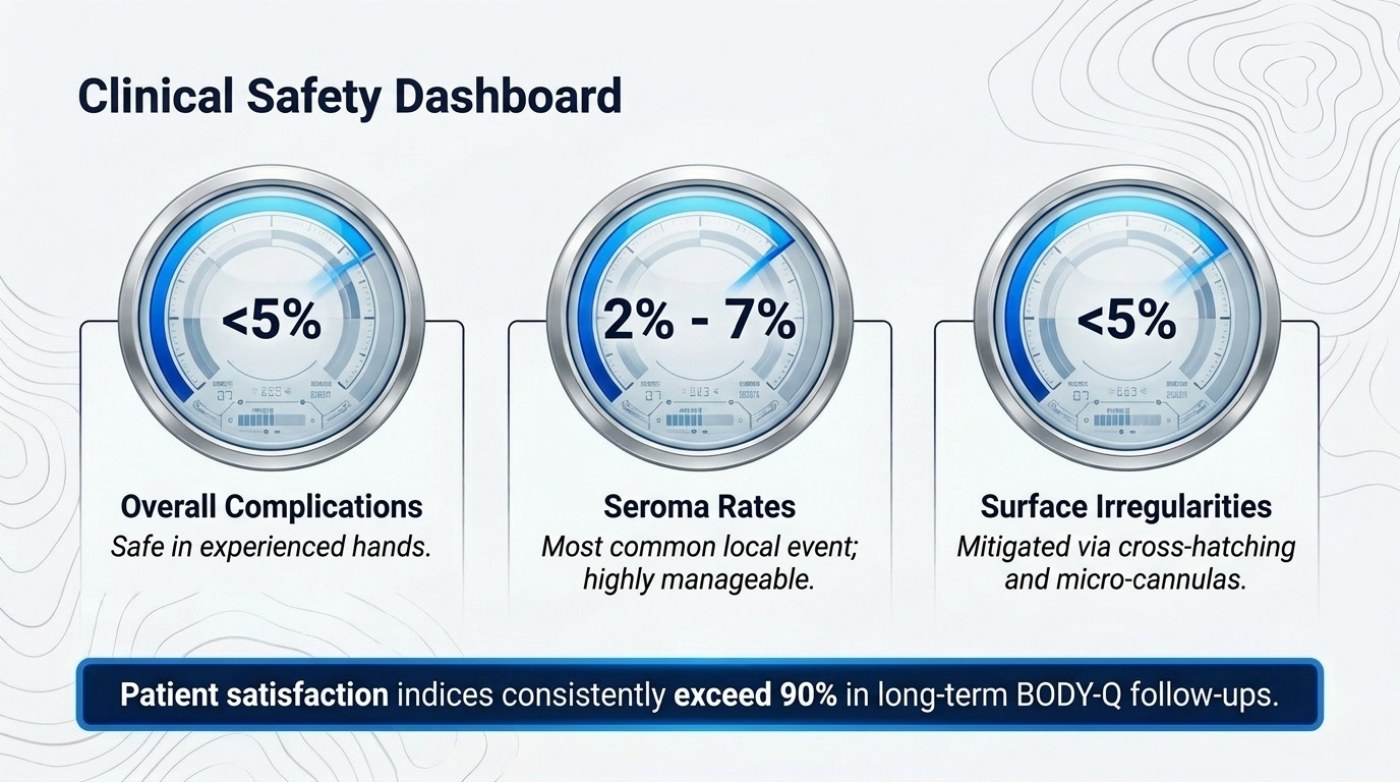
The deck slide “Clinical Safety Dashboard” is built as an instrument panel: three circular gauges with needles, each carrying a number and a caption, and a banner running across the bottom. The gauges read “<5%” for overall complications, “2% – 7%” for seroma rates, and “<5%” for surface irregularities. The banner states that “Patient satisfaction indices consistently exceed 90% in long-term BODY-Q follow-ups.” The layout is the argument. A dashboard is not a claim that nothing goes wrong; it is a set of monitored quantities with a range attached to each, and the deck places it next to a slide on mitigating localized adverse events and a slide on aspirate volume for exactly that reason. If you have been weighing up facial liposuction for a home around Miami, FL, this guide covers how it actually works, what it tends to cost, and where the results usually fall short.
The short version
- The clinical safety dashboard shows overall complications under 5%, seroma rates of 2% to 7% and surface irregularities under 5%.
- Patient satisfaction indices are stated to exceed 90% consistently in long-term BODY-Q follow-ups.
- The dashboard treats each figure as a monitored range attached to a protocol rather than a prediction for any individual.
- A 50-patient study recorded 17 seromas, with 13 of 25 patients affected without adjunctive drainage against 4 of 25 with it.
- Complication cases in the deck averaged 3.4 litres of aspirate against roughly 2 litres overall, pointing at case selection.
The first gauge: overall complications under 5%
The left-hand dial reads “<5%” under the heading “Overall Complications,” captioned “Safe in experienced hands.” The caption is doing more work than the number. Published overall complication rates for liposuction differ by an order of magnitude depending on which population was studied and how a complication was defined: 2.62% pooled across 39 studies and 29,368 patients, 12% in a second meta-analysis of a different study set, and 1.16% for liposuction performed alone in a national cosmetic-surgery insurance registry of 69,424 patients. One counts a treated area with slight rippling; another counts only events needing treatment. That spread is the reason a dashboard figure and a pooled meta-analysis figure are not competing claims — they describe different denominators.
The second gauge: seroma at 2% to 7%
The middle dial is the widest band on the slide and the only one expressed as a range: “2% – 7%,” labelled “Seroma Rates” and captioned “Most common local event; highly manageable.” Seroma is a pocket of lymphatic fluid collecting in the space fat was removed from, and it is the complication most consistently reported as the most common one. Published pooled rates run from 0.65% to 2% in the two meta-analyses already cited; a systematic review of contemporary techniques pooled radiofrequency-assisted liposuction at roughly 3.93% for seroma; and the ASPS TOPS analysis of more than 4,500 patients found seroma not only the most common complication but the reason overall rates jumped from 1.1% to 3.7% above the five-litre aspirate line. A 50-patient study of drains recorded 17 post-operative seromas, with 13 of 25 in the group without adjunctive drainage against 4 of 25 where drainage was added, and graded them by volume — mild under 50 cc, moderate 50–100 cc, severe over 100 cc. The slide’s upper bound of 7% is well above any pooled average, which is consistent with a dashboard built to show a monitored range rather than a best case.
The third gauge: surface irregularities under 5%
The right-hand dial repeats “<5%” for “Surface Irregularities,” captioned “Mitigated via cross-hatching and micro-cannulas.” This is the one gauge whose mitigation is named on the face of the slide, and it points directly at the cannula-dynamics slide: contour deformity and irregularity is the most common complication in every pooled dataset, reported at 2.35% by Comerci and 2% by Aljerian, with modality-specific pooling showing ultrasound-assisted liposuction at about 0.12% against about 3.36% for traditional suction-assisted liposuction. Older studies relying on surgeon self-reporting cited figures as high as 9%. The dashboard’s sub-5% reading sits inside that published spread, and the caption identifies the two techniques the deck credits with moving it.
The banner: satisfaction above 90%
The line across the bottom of the slide concerns a different kind of measurement. Satisfaction is patient-reported rather than clinician-reported, and BODY-Q is the named instrument — a patient-reported outcome measure developed for body contouring and weight-loss populations, with scales covering appearance, body image and other domains, and with long-term follow-up as the frame of reference. That framing matters: a satisfaction figure collected at a six-week visit and one collected in long-term follow-up are not the same measurement, and the slide specifies the longer of the two. Nothing in the published complication data contradicts a high satisfaction figure, because the two measure different things — a patient can be satisfied with a durable contour while a minor seroma resolves.
The dashboard as the slide presents it
| Gauge | Reading | Caption on the slide | What the number measures |
|---|---|---|---|
| Overall Complications | <5% | Safe in experienced hands | All recorded complications pooled into one rate |
| Seroma Rates | 2% – 7% | Most common local event; highly manageable | Fluid collections in the treated space, expressed as a range |
| Surface Irregularities | <5% | Mitigated via cross-hatching and micro-cannulas | Visible contour irregularity and surface unevenness |
| Patient satisfaction (banner) | Consistently above 90% | Long-term BODY-Q follow-ups | A patient-reported outcome instrument, not a complication rate |
Each dashboard number beside its published comparator
| Endpoint | Deck figure | Published comparators | Why they differ |
|---|---|---|---|
| Overall complications | <5% | 2.62% pooled (39 studies, 29,368 patients); 12% in a second meta-analysis; 1.16% for liposuction alone in a 69,424-patient registry | Definition of a complication, case mix and whether the operation was combined with others |
| Seroma | 2% – 7% | 0.65% to 2% pooled; about 3.93% with radiofrequency assistance; drives overall rates from 1.1% to 3.7% above five litres | Volume of aspirate, technique family and whether drains or drainage adjuncts were used |
| Surface irregularities | <5% | 2.35% (Comerci); 2% (Aljerian); about 0.12% ultrasound-assisted vs about 3.36% suction-assisted; up to 9% in older self-reported series | Technique and instrument choice; whether the endpoint is judged clinically or by patient report |
| Venous thromboembolism (context) | Under 1% goal with protocol adherence (companion slide) | 0.017% pooled; 0.20% combined vs 0.04% solitary procedures; 2.1% to 0.5% after standardised protocols | Prophylaxis, procedure combination and case duration |
| Patient satisfaction | Above 90% in long-term BODY-Q follow-ups | A patient-reported outcome measure rather than a complication endpoint | Not comparable to a complication rate at all |
What moves each number
| Number on the dashboard | Mitigation named on the deck | Supporting published finding |
|---|---|---|
| Overall complications | Case selection, volume limits and the full perioperative protocol across the deck | Complication cases averaged 3.4 L aspirate against roughly 2 L overall |
| Seroma | Tailored closed-suction drainage plus manual lymphatic drainage (companion slide) | 17 of 50 patients developed seroma; 13 of 25 without adjunctive drainage vs 4 of 25 with it |
| Surface irregularities | Cross-hatching and micro-cannulas (stated on this slide) | Irregularity is the most common complication in pooled data and the endpoint modality choice moves most |
| Thermal injury (adjacent gauge theme) | Thermoguidence keeping skin below 42 °C with room control at 20–23 °C | Radiofrequency-assisted liposuction pooled at about 1.64% for thermal injury |
| Patient satisfaction | Early mobilisation, compression schedule and weight stability, not the operative technique alone | Long-term follow-up in patients whose weight stayed stable is the frame BODY-Q measures |
FAQ: reading a safety dashboard
Why do the deck’s numbers differ from published meta-analyses?
Because they are answers to different questions. A dashboard reading describes a monitored range attached to a protocol; a pooled meta-analysis figure averages across studies with different definitions, techniques and populations, which is why overall complication rates in the published literature span 1.16% to 12%. The deck’s own companion slide is explicit that its readings are tied to protocol adherence, and the deck’s closing slide states that results depend on the whole protocol rather than on any single device. Treat a rate as a description of a population and a process, not as a forecast about one person.
What is BODY-Q and why does it matter that the slide names it?
BODY-Q is a patient-reported outcome measure developed for body-contouring and weight-loss populations, covering domains such as appearance and body image. Naming it matters because it tells you the satisfaction figure is self-reported by patients using a validated instrument, collected in long-term follow-up, rather than a clinic’s own survey. A satisfaction percentage and a complication rate are measured on different scales by different people; a page that quoted one as evidence for the other would be misleading, and the slide keeps them in separate places.
Where does the five-litre line sit on this dashboard?
It is not printed on this slide, and that is consistent with the rest of the deck: the volume threshold appears on its own slide as a risk curve rather than as a number on the safety panel. Published data connect the two directly — above five litres of aspirate, overall complications were 3.7% against 1.1% below, with the increase described as almost entirely seromas, which is the widest band on this dashboard. If you are comparing two practices, the volume mix behind their numbers explains more variation than the headline rate alone.
This is published information, not medical advice — a board-certified surgeon must assess whether a procedure suits you.
Related reading
Three published guides on this site cover adjacent parts of the same protocol:
- Liposuction Risks and Complication Rates as Published — every published rate behind these dials
- How Much Fat Can Be Removed in One Liposuction Session? — the volume line that moves complication rates
- Verifying Surgeon Credentials and Facility Accreditation — what ‘experienced hands’ can be checked against