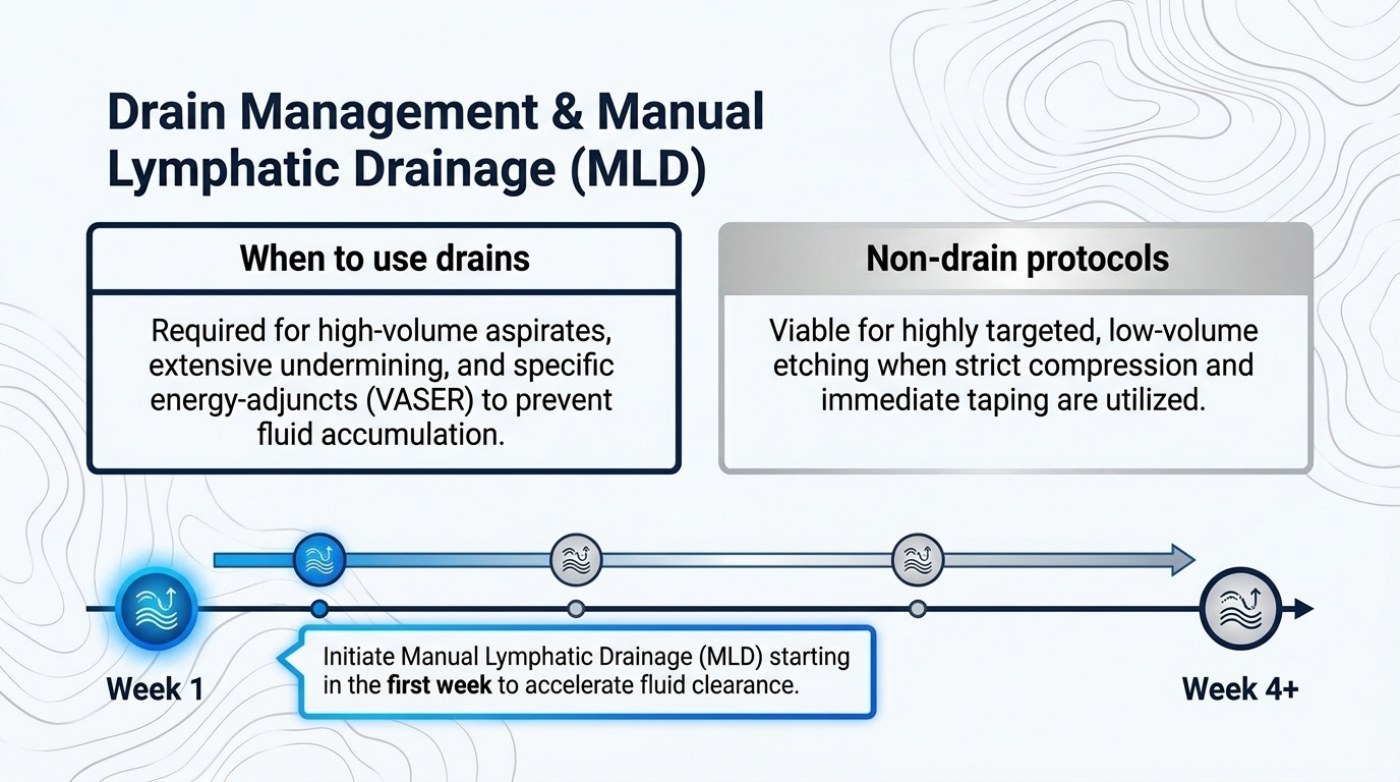
Two decisions shape the fluid side of liposuction recovery: whether drains are used at all, and when hands-on lymphatic work begins. A teaching deck on high-definition liposuction handles both on one slide, and the way it splits them is informative. Rather than presenting drains as a default, the deck sets out a drain indication and a non-drain protocol side by side, then attaches a timeline that starts manual lymphatic drainage in the first week and runs to week four and beyond. Most homeowners who read this are comparing facial liposuction options around Miami, FL, so what follows sticks to the details that change in practice.
The short version
- The drain decision after liposuction turns on aspirate volume and the extent of undermining rather than on preference.
- Drains are listed for high-volume aspirates, extensive undermining and energy-adjunct procedures such as VASER, to prevent fluid accumulation.
- A non-drain protocol is described as viable for highly targeted, low-volume etching when strict compression and immediate taping are used.
- Manual lymphatic drainage starts in the first week to accelerate fluid clearance and continues to week four and beyond.
- Radiofrequency-assisted liposuction showed seroma at approximately 3.93% in a systematic review, against 0.27% to 1% pooled for haematoma.
That structure reflects how the field has moved. Drains were once routine; today a targeted, low-volume procedure with strict compression and immediate taping may reasonably proceed without them, while a high-volume aspirate with extensive undermining still calls for them. The dividing line is not fashion but the volume of fluid the tissue is expected to produce.
When the deck says drains are used
The deck's indication is specific and covers three overlapping situations: high-volume aspirates, extensive undermining, and specific energy-adjunct procedures such as VASER. The stated purpose is to prevent fluid accumulation. Each of the three conditions points to the same underlying issue — a large raw surface with nowhere for the fluid to go — and a drain is a route out of the body for the serous fluid that the healing tissue will produce in the days after surgery.
When the deck says a non-drain protocol is viable
The non-drain column is equally specific. The deck states it is viable for highly targeted, low-volume etching when strict compression and immediate taping are used. Two enabling conditions are named, and both have to hold: the volume removed must be small enough that the fluid load is modest, and the compression and taping regime must be tight enough to manage what does accumulate. Take away either condition and the protocol the deck describes no longer applies.
| Consideration | Drain protocol (deck) | Non-drain protocol (deck) |
|---|---|---|
| Indication | High-volume aspirates; extensive undermining; specific energy-adjuncts (VASER) | Highly targeted, low-volume etching |
| Stated aim | Prevent fluid accumulation | Manage fluid with compression and taping instead |
| Required adjuncts | — | Strict compression + immediate taping |
| Volume profile | High | Low |
Manual lymphatic drainage: starting in week one
The timeline on the slide is short and unambiguous. Manual lymphatic drainage (MLD) is initiated in the first week, and the deck's stated rationale is to accelerate fluid clearance. The timeline extends to week 4 and beyond, placing MLD alongside compression as a continuing part of the recovery routine rather than a single early appointment.
The logic is that the first week is when fluid movement is most needed and most movable. Tissue that has been infiltrated with tumescent fluid is at its most congested early on; a structured lymphatic technique is aimed at giving that fluid a direction. By week four the routine is usually less about acute fluid load and more about supporting the settling phase as the skin redrapes over the new contour, which is why the deck's timeline does not close at week one but runs outward.
What the published seroma data say about volume
The deck's split between drain and non-drain cases rests on volume, and the published literature agrees that volume is the variable to watch. Seroma is the complication most sensitive to how much aspirate is removed, and it is also the most commonly reported local event overall.
| Published figure | Value | Where it comes from |
|---|---|---|
| Seroma, pooled analyses | About 0.65% (one meta-analysis) to 2% (another) | Comerci et al.; Aljerian et al. |
| Seroma, radiofrequency-assisted subgroup | ≈3.93% | Systematic review of contemporary techniques |
| Overall complication rate above the five-litre aspirate line | Rises from 1.1% to 3.7% | ASPS TOPS analysis of 4,500+ patients |
| Haematoma, pooled | 0.27% to 1% | Both meta-analyses |
The ASPS figure is the clearest illustration of the deck's logic: the overall complication rate roughly tripled once aspirate volume crossed five litres, and seroma was the most common complication driving that move. A drain decision on the deck's terms is therefore a volume decision, made before the first incision rather than during recovery.
Reading the two columns together
The value of the slide is that it refuses to make drains a matter of preference. Read across, the two columns describe a spectrum rather than a binary: as the aspirate volume and the extent of undermining rise, the case moves rightward, and the need for a mechanical route for fluid rises with it.
Three practical consequences follow from the deck's own framing. The first is that the decision belongs to procedure planning, because volume and undermining are chosen before surgery, not discovered afterwards. The second is that a non-drain protocol is conditional rather than free — it depends on strict compression and immediate taping being delivered as stated, so the protocol is only as good as the adjuncts that support it. The third is that manual lymphatic drainage runs in parallel with whichever drainage route is chosen, starting in the first week, because the fluid that reaches the tissues still has to move.
That last point is where the deck's timeline does its work. A drain removes what pools and can be routed out; lymphatic drainage is aimed at the fluid distributed through the soft tissue, which no drain reaches. The two mechanisms address different fractions of the same problem, which is why the slide presents them on one page rather than as alternatives.
Frequently asked questions
Do all liposuction procedures need drains?
No, and the deck says so explicitly. It lists a non-drain protocol as viable for highly targeted, low-volume etching — but only where strict compression and immediate taping are in place. The indication for drains covers high-volume aspirates, extensive undermining and specific energy-adjunct procedures.
Why does manual lymphatic drainage start so early?
The deck initiates MLD in the first week specifically to accelerate fluid clearance at the point when fluid load is highest. The benefit it describes is timing-dependent, which is why the first-week start is stated as part of the protocol rather than left open.
How long does lymphatic drainage continue?
The deck's timeline runs to week 4 and beyond, matching the recovery phase in which the tissue is settling. It is presented as a routine that spans recovery rather than a single early intervention.
This is published information, not medical advice — a board-certified surgeon must assess whether a procedure suits you.
Related reading
- Liposuction recovery week by week — the milestones drains and lymphatic drainage fit into
- How much fat can be removed in one session — why volume drives so many of the protocol decisions
- Compression garments and lymphatic massage after liposuction — the pressure routine that works alongside drainage