Compression after liposuction is a schedule, not a single instruction. A teaching deck on high-definition liposuction sets it out in three phases across six weeks: high compression with internal foams and anatomical contour boards for the first fortnight, a transition to moderate continuous compression in weeks three and four, and a tapered phase in weeks five and six as the tissue settles. Each phase is defined by a different garment regime and a different job. Most homeowners who read this are comparing facial liposuction options around Miami, FL, so what follows sticks to the details that change in practice.
The short version
- Compression after liposuction follows a schedule of three phases spread across six weeks, not one fixed instruction.
- Weeks one and two pair high-compression garments with internal foams and anatomical contour boards to close dead space.
- Weeks three and four switch to moderate continuous compression so pressure stays uniform while the skin redrapes.
- Weeks five and six taper to part-time or lighter garments, supporting final tissue settling rather than an abrupt stop.
- Seroma is the most commonly reported local event after liposuction, pooled at roughly 0.65% to 2%.
The reason the schedule is phased rather than fixed is that the tissue is doing different things at each stage. Early on, the priority is closing the dead space left by fat removal and controlling severe edema. Midway, it shifts to keeping pressure uniform while the skin redrapes. Late, the goal becomes stabilisation — holding a result while allowing enough freedom for the last of the swelling to resolve.
The schedule at a glance
| Phase | Garment regime | Stated purpose (source deck) |
|---|---|---|
| Weeks 1–2 | High-compression garments paired with internal foams and anatomical contour boards | Prevent dead space and control severe edema |
| Weeks 3–4 | Transition to moderate, continuous compression | Focus on uniform skin redraping |
| Weeks 5–6 | Tapered use (part-time or lighter garments) | Support final tissue settling and stabilise aesthetic results |
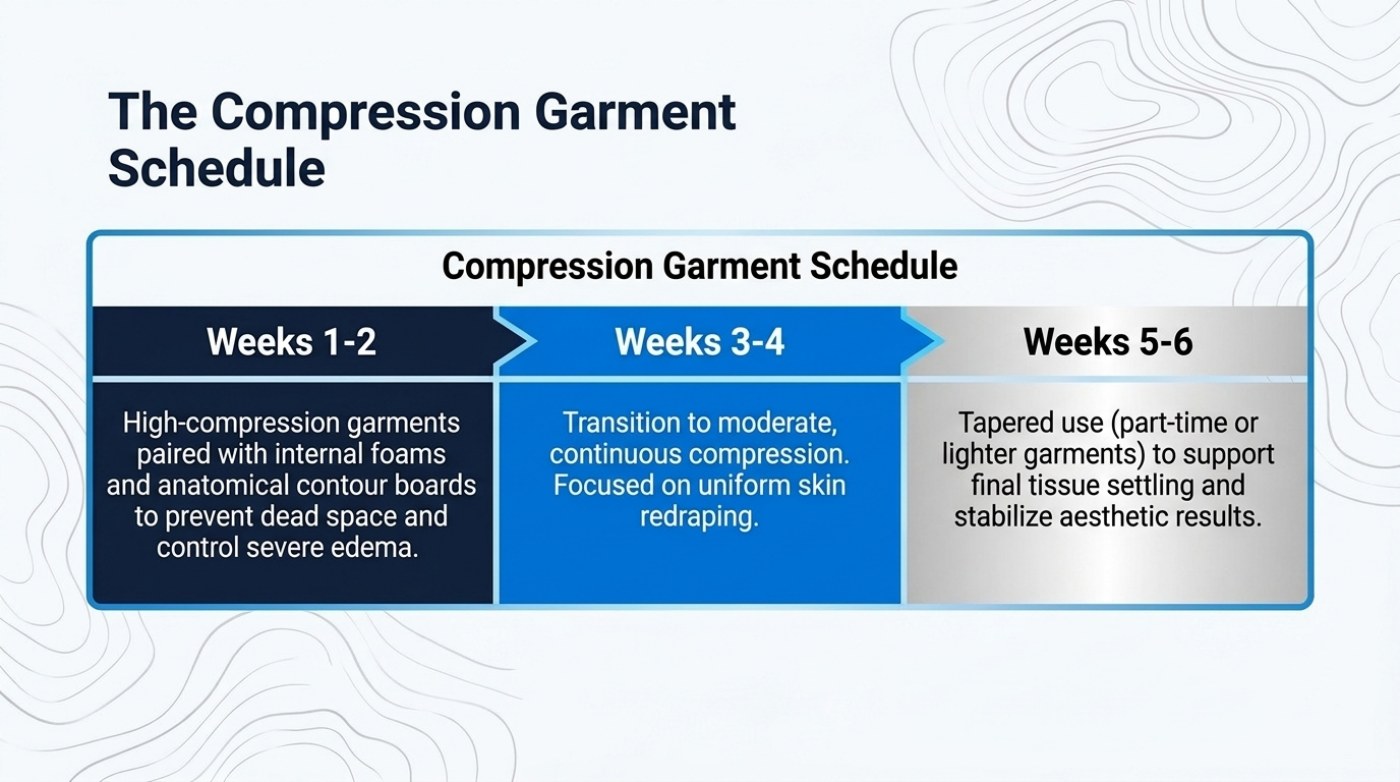
Weeks 1–2: high compression, foams and contour boards
The first phase is the most elaborate. A high-compression garment is combined with internal foams and anatomical contour boards, and the deck gives two reasons: to prevent dead space and to control severe edema. Dead space is the cavity that remains where fat has been removed and the skin has not yet re-adhered; internal foams are used to press the healing tissue layers together so that cavity closes predictably. Contour boards add a rigid anatomical shape to areas where the garment alone would not hold a defined edge.
This is also the phase in which the deck's other early interventions, immediate taping and the first week of manual lymphatic drainage, are active. Compression is not asked to do all the work; it is the pressure layer in a set of mechanisms.
Weeks 3–4: moderate, continuous compression
By the second phase the instruction changes from high compression to moderate, continuous compression, with the stated focus shifting to uniform skin redraping. The garment is still worn continuously, but the regime is deliberately reduced. The reason follows from the first phase: once the dead space has closed and the acute edema has settled, the tissue's need is evenness rather than force, and uniform pressure through a period of ongoing swelling is what helps the skin settle smoothly over the new contour.
Weeks 5–6: tapered use and tissue settling
The third phase is a taper. The deck describes part-time wear or lighter garments, with the stated purpose of supporting final tissue settling and stabilising the aesthetic result. Continuous, high-pressure compression is no longer the goal; the aim is to hold the result while the last of the swelling resolves. The phrase the deck uses — tapered — is important, because it describes a gradual reduction rather than an abrupt end to compression.
What each element is for
Read as a set rather than a sequence, the deck's three phases deploy four distinct elements, and separating them makes the schedule easier to follow.
| Element | Deck phase | Function described in the deck |
|---|---|---|
| High-compression garment | Weeks 1–2 | Close dead space; control severe edema |
| Internal foams | Weeks 1–2 | Press healing tissue layers together under the garment |
| Anatomical contour boards | Weeks 1–2 | Hold a defined anatomical shape where the garment alone would not |
| Moderate continuous compression | Weeks 3–4 | Uniform skin redraping |
| Tapered / part-time wear | Weeks 5–6 | Final tissue settling; result stabilisation |
Against the published complication picture, the early phase is where the schedule earns its keep. Seroma is the most commonly reported local event, pooled at roughly 0.65% to 2%, and the complication most sensitive to aspirate volume; the ASPS TOPS analysis of more than 4,500 patients found seroma the most common complication overall and the driver of a jump in the overall complication rate from 1.1% to 3.7% above the five-litre aspirate line. Dead-space control in the first fortnight, which is what the deck's foams and boards are for, sits directly against that figure.
The later phases map onto the same reasoning at lower intensity. Weeks three and four are described as a transition to moderate continuous compression with a focus on uniform skin redraping, which is the point at which the tissue's requirement shifts from force to evenness. Weeks five and six taper the regime — part-time or lighter garments — so that the result stabilises while the remaining swelling resolves. Read as a whole, the schedule is a single argument in three movements: close the space, even the surface, then hold the shape.
Frequently asked questions
Why does compression change strength instead of staying constant?
Because the deck assigns each phase a different task. High compression with foams and boards is aimed at dead space and severe edema in the first two weeks; moderate continuous pressure is aimed at uniform redraping in weeks three and four; a taper supports settling in weeks five and six.
What are anatomical contour boards for?
The deck lists them with internal foams in the weeks 1–2 phase, where the stated purpose is preventing dead space and controlling severe edema. They provide a rigid anatomical shape in areas where a garment alone would not hold a defined contour.
Does the schedule mean compression is finished at six weeks?
Not exactly. The deck describes weeks 5–6 as tapered use — part-time wear or lighter garments — rather than a stop date. The phase is about reducing support gradually as the tissue settles, not ending it abruptly.
This is published information, not medical advice — a board-certified surgeon must assess whether a procedure suits you.
Related reading
- Liposuction recovery week by week — the same six weeks seen from the patient's side
- Compression garments and lymphatic massage after liposuction — why each element in the schedule is used
- Liposuction risks and complication rates as published — the seroma data the early compression phase is aimed at