A curve, not a threshold
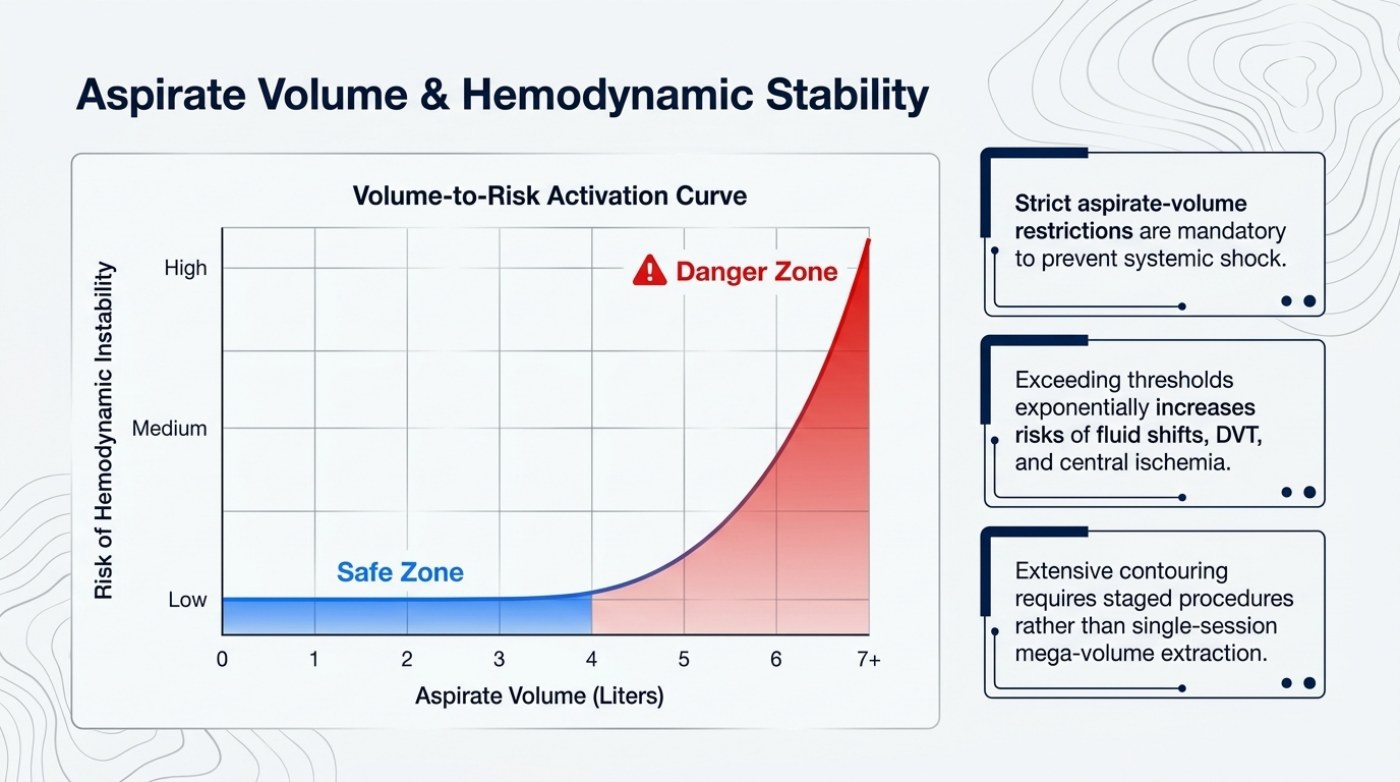
The deck slide “Aspirate Volume & Hemodynamic Stability” makes its argument with a single chart. The vertical axis is risk of hemodynamic instability, graded low, medium and high. The horizontal axis is aspirate volume in litres, running from zero to seven and beyond. The curve is nearly flat and blue well into the left of the chart, then turns upward with increasing steepness through the middle and climbs into a red-shaded region the slide labels the “Danger Zone.” The shape is the point: the relationship is not a wall at a certain number of litres but an accelerating rise, and the same extra litre costs far more at six litres than at two. Three callout boxes spell out the operational reading of that geometry. This is written for homeowners around Miami, FL who are looking into body contour services and want the honest version rather than a sales page.
The short version
- Aspirate volume and hemodynamic stability follow an accelerating risk curve rather than a fixed threshold of litres.
- The slide's callouts say strict aspirate-volume restrictions are mandatory and that extensive contouring requires staged procedures.
- QUAD A describes large-volume liposuction as greater than 5,000 millilitres of total aspirate including tumescence.
- The ASPS advisory states there is no scientific data supporting a specific volume maximum at which liposuction stops being safe.
- Aspirate is not fat alone: it is fat plus the tumescent fluid removed with it, so the recorded number is much larger.
What the three callouts say
The first box sets the rule: “Strict aspirate-volume restrictions are mandatory to prevent systemic shock.” The second describes the mechanism behind the curve’s shape — “Exceeding thresholds exponentially increases risks of fluid shifts, DVT, and central ischemia.” The third box draws the planning conclusion, and it is a structural instruction rather than a warning: “Extensive contouring requires staged procedures rather than single-session mega-volume extraction.” Read together, the slide is saying that large-volume cases are not forbidden, they are reorganised.
Why fluid moves to the centre of the picture
“Aspirate” is not fat. It is fat plus the tumescent fluid removed with it, and the tumescent technique typically infuses a multiple of the volume of fat being removed, so the number on the operative record is always much larger than the amount of fat. That ratio is why volume and hemodynamics are the same conversation. ASPS’s practice advisory describes “profound metabolic alterations” accompanying large-volume liposuction and directs surgeons to account for maintenance requirements, pre-existing deficits, intraoperative losses and third-space deficits, with accurate intake and output monitoring. A published large-volume series summarises the same accounting as maintenance fluid, wetting solution and an additional crystalloid component scaled to the volume aspirated beyond the first five litres. Local anaesthetic load sits in the same ledger: the advisory caps the local anaesthetic concentration permitted in wetting solutions, calculates it on total body weight, and notes that the maximum may not be safe in all patients.
“DVT” and “central ischemia” on the same line
The second callout lists fluid shifts, deep vein thrombosis and central ischemia as the risks that rise together once volume exceeds the safe band. They are not three versions of the same event; they are the ways a long, large-volume operation under anaesthesia affects the circulation. Published data support the pattern. The ASPS TOPS analysis of more than 4,500 liposuction patients found an overall complication rate of 1.5% with no deaths and seroma the most common complication, and it found that complication cases averaged 3.4 L of aspirate against roughly 2 L overall. Above the five-litre line the overall rate was 3.7% against 1.1% below it, and the increase was described as almost entirely from seromas. Registry analysis of cosmetic surgery patients found combined procedures carried a 0.20% venous thromboembolism rate against 0.04% for solitary procedures. The curve on the slide is an illustration of the same tendency.
Where the published thresholds sit
ASPS’s advisory is explicit that “there is no scientific data available that support a specific volume maximum at which point liposuction is no longer safe, although the risk of complications is unavoidably higher as the volume of aspirate and the number of anatomic sites treated increases.” What exists instead is a body of practical lines. QUAD A describes a traditional single-area procedure removing roughly 200–500 mL of fat, multi-site contouring targeting up to 5,000 mL of aspirate including tumescence, and defines large-volume liposuction as greater than 5,000 mL. Above that figure, published facility standards point to an acute-care hospital or an accredited facility with overnight vital-sign and urinary-output monitoring. Volume therefore decides not only how a case is planned but where it happens.
The finding that makes a single number unreliable
The TOPS analysis also found a significant interaction between volume and body mass index: patients at higher BMI tolerated larger aspirate volumes with somewhat lower complication rates, while lower-BMI patients showed a more exponential increase in risk as volume rose. The authors proposed a relative volume threshold indexed to BMI instead of a flat five-litre rule, and were careful to say that such a threshold marks where complications begin to rise rather than a limit above which a procedure is forbidden. The slide’s own chart stops short of naming a number for that reason — it shows a shape and labels the far end as a danger zone. Length of surgery, combined procedures and general health act alongside volume, which is why two cases with the same litre count can carry different risk.
The slide’s zones and what sits in them
| Region of the chart | Aspirate volume axis (litres) | What the slide says about it | Planning consequence stated on the slide |
|---|---|---|---|
| Safe zone (blue band, low risk) | Roughly 0–4 L, curve still flat | Risk of hemodynamic instability graded low | Volume restrictions still mandatory as a rule, not as a warning for extreme cases |
| Transition (curve turning upward) | Roughly 4–6 L, risk graded medium | Thresholds begin to be exceeded, risk rising faster than volume | Hemodynamic monitoring ceases to be routine and becomes the case’s main control |
| Danger zone (red shading, high risk) | 6 L and above, shown to 7+ | Exponential increase in fluid shifts, DVT and central ischemia | Extensive contouring staged rather than taken as one mega-volume session |
Published volume thresholds and facility lines
| Published threshold | Figure | Source |
|---|---|---|
| Fat yield from a single treated area | Roughly 200–500 mL | QUAD A, Liposuction: What is Safe? |
| Multi-site total aspirate including tumescence | Up to 5,000 mL | QUAD A |
| Definition of large-volume liposuction | Greater than 5,000 mL total aspirate | ASPS Practice Advisory; ASPS press release |
| Facility rule above that volume | Acute-care hospital, or accredited facility with overnight vital-sign and urinary-output monitoring | ASPS Practice Advisory; QUAD A standards |
| Average volume in a registry analysis of 4,500+ patients | About 2 L; complication cases averaged 3.4 L | ASPS TOPS database analysis |
| Overall complication rate above and below five litres | 3.7% versus 1.1%; increase almost entirely seromas | ASPS TOPS database analysis |
| No absolute maximum | “No scientific data… support a specific volume maximum” | ASPS Practice Advisory on Liposuction |
What hemodynamic control actually tracks
| Item to account for | Published guidance |
|---|---|
| Fluid balance | Maintenance requirement, pre-existing deficit, intraoperative loss and third-space deficit tracked with accurate intake and output monitoring |
| Replacement after the five-litre line | Maintenance fluid plus wetting solution plus an additional crystalloid component scaled to the aspirate removed beyond the first 5 L (as summarised in a published large-volume series) |
| Local anaesthetic load | A maximum local anaesthetic dose for wetting solutions, calculated on total body weight, with reduced concentration where published guidance indicates it |
| Blood loss | Estimated intraoperatively and confirmed with pre- and post-operative haemoglobin |
| Core temperature | Preserved with warming devices |
| Positioning and clot risk | Positioning to maximise popliteal flow, intraoperative intermittent pneumatic compression for moderate- to high-risk patients, low-molecular-weight heparin for higher-risk patients |
FAQ: aspirate volume and hemodynamic stability
Does the curve mean a five-litre rule?
The slide deliberately does not print a number on its safe-to-danger transition; it shows where the slope changes. The published five-litre line comes from elsewhere: it is the figure at which liposuction is defined as large-volume, at which facility standards change, and the point above which TOPS recorded overall complications at 3.7% against 1.1% below. ASPS’s advisory declines to name a maximum at all, saying only that risk rises with volume and site count. If someone quotes a hard ceiling, the honest follow-up question is which published standard it comes from.
Why does staging show up on a slide about fluids?
Because the third callout on the slide makes staging the answer to the curve. Splitting extensive contouring into separate procedures keeps each session inside a lower part of the risk curve, where fluid shifts and clot risk are managed with routine monitoring rather than escalated support. ASPS’s advisory makes the same structural point from a different direction, advising that where circumstances warrant it, large-volume work may be better performed as separate serial procedures rather than combined with other operations.
Is aspirate the same as fat removed?
No, and the confusion is common enough to be worth stating plainly. Total aspirate is fat plus the tumescent fluid removed with it. Tumescent technique typically infuses several cubic centimetres of solution for every cubic centimetre of planned aspirate, so a five-litre aspirate is far from five litres of fat. ASPS is explicit that total aspirate is the measure to track, which is why every figure in this guide is an aspirate figure unless stated otherwise.
This is published information, not medical advice — a board-certified surgeon must assess whether a procedure suits you.
Related reading
Three published guides on this site cover adjacent parts of the same protocol:
- How Much Fat Can Be Removed in One Liposuction Session? — the published litres and facility rules in detail
- Liposuction Risks and Complication Rates as Published — what the complication data shows above five litres
- Liposuction Cost Anatomy: Fees and What They Cover — why staging a plan changes the price structure